
Evacuation Chairs and Powered Evacuation Chairs: Choosing the Right Solution
When a fire, power failure or other emergency makes ordinary passenger lifts unavailable, stairs can become a serious barrier. A person who cannot use the standard escape route independently may need assistance, specialist equipment and a carefully planned procedure.
For many organisations, Evacuation chairs form an important part of that provision. They are widely used in offices, schools, universities, hospitals, hotels, residential buildings and public venues. Traditional models can provide a practical method of descending stairs when they are matched to the user and route, maintained correctly and operated by trained people.
Some users and buildings create more complex demands. The person may be unable to transfer safely. The route may include several flights, a basement ascent or landings that require powered manoeuvring. Operators may face physical demands that make a manual chair unsuitable. In these situations, Powered Evacuation chairs can provide motor-assisted movement and greater control.
Neither category is automatically right for every emergency plan. The decision must connect the person who may need assistance, the building, the escape route, the operators and the organisation’s procedures. Buying equipment without completing this work can create the appearance of preparedness while leaving a plan that cannot be implemented under pressure.
This guide explains the differences between Evacuation chairs and Powered Evacuation chairs, where each may be suitable and what responsible persons, facilities managers and fire-safety teams should assess before making a decision.
For a broader explanation of powered models, planning and UK responsibilities, read The Evacuation Company’s Complete Guide to Powered Evacuation Chairs in the UK 2026.
What are evacuation chairs?
An evacuation chair is designed to help move a person along an emergency route when they cannot use stairs independently. Many traditional chairs use friction-controlled tracks to descend a staircase. Once correctly positioned, the chair and passenger travel down the flight under the guidance of trained operators.
Traditional Evacuation chairs are often lightweight, compact and quick to deploy. They can be stored close to an escape staircase and may suit people who can transfer into the chair and maintain an appropriate seated position. They can be effective across straightforward downward routes where the assessed operators can control the equipment safely.
Their apparent simplicity should not be confused with universal suitability. The user must be able to transfer or be transferred using an agreed method. The chair must provide suitable support and restraint. The staircase, doors and landings must permit safe movement, and enough trained people must be available whenever the building is occupied.
Some manual evacuation chairs can be moved upstairs with additional physical assistance or accessories, but this can place considerable demands on operators. If the escape route begins in a basement or involves an upward change in level, the required direction of travel should be identified before equipment is selected.
What are Powered Evacuation chairs?
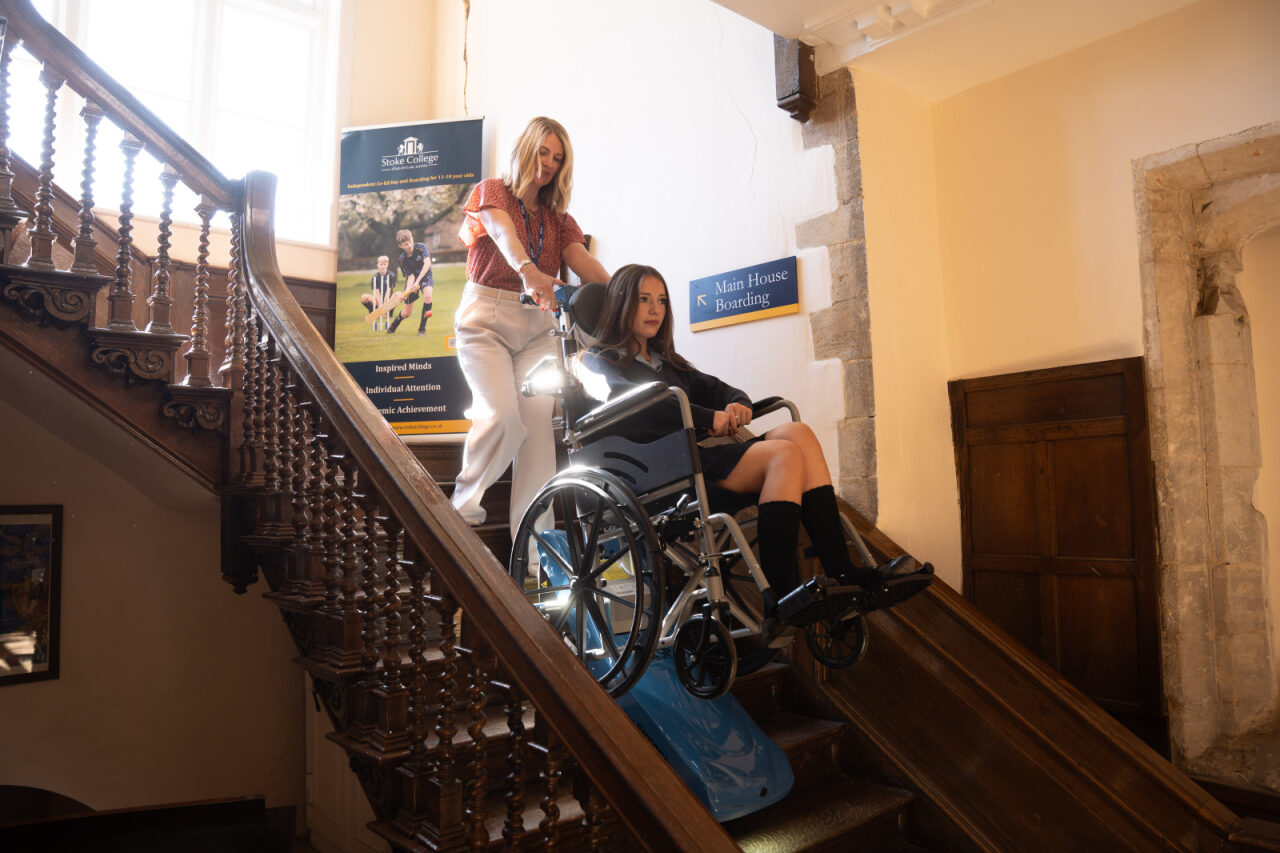
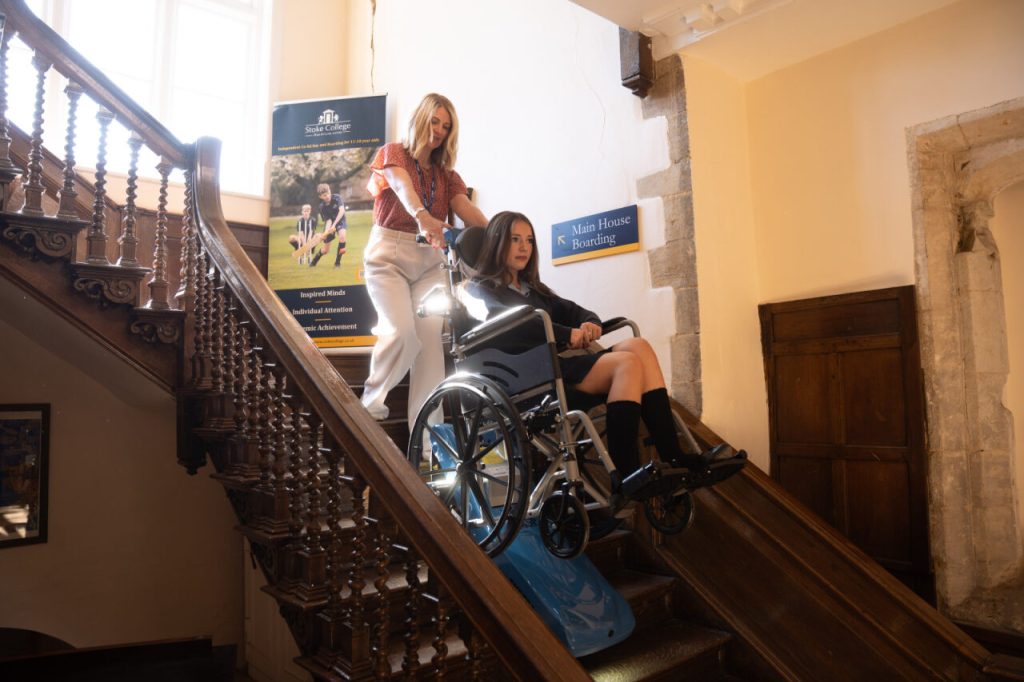
Powered Evacuation chairs use a battery-driven system to assist movement on stairs. The precise design varies by model. Some provide powered descent, while others can travel both downstairs and upstairs. Certain non-transfer systems can accommodate a compatible wheelchair, allowing the user to remain in their own seating rather than moving into a separate evacuation chair.
Motor assistance can reduce reliance on operator strength and provide controlled movement over long or demanding routes. This may be valuable in high-rise offices, healthcare settings, universities, transport environments, residential buildings and sites with lower-ground floors.
Powered operation does not remove the operator’s responsibilities. The equipment must still be positioned, guided and monitored correctly. Operators need model-specific training and practice on the route where the chair may be deployed. Batteries, controls, tracks, restraints and attachments must remain ready for an emergency.
The benefit is not simply that the chair contains a motor. A suitable powered system can expand the range of users and routes an organisation can support, particularly where transfer, ascent or sustained operator effort would otherwise make the plan difficult.
Evacuation chairs and the legal fire-safety framework
The Regulatory Reform (Fire Safety) Order 2005 provides the central fire-safety framework for most non-domestic premises in England and Wales. It places duties on the responsible person, including carrying out and reviewing a fire risk assessment and implementing appropriate fire precautions.
Equipment is one part of those arrangements. The government’s official guidance on means of escape for disabled people explains that fire-safety planning should include the measures provided to assist disabled people to leave the building. It also makes clear that the responsibility should not be transferred to the Fire and Rescue Service.
This principle matters when selecting Evacuation chairs. The organisation needs an evacuation method that can be delivered using the people, routes and equipment available on site. A chair stored on a wall does not, by itself, establish that a person can reach a place of safety.
Employers and service providers should also consider their wider equality responsibilities. The duty to make reasonable adjustments under section 20 of the Equality Act 2010 may be relevant where a disabled person would otherwise be placed at a substantial disadvantage.
PEEPs, GEEPs and building evacuation arrangements
A Personal Emergency Evacuation Plan, usually called a PEEP, records the arrangements for an individual who may need assistance. It should be developed with the person rather than written around assumptions about a diagnosis or visible disability.
The discussion should establish what the individual can do, what assistance is acceptable, whether a transfer is possible, how they communicate and what equipment supports their needs. The plan should identify the route, operators, refuge arrangements where relevant, method of travel and a contingency if the primary arrangement is unavailable.
A Generic Emergency Evacuation Plan, or GEEP, can support visitors whose needs are not known before they arrive. A Building Emergency Evacuation Plan coordinates individual and generic arrangements with alarms, stairs, lifts, refuges, final exits and staff responsibilities.
Residential settings have additional developments to consider. The Fire Safety (Residential Evacuation Plans) (England) Regulations 2025 introduced requirements relating to residential personal emergency evacuation plans in specified higher-risk residential buildings. Housing providers and responsible persons should obtain competent advice on how the regulations apply to their premises and residents.
Evacuation chairs or Powered Evacuation chairs should support the documented plan. The plan should never be written merely to justify equipment that has already been purchased.
Traditional evacuation chairs or powered models?
Traditional chairs remain a strong solution in many buildings. They occupy limited storage space and do not depend on a charged battery for descent. Where the user can transfer and trained operators can manage a downward route confidently, a manual model may be appropriate.
Powered models become important when a user needs to remain in a compatible wheelchair, a basement route requires ascent or several flights increase operator fatigue. They may also suit situations where available staff cannot control a manual chair safely for the complete journey.
The answer may involve a combination. A site can use traditional Evacuation chairs on suitable routes while providing Powered Evacuation chairs for non-transfer needs, upward travel or longer staircases.
Cost should not be considered in isolation. A lower purchase price does not make a chair suitable for the user or achievable for operators. Equally, a powered model is not automatically better simply because it offers motor assistance. The value lies in whether the chosen equipment makes the emergency plan safer, realistic and repeatable.
Why transfer ability changes the decision
Many traditional Evacuation chairs require the user to transfer from a wheelchair. Some people can do this independently, while others may transfer with agreed assistance.
For a person with significant physical support needs, transfer may introduce pain, loss of posture, manual-handling risk or delay. Specialist wheelchairs can include tilt-in-space functions, pressure care, head support, lateral supports, communication equipment or respiratory accessories. Removing the person from this system can change their safety and comfort substantially.
Non-transfer Powered Evacuation chairs may allow a compatible wheelchair to be secured to the powered unit. The wheelchair type, dimensions, combined weight, accessories and attachment points must all be checked. Compatibility should never be assumed from appearance.
A practical demonstration allows the person to comment on positioning, communication, movement and dignity while helping operators test the planned journey.
Stair direction, distance and building geometry
The direction of escape is one of the clearest reasons to distinguish between manual and powered equipment. Many evacuation chairs are designed primarily for descent. That can suit upper floors where the escape route leads down to ground level.
Basements, underground workplaces and lower-ground facilities may require people to travel upstairs. A device that descends safely is not necessarily capable of powered ascent. The intended direction should be confirmed in the manufacturer’s instructions and demonstrated on the proposed route.
Distance matters too. Repeated flights, landings, doors and changes of direction increase time and effort. The final route may also include thresholds, slopes or external surfaces.
Stair width alone is not enough to establish suitability. Tread depth, riser height, pitch, nosings, surfaces, handrails, turns, doors and clear landing space all affect operation. A building assessment should follow the complete route from the person’s location to a place of safety.
Operator safety and manual-handling demands
Evacuation planning needs to protect both the passenger and the people providing assistance. A chair that requires more force, balance or sustained control than the operators can provide will not create a dependable plan.
Powered systems can reduce physical effort, particularly during ascent and along extended routes. They may also allow more controlled movement for a heavier combined load. The actual operator task still needs assessment because manoeuvring, initial positioning and movement across landings require competence.
Where evacuation chairs are used as work equipment, the organisation should consider the Health and Safety Executive’s PUWER guidance. It explains that work equipment should be suitable, maintained, inspected where necessary and used by people who have received adequate information, instruction and training.
Operator availability is as important as ability. The number of competent operators should reflect occupancy, shifts, absence, turnover and the people who may require assistance.
Training should test the complete procedure
Training needs to go beyond unfolding the chair. Operators should understand pre-use checks, deployment, passenger communication, transfers or wheelchair attachment, restraints, stair positioning, ascent or descent, landing manoeuvres and what to do if the planned route becomes unavailable.
Practice on the building’s own assessed staircase is especially valuable. A smooth demonstration flight cannot reproduce every narrow landing, fire door or turn in the real premises.
Competence should be observed rather than assumed. Refresher training is important because equipment may be used rarely outside drills. Staff, equipment, building or user changes should trigger review.
Drills can test communication, operator response, access to equipment and the route without exposing participants to unnecessary risk. The goal is not simply to deploy the chair quickly. It is to confirm that the whole system works from alarm to place of safety.
Storage, inspection and powered readiness
Evacuation equipment must be available when an alarm occurs. A chair stored too far from the route, locked behind an unavailable key holder or hidden by furniture cannot support a time-critical procedure.
Storage must protect the equipment while keeping it accessible and avoiding obstruction of the escape route. Locations should be marked on relevant plans, and staff should know which chair supports each route or PEEP.
Traditional Evacuation chairs require routine visual and functional checks. Powered Evacuation chairs also need battery management. The charging method and frequency should follow the manufacturer’s instructions, with responsibility assigned to a named role or team.
Maintenance and inspection records help demonstrate that the equipment remains ready. Restraints, tracks, wheels, controls, attachments and visible condition should be checked at appropriate intervals. Suspected faults should remove a chair from use and activate a planned contingency.
Frequently asked questions
Are Powered Evacuation chairs better than traditional evacuation chairs?
Not in every situation. Powered models can reduce operator effort, support ascent and, in some configurations, avoid a wheelchair transfer. Traditional chairs can be lighter, simpler and highly effective on suitable downward routes. The building, user and plan determine the better choice.
Can evacuation chairs travel upstairs?
Some powered models are designed for both ascent and descent. Many traditional chairs are intended mainly for downward travel. The required direction must be confirmed before equipment is selected.
Can a person remain in their wheelchair?
Certain non-transfer Powered Evacuation chairs accommodate compatible wheelchairs. The user, chair, attachments, weight and route require professional assessment and demonstration.
Building a complete and inclusive evacuation plan
Evacuation chairs have an established and valuable role in emergency planning. When a user can transfer, the route is suitable and trained operators are available, a traditional chair may offer a simple and effective method of descent.
Powered Evacuation chairs extend the available options. Motor assistance can reduce operator demands, support controlled movement over longer routes and make upward evacuation possible with suitable models. Non-transfer systems may help wheelchair users remain in their own compatible seating.
The decision should never be reduced to manual versus powered. A successful plan brings together the person, equipment, operators, staircase, fire strategy and management arrangements. It is assessed, documented, trained, practised, maintained and reviewed.
The Evacuation Company supports organisations with building assessments, equipment selection, evacuation planning, operator training, servicing and ongoing advice. Our role is to help turn written procedures into arrangements that work under real conditions.
Learn more in The Complete Guide to Powered Evacuation Chairs in the UK 2026 and speak to The Evacuation Company about selecting Evacuation chairs or Powered Evacuation chairs for your building.
Key Takeaways
- Evacuation chairs are essential for helping individuals escape during emergencies, particularly when stair use is necessary.
- Traditional evacuation chairs suit users who can transfer from a wheelchair, while powered evacuation chairs assist those needing to remain in their wheelchair.
- Choosing the right evacuation solution requires assessing the user, building layout, and the escape route to ensure safety and effectiveness.
- Both types of chairs require trained operators and proper planning to function effectively in real emergencies.
- Developing a comprehensive evacuation plan involves detailed assessments, training, and regular drills to ensure all equipment and procedures work under pressure.
Estimated reading time: 11 minutes
Table of contents
- Evacuation Chairs and Powered Evacuation Chairs: Choosing the Right Solution
- What are evacuation chairs?
- What are Powered Evacuation chairs?
- Evacuation chairs and the legal fire-safety framework
- PEEPs, GEEPs and building evacuation arrangements
- Traditional evacuation chairs or powered models?
- Why transfer ability changes the decision
- Stair direction, distance and building geometry
- Operator safety and manual-handling demands
- Training should test the complete procedure
- Storage, inspection and powered readiness
- Frequently asked questions
- Building a complete and inclusive evacuation plan