

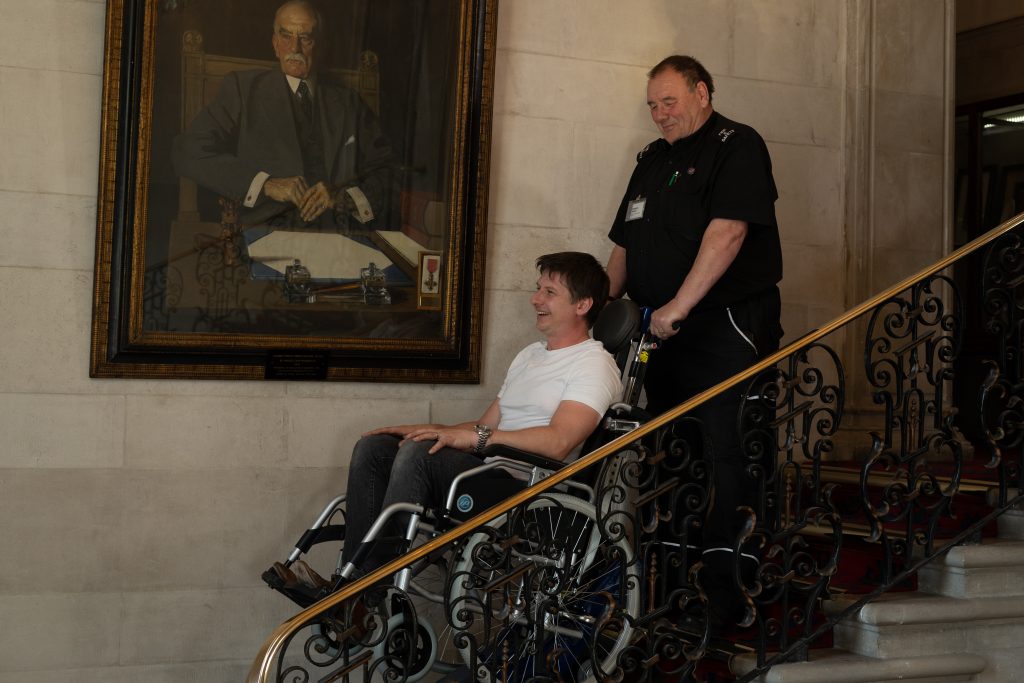
Powered Evacuation Chairs in the City of London: The Future of Inclusive Emergency Evacuation
The City of London is one of the most important commercial districts in the world. Home to global financial institutions, multinational corporations, law firms, insurance companies, government organisations and landmark commercial developments, the Square Mile welcomes hundreds of thousands of workers and visitors every day. With some of the UK’s tallest office buildings, complex multi-storey developments and densely populated workplaces, emergency evacuation planning has become a critical priority for organisations operating within the City.
As expectations around accessibility, fire safety and duty of care continue to evolve, many organisations are reassessing how they support occupants during emergency situations. Increasingly, Powered Evacuation Chairs are becoming a key component of modern evacuation strategies throughout the City of London.
While traditional evacuation chairs remain an important and effective solution in many environments, Powered Evac Chairs and Powered Stairclimbers are helping organisations improve safety, reduce manual handling risks and deliver more inclusive emergency evacuation plans.
The discussion extends beyond equipment alone. Modern evacuation planning is closely connected to PEEPs, RPEEPs, GEEPs and BEEPs. These evacuation planning frameworks are helping responsible persons, facilities managers and health and safety professionals create practical evacuation procedures that protect everyone within a building.
For organisations across the City of London, Powered Evacuation Chairs are increasingly being viewed as a strategic investment in safety, resilience and accessibility.
Why Emergency Evacuation Planning Matters in the City of London
Few locations in the United Kingdom present the same evacuation challenges as the City of London.
The area contains some of the country’s most recognisable commercial buildings, including high-rise office towers, financial headquarters and large mixed-use developments. Thousands of employees may occupy a single building at any given time, while visitors, contractors and members of the public move through these premises every day.
In an emergency, lifts are often unavailable, making staircases the primary evacuation route.
For people with mobility impairments, temporary injuries, medical conditions or age-related mobility limitations, this can create significant challenges. A successful evacuation strategy must ensure that these individuals can leave the building safely without relying solely on emergency services.
This is where evacuation chairs, Powered Evacuation Chairs and Powered Stairclimbers become essential.
The goal is not simply compliance with regulations. The objective is creating an evacuation process that is realistic, achievable and capable of being implemented under pressure.
The Continuing Importance of Traditional Evacuation Chairs
Traditional evacuation chairs have been a cornerstone of emergency evacuation planning for many years.
Across the City of London, they continue to provide a trusted solution for assisting mobility impaired individuals during emergency evacuations.
Their strengths remain significant.
Traditional evacuation chairs are compact, lightweight and relatively easy to deploy. Many are specifically designed to facilitate controlled stair descent using friction track systems that allow trained operators to guide occupants safely down staircases.
For many office buildings and commercial premises, traditional evacuation chairs remain an effective and economical solution.
They are particularly valuable where stair routes are straightforward and where trained staff are available to support evacuation procedures.
Many organisations throughout the City of London continue to rely on traditional evacuation chairs as part of their Building Emergency Evacuation Plans and wider fire safety strategies.
When supported by regular training, maintenance and evacuation drills, they remain a dependable and proven evacuation method.
However, as buildings become taller and evacuation routes more complex, many organisations are exploring whether powered alternatives can provide additional benefits.
Why Powered Evacuation Chairs Are Becoming Essential
The modern workplace has changed dramatically.
The City of London contains an increasing number of high-rise developments where stair evacuation may involve multiple floors and significant distances.
In these environments, manual evacuation can place considerable physical demands on operators.
Powered Evacuation Chairs address this challenge through motorised technology that assists movement on staircases.
The result is greater control, reduced operator strain and a smoother evacuation process.
For facilities managers responsible for large commercial properties, this can be a significant advantage.
Powered Evac Chairs help reduce the manual effort required to evacuate an individual while maintaining stability throughout the journey.
This is particularly important in high-rise office environments where emergency evacuation may involve lengthy stair descents.
The benefits are not limited to physical assistance.
Powered systems can also improve confidence among operators. During an emergency, staff must make quick decisions under stressful conditions. Knowing that powered equipment is available can help reduce anxiety and improve overall preparedness.
As a result, Powered Evacuation Chairs are becoming increasingly popular among City of London organisations seeking to enhance evacuation resilience.
Powered Stairclimbers and High-Rise Building Safety
Powered Stairclimbers are also gaining significant attention throughout London’s commercial sector.
Designed to move individuals safely up or down staircases, Powered Stairclimbers provide an advanced solution for environments where traditional manual methods may be challenging.
Their value becomes particularly evident in tall buildings, complex commercial developments and facilities with demanding evacuation routes.
In the City of London, where high-rise office towers dominate the skyline, Powered Stairclimbers offer an additional layer of support that aligns with modern accessibility and safety expectations.
For organisations focused on reducing manual handling risks while improving emergency preparedness, Powered Stairclimbers represent a practical and future-focused investment.
Understanding PEEPs in the Workplace
Personal Emergency Evacuation Plans, commonly referred to as PEEPs, play a central role in modern evacuation planning.
A PEEP identifies how an individual who may require assistance will evacuate safely during an emergency.
This may include employees, contractors or regular visitors who have mobility impairments or other conditions that could affect evacuation.
Within the City of London, where many organisations employ large and diverse workforces, PEEPs are increasingly viewed as an essential component of workplace safety.
A PEEP must be realistic.
It must consider the individual’s needs, the building layout, available assistance and the equipment required to complete the evacuation safely.
Powered Evacuation Chairs can significantly strengthen a PEEP because they help reduce operator dependence on physical strength alone.
This makes evacuation procedures more practical and achievable, particularly within large commercial buildings.
RPEEPs and Residential Developments in Central London
Although the City of London is best known for its commercial activity, it also contains a growing residential population.
Luxury apartments, residential towers and mixed-use developments continue to increase throughout the area.
This has led to greater focus on Residential Personal Emergency Evacuation Plans, or RPEEPs.
RPEEPs are designed to support residents who may require assistance during emergency evacuation.
For residential building owners, managing agents and responsible persons, ensuring that evacuation arrangements are appropriate has become an increasingly important consideration.
Powered Evacuation Chairs can form part of a wider strategy for supporting residents who may be unable to self-evacuate via staircases.
Their inclusion within residential evacuation planning demonstrates a proactive commitment to resident safety and accessibility.
The Importance of GEEPs in Commercial Buildings
Generic Emergency Evacuation Plans, known as GEEPs, provide a practical framework for supporting groups of people with similar evacuation requirements.
They are particularly useful in environments where individual plans may not be practical for every visitor or temporary occupant.
The City of London attracts a constant flow of clients, visitors, contractors and members of the public.
Many organisations cannot predict in advance who may require assistance during an emergency.
GEEPs help address this challenge by establishing procedures that can be applied more broadly.
Powered Evac Chairs support these plans by providing a versatile evacuation solution capable of assisting a wide range of users.
This flexibility is particularly valuable in large commercial environments where occupancy levels can fluctuate significantly throughout the day.
Building Emergency Evacuation Plans and Whole-Building Safety
Building Emergency Evacuation Plans, commonly referred to as BEEPs, provide the overarching strategy for emergency evacuation.
A BEEP considers every aspect of a building’s emergency response, including evacuation routes, refuge areas, staff responsibilities, alarm systems, communication procedures and evacuation equipment.
For City of London buildings, a comprehensive BEEP is essential.
The complexity of many commercial developments means that evacuation planning must be carefully coordinated and regularly reviewed.
Including Powered Evacuation Chairs within a BEEP demonstrates a commitment to inclusive safety and operational resilience.
It ensures that mobility impaired occupants have been properly considered within the overall evacuation strategy.
The Stair Climbing Company and The Evacuation Company Leading the Way
As organisations throughout the City of London review their evacuation arrangements, specialist expertise has become increasingly important.
The Stair Climbing Company and The Evacuation Company are recognised as leaders in the provision of Powered Evacuation Chairs, Powered Stairclimbers and evacuation solutions across the United Kingdom.
Their expertise extends beyond equipment supply.
Both organisations help clients assess risks, develop evacuation procedures, support PEEPs, RPEEPs, GEEPs and BEEPs, and deliver practical evacuation training.
This comprehensive approach ensures that equipment selection aligns with wider emergency planning objectives.
The Stair Climbing Company specialises in advanced stair climbing technology and Powered Stairclimbers that help organisations overcome complex evacuation challenges.
The Evacuation Company supports businesses, public sector organisations and building operators with specialist evacuation equipment and evacuation planning expertise.
Together, they are helping shape the future of emergency evacuation across London and beyond.
Choosing the Right Evacuation Solution
Every building is different.
The most effective evacuation strategy depends on occupancy levels, building design, available resources and individual evacuation requirements.
Traditional evacuation chairs remain a highly effective solution in many situations and continue to play an important role in emergency preparedness.
Powered Evacuation Chairs provide additional benefits where operator support, reduced manual handling and enhanced control are priorities.
For many City of London organisations, the most effective approach involves a combination of traditional and powered solutions.
This enables organisations to tailor evacuation arrangements to specific areas of a building while maintaining maximum flexibility.
The Future of Powered Evacuation Chairs in the City of London
The future of emergency evacuation in the City of London will increasingly focus on inclusivity, resilience and practical implementation.
As expectations around workplace accessibility continue to evolve, organisations are seeking evacuation solutions that go beyond minimum compliance requirements.
Powered Evacuation Chairs, Powered Evac Chairs and Powered Stairclimbers are helping meet these expectations.
By reducing physical strain, supporting safer evacuation procedures and strengthening PEEPs, RPEEPs, GEEPs and BEEPs, they are becoming a key component of modern emergency planning.
Traditional evacuation chairs will continue to provide valuable support across many environments. However, powered solutions are increasingly recognised as the next step in evacuation preparedness for complex commercial buildings.
For organisations operating within the City of London, investing in Powered Evacuation Chairs is more than a fire safety decision. It is a commitment to protecting employees, visitors and building occupants while creating a safer, more accessible and more resilient environment.
With support from The Stair Climbing Company and The Evacuation Company, organisations throughout the Square Mile can develop evacuation strategies that are practical, compliant and ready to meet the challenges of modern building management.
As demand for Powered Evacuation Chairs, Powered Evac Chairs and Powered Stairclimbers continues to grow, the City of London is leading the way in demonstrating how innovative evacuation technology can support safer outcomes for everyone.
Key Takeaways
- The City of London faces unique evacuation challenges due to its high-rise buildings and large occupancy.
- Powered Evacuation Chairs significantly enhance safety and accessibility during emergencies, reducing manual handling risks.
- Traditional evacuation chairs remain important, but powered alternatives improve efficiency and control in complex environments.
- Personal Emergency Evacuation Plans (PEEPs) and relevant evacuation strategies help protect individuals with mobility impairments.
- Investing in Powered Evacuation Chairs reflects a commitment to inclusive safety and operational resilience for all building occupants.
Estimated reading time: 10 minutes