

Key Takeaways
- Historic buildings face unique evacuation challenges due to their design and usage, complicating safety measures for occupants with reduced mobility.
- Powered Evacuation Chairs in heritage buildings offer a modern solution, requiring fewer structural changes while assisting evacuation without heavy physical effort.
- Successful evacuation plans integrate Powered Evacuation Chairs, Personal Emergency Evacuation Plans (PEEPs), and Generic Emergency Evacuation Plans (GEEPs) for all users.
- Operators of Powered Evacuation Chairs need thorough training, including practical assessments of the specific building’s stair conditions.
- Balancing conservation with safety is crucial; solutions must protect historic features while ensuring effective evacuation for all occupants.
Estimated reading time: 12 minutes
Britain’s historic buildings connect us with centuries of architecture, culture and community. They include museums, theatres, hotels, universities, civic buildings, churches, country houses and visitor attractions. Many remain busy public places, but few were designed around modern expectations of accessibility or emergency evacuation.
This creates a difficult responsibility for the people who manage them. They must protect the features that make a building significant while ensuring that disabled people, older visitors and anyone with reduced mobility can reach safety during an emergency.
Passenger lifts can improve everyday access, but ordinary lifts are generally not used during a fire unless they are specifically designed and managed for evacuation. Permanent changes such as evacuation lifts, new protected stairs or major structural alterations may also be difficult in a listed building.
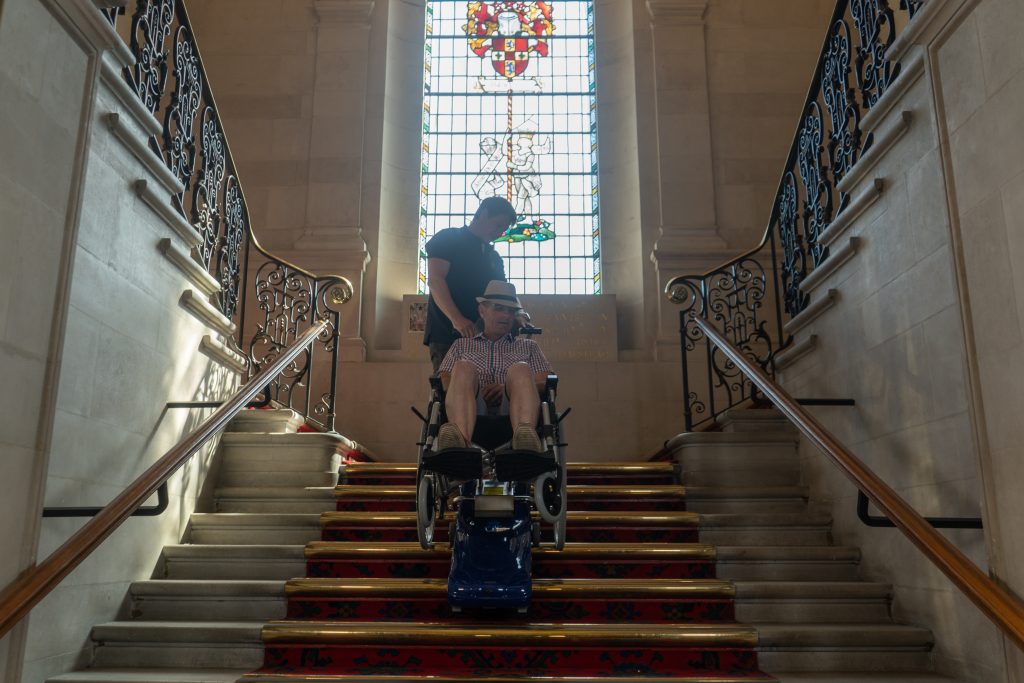
Powered Evacuation Chairs can provide another option. Motorised assistance helps a trained operator move a person on suitable stairs with greater control and less physical effort than many manual methods. In the right building, a Powered Evac Chair may strengthen the evacuation plan without requiring substantial intervention into historic fabric.
The equipment still has to fit the building, user and fire strategy. Heritage staircases can be narrow, curved, worn or unusually detailed. A powered chair must therefore be assessed on the actual route and managed as part of a complete evacuation system.
Why heritage buildings present particular evacuation challenges
Historic buildings often evolved over many years rather than being designed as a single coherent space. A Georgian townhouse may have become a hotel, an industrial building may now be a museum and a medieval hall may host weddings or public events. Changes of use can introduce more people and new activities into a structure with limited escape options.
Common challenges include narrow stairs, winders, small landings, uneven stone treads and changes of level between rooms. Doorways may be tight, corridors may not follow a simple route and some buildings have only one principal staircase.
Original panelling, balustrades, tiled floors and carved stone can restrict storage or travel. Alterations affecting a listed building’s special character may require listed building consent.
Occupancy can also vary. A museum may welcome school groups during the day and host a reception in the evening. A historic university building may contain staff offices, public lectures and ceremonial events. The evacuation plan must work for regular occupants and people whose needs are not known in advance.
Conservation does not remove the duty to protect life. The aim is to find a solution that provides effective evacuation while avoiding unnecessary harm to the building. This requires early coordination between fire-safety, access, conservation and operational specialists.
What is a Powered Evacuation Chair?
A Powered Evacuation Chair is a motor-assisted chair designed to help evacuate a person on stairs. Depending on the model, it may provide powered descent, powered ascent or both.
Traditional evacuation chairs remain an effective option in many settings. They are familiar, comparatively lightweight and often quick to deploy. Their safe operation can, however, depend heavily on the operator’s strength and confidence, particularly over several floors or with a heavier passenger.
Powered Evac Chairs add motorised assistance to help control movement. This can reduce the force required from the operator and support a smoother, more consistent journey. The benefit may be significant in a heritage building where stair conditions are demanding or the escape route includes upward travel.
Operators still need to deploy the chair, assist the passenger, negotiate landings and maintain control. The task therefore requires assessment and training.
Different models have different requirements for width, pitch, tread depth, nosings, landings and total weight. A chair suited to a wide Victorian staircase may not work on a narrow spiral or a flight with winders.
Powered Evacuation Chairs and Powered Stairclimbers
Powered Evacuation Chairs and Powered Stairclimbers use related technology, but the intended task matters.
Powered Stairclimbers are often selected for planned access during normal building use. Some attach to compatible wheelchairs, while others have an integrated seat. In a heritage property, they can sometimes provide access without the structural intervention required for a lift.
A Powered Evac Chair is chosen around emergency movement. It must be stored where trained people can reach it, suit an escape route and operate within the building’s fire strategy.
One item of equipment may appear capable of performing both tasks, but planned access and fire evacuation take place under different conditions. An everyday stair journey is controlled and scheduled. During an alarm there may be smoke, noise, crowd movement and pressure to act quickly.
Managers should define the intended purpose before choosing equipment. A Powered Stairclimber that works well for visitor access should not be added to an evacuation plan without a separate assessment for emergency use.
Balancing conservation and inclusive safety
Historic England recognises that inclusive access can often be improved sensitively without compromising what makes a historic building important. The same principle can guide evacuation planning.
A mobile Powered Evacuation Chair may require less physical alteration than a new lift or staircase. This can be valuable where structural intervention would remove historic fabric or change an important interior.
Portable does not mean impact-free. Powered tracks or wheels place loads on stair treads and may affect delicate surfaces. Worn stone nosings, historic tiles, polished timber and stair runners all need consideration. The combined weight of the chair, passenger and equipment must also be appropriate for the structure.
A conservation professional may advise on vulnerable finishes, protection and storage. New charging points, cabinets, signs or fixings should be considered as part of the building.
The right outcome is not necessarily the least visible option. An evacuation solution must work reliably. If a mobile chair cannot negotiate the route or cannot be deployed quickly enough, a more substantial adaptation may be necessary. Conservation and access decisions should be based on evidence rather than assumptions.
Assessing a historic staircase
The most important step is an on-site assessment. Catalogue dimensions cannot capture the irregularities of an old staircase or the operational pressures of a particular building.
The assessment should examine the narrowest width, stair pitch, tread depth, riser height, nosing shape, landings, turns and headroom. It should note handrails, projections, floor coverings, loose edges and fragile finishes. The complete route to a place of safety matters, including doors, corridors, thresholds and any further changes of level.
Users must also be considered. Posture, transfers, support, communication, anxiety and medical needs can affect suitability.
An on-site demonstration provides valuable evidence. It allows the team to see how the Powered Evac Chair approaches the first step, clears the landings and travels over the actual treads. It can also identify potential contact with walls, panelling or balustrades.
The demonstration should involve the people managing the plan, including fire-safety, facilities, access, conservation and equipment specialists. A structural engineer may be needed for a fragile or unusual stair.
Manual handling and operator safety
Evacuating a person on stairs can be physically demanding. HSE guidance says employers should avoid hazardous manual handling where reasonably practicable, assess unavoidable operations and reduce the risk of injury.
Powered assistance can reduce reliance on operator strength. It may help staff control speed and maintain a more stable posture during a long descent. Models capable of ascent can also support routes where safety lies above the starting level, although that use must be specifically assessed.
The chair does not remove every handling task. A passenger may need help transferring, positioning their feet or moving through a doorway. Staff may have to unfold, turn or reposition the equipment in limited space.
The assessment must cover the full process. Operator numbers should follow the manufacturer’s instructions and task-specific risk assessment.
In a historic visitor attraction, operator availability can change across the day or season. The plan must work during evenings, private events and quieter periods, not only when the full daytime team is present.
PEEPs for regular building users
A Personal Emergency Evacuation Plan, or PEEP, describes how a specific person will reach safety when they cannot follow the standard procedure independently. It may be appropriate for an employee, volunteer, resident, student or regular visitor.
The PEEP should be developed with the person. It needs to reflect the rooms they use, communication requirements, preferred assistance, ability to transfer and any equipment involved. The individual should understand the plan and have an opportunity to familiarise themselves with the Powered Evac Chair where appropriate.
Large heritage sites may require several routes. Temporary exhibitions, room changes and seasonal opening can affect the plan.
Where powered equipment is included, the PEEP should record the approved route, storage location, operators and backup procedure. It should be reviewed if the person’s needs, the building or the equipment change.
GEEPs for visitors and public events
Many heritage buildings are open to the public. Managers may not know in advance who will need assistance, which makes a Generic Emergency Evacuation Plan, or GEEP, essential.
The GEEP should explain how visitors can request help and what the organisation will do. Information may be provided on the website, during booking, at reception and through accessible signage.
Front-of-house teams, guides, event staff, volunteers and security personnel should understand their roles. During a wedding, exhibition opening or evening performance, the people present may differ from the normal daytime team.
A GEEP does not mean every visitor receives identical assistance. It creates a dependable framework for identifying needs and implementing the appropriate procedure. Where a regular visitor’s requirements are known, an individual PEEP may still be more suitable.
BEEPs and the building’s fire strategy
A Building Emergency Evacuation Plan, or BEEP, connects alarms, escape routes, staff roles, communications, refuges, assembly points and assistance for disabled occupants.
A Powered Evacuation Chair must fit within that plan. Storage should keep it ready and secure without obstructing the escape route. Operators need a reliable way to reach the user, and the chair’s movement must not create an unacceptable bottleneck on the stairs.
Historic properties may rely on compartmentation, phased procedures or specific staff actions. A competent fire-safety professional should ensure that the chair and route align with the overall strategy.
The plan should not depend on the Fire and Rescue Service arriving to complete the evacuation. The responsible person must provide arrangements that can be implemented by the organisation under expected conditions.
RPEEPs, or Residential Personal Emergency Evacuation Plans, relate to particular residential contexts and should not be applied casually to every historic property. Hotels, care settings, apartments and staff accommodation may sit under different requirements. Competent advice is needed for the relevant building use and jurisdiction.
Training, drills and readiness
Only trained and authorised people should operate Powered Evacuation Chairs. Training should cover equipment checks, deployment, transfers, restraints, communication, stair travel, landings and what to do if the machine stops.
Practice on the real staircase is particularly important in a heritage building. Operators need to experience its turns, changes in pitch and limited clearances. They should also understand how to prevent contact with vulnerable surfaces.
One trained person does not create a resilient system. The organisation needs enough competent operators across all opening hours, including weekends, evening events, annual leave and sickness.
Drills should test the complete procedure without causing unnecessary risk or distress. They can reveal delays in contacting staff, reaching a refuge, unlocking storage or moving through a landing. Findings should lead to practical improvements.
The equipment also needs routine inspection, charging and maintenance in line with the manufacturer’s instructions. Battery condition, controls, tracks or wheels, restraints and attachments should be checked, with clear action if a fault is found.
Protecting history while planning for people
Heritage buildings should be protected for future generations, but they must also be safe and welcoming for the people who use them today. Inclusive evacuation planning is part of responsible stewardship.
Powered Evacuation Chairs can help bridge the gap between conservation constraints and modern safety expectations. Their motorised assistance may reduce operator effort, improve control and offer a dignified route to safety without extensive physical alteration.
The result depends on careful integration. The equipment must suit the staircase and user, staff must be competent and available, and the process must connect with the fire risk assessment, PEEPs, GEEPs and BEEP.
The Evacuation Company supports heritage organisations with site assessments, equipment selection, evacuation planning, training and ongoing guidance. We look beyond the chair to understand the building, its occupants, its historic significance and the people expected to implement the plan.
If you manage a listed building, museum, historic hotel, theatre, place of worship or visitor attraction, contact The Evacuation Company to arrange an assessment. The right Powered Evac Chair should protect the passenger, support the operator and respect the building it is chosen to serve.
Frequently asked questions
Can Powered Evacuation Chairs be used in listed buildings?
Yes, where the chair, staircase and fire strategy are compatible. Mobile equipment may require less structural intervention than a fixed installation, but the route, surfaces, storage and any associated work still need assessment.
Will a powered chair damage historic stairs?
Suitability depends on the machine, stair construction, surface and frequency of use. A site demonstration and conservation input can identify risks to stone, timber, tiles, runners and decorative features.
Can a Powered Evac Chair travel up stairs?
Some models provide powered ascent as well as descent. The required direction must be established from the building’s fire strategy before equipment is selected.
Does a listed building still need evacuation plans for disabled people?
Yes. Heritage status does not remove the need to plan for everyone likely to use the premises. The solution should balance life safety, accessibility and conservation through competent assessment.
Can the same chair be used for routine access and emergencies?
Potentially, but each use must be separately assessed. A Powered Stairclimber that performs well during planned access is not automatically suitable for an emergency evacuation.
Authoritative external references
Historic England, Easy Access to Historic Buildings: https://historicengland.org.uk/images-books/publications/easy-access-to-historic-buildings/
GOV.UK, Equality Act 2010 guidance: https://www.gov.uk/guidance/equality-act-2010-guidance
GOV.UK, Fire safety risk assessment: means of escape for disabled people: https://www.gov.uk/government/publications/fire-safety-risk-assessment-means-of-escape-for-disabled-people
HSE, Manual handling at work: https://www.hse.gov.uk/msd/manual-handling/
London Fire Brigade, Fire safety in heritage and historical buildings: https://www.london-fire.gov.uk/safety/property-management/fire-safety-in-heritage-and-historical-buildings/
Table of contents
- Why heritage buildings present particular evacuation challenges
- What is a Powered Evacuation Chair?
- Powered Evacuation Chairs and Powered Stairclimbers
- Balancing conservation and inclusive safety
- Assessing a historic staircase
- Manual handling and operator safety
- PEEPs for regular building users
- GEEPs for visitors and public events
- BEEPs and the building’s fire strategy
- Training, drills and readiness
- Protecting history while planning for people
- Frequently asked questions
- Authoritative external references
For more reading on Powered Evacuation chairs check out our Pillar post below.
Powered Evacuation Chair for Dignified Evacuations – The Evacuation Company The Evacuation Company