
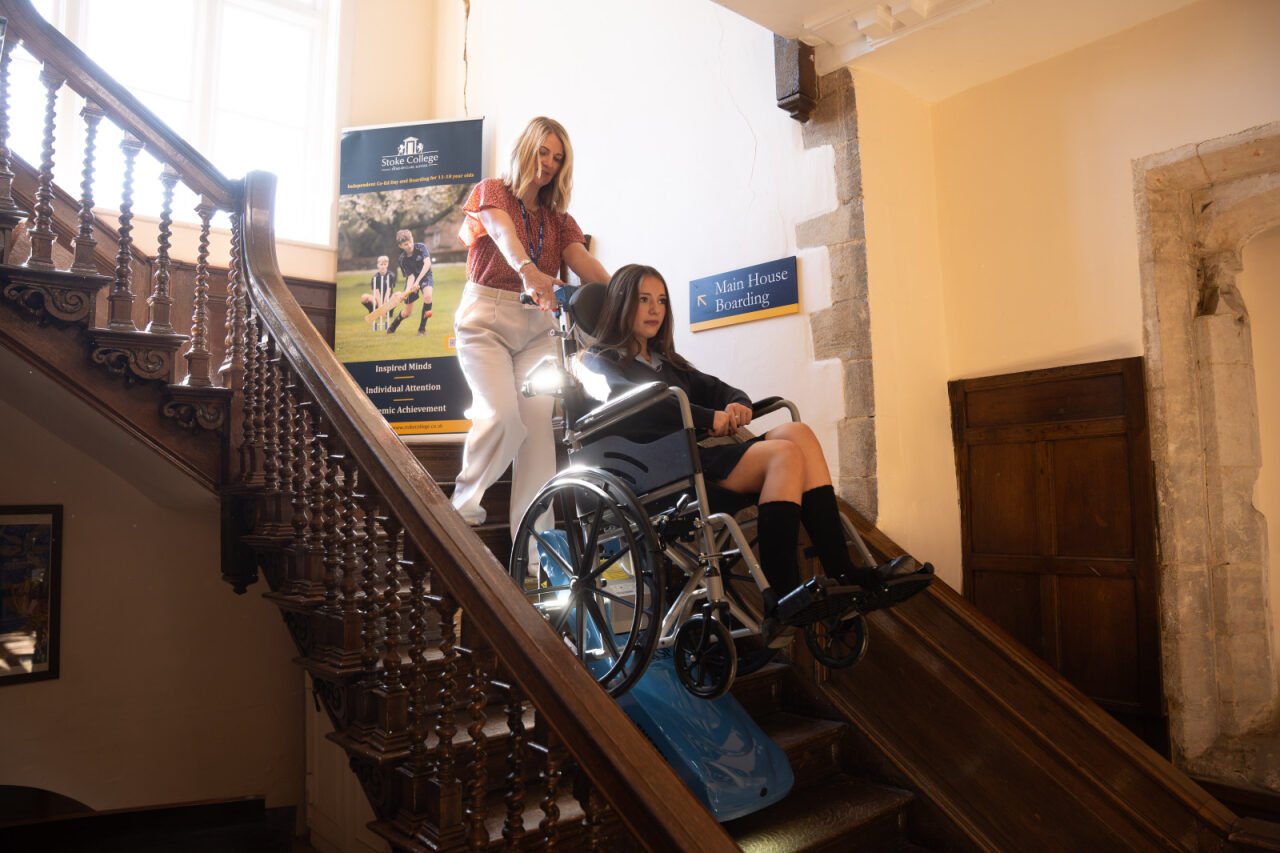
Evacuation Chair Training for Schools, Colleges and Universities in England
Does your school, college or university need evacuation chair training? Book professional education-sector training with The Evacuation Company or contact our team for a free assessment. We provide practical training, equipment assessments, PEEPs, GEEPs, servicing and powered evacuation solutions for educational establishments throughout England.
Schools, colleges and universities have a responsibility to provide safe and inclusive environments for pupils, students, staff and visitors. That responsibility becomes especially important during an emergency, when everyone must be able to reach a place of safety without avoidable delay.
For people who cannot use stairs independently, a building’s normal escape route may create a serious barrier. Wheelchair users, people with temporary injuries, those with reduced mobility and individuals affected by medical, sensory or cognitive conditions may all require assistance. An evacuation chair can form an important part of the solution, but equipment alone is not enough.
The chair must be suitable for the intended user and staircase. It must be stored correctly, inspected and maintained. Most importantly, the people expected to operate it must have practical training and understand how the equipment fits the establishment’s fire strategy.
Professional evacuation chair training for schools, colleges and universities turns emergency equipment into a workable procedure. It gives staff hands-on experience, builds confidence and helps leadership teams identify gaps before an actual evacuation occurs.
The Evacuation Company is one of England’s top specialist providers of evacuation chair training and inclusive evacuation support for education. We help schools, academy trusts, further-education colleges, specialist settings and universities combine training with suitable equipment, PEEPs, GEEPs, audits and ongoing servicing.
For a detailed overview of manual and powered equipment, read our complete guide to Powered Evacuation Chairs in the UK. This pillar resource explains how modern evacuation solutions can support safer escape from a wide range of buildings.
Why evacuation chair training is essential in education
An educational setting is rarely occupied by the same people in the same places throughout the day. Pupils and students move between classrooms, lecture theatres, laboratories, libraries, workshops, sports facilities and performance spaces. Staff may teach across several buildings, while contractors, parents, prospective students and members of the public regularly visit the site.
This movement makes emergency planning more complex. A person who needs assistance may be on an upper floor, in a basement teaching area or in a building far from their usual support team when an alarm sounds.
An evacuation chair attached to a wall does not resolve these challenges. If staff cannot deploy it, do not know the planned route or have never practised controlling it on stairs, the equipment may not be usable when it matters.
The Health and Safety Executive’s guidance on emergency procedures explains that people are more likely to respond reliably when they are trained and competent, have rehearsed responsibilities and take part in realistic practice. It also makes clear that emergency arrangements must consider disabled people and vulnerable workers.
Effective evac chair training in schools, colleges and universities should therefore be practical. Delegates need supervised experience with the chair they may be asked to use. Training should cover deployment, passenger preparation, communication, restraints, safe operating position and controlled movement on the designated stairs.
Fire safety responsibilities in educational premises
The Regulatory Reform (Fire Safety) Order 2005 applies to non-domestic educational premises in England. Depending on the establishment, responsibility may involve the employer, head teacher, governing body, academy trust, vice-chancellor, owner or other person with control of the premises.
The Government’s fire-safety risk-assessment guidance for educational premises is written for schools, academies, universities, adult education centres and other education providers. It helps responsible persons understand how to assess fire risks and protect everyone who may be on the premises.
Article 21 of the Regulatory Reform (Fire Safety) Order 2005 requires employees to receive adequate safety training when they begin work and when new or increased risks arise. Training should be repeated periodically where appropriate and must be suitable for the responsibilities employees may be expected to carry out.
This means evacuation chair training should not be treated as a one-off purchase completed when the equipment is installed. Education providers need to consider staff turnover, role changes, new buildings, revised escape routes and changes in the needs of pupils or students.
The Department for Education’s guidance on emergency planning and response for education settings also reinforces the importance of plans that are proportionate, understood and capable of being put into action.
PEEPs for pupils, students and staff
A Personal Emergency Evacuation Plan, or PEEP, describes how a specific person will reach a place of safety. It should be developed with the individual and, where appropriate, their parent, carer, occupational therapist or other relevant professional.
A good PEEP is based on the person rather than a general assumption about disability. One wheelchair user may transfer independently into a manual evacuation chair. Another may depend on specialist seating and be unable to transfer safely. A student who usually walks without support may need assistance because of fatigue, a fluctuating condition or a temporary injury.
The plan may need to address how the alarm will be communicated, where assistance will come from, which equipment will be used, whether a transfer is required, the selected escape route and the destination after leaving the staircase. It must also account for different timetables and locations.
The Government’s guidance on means of escape for disabled people explains that suitable evacuation arrangements are a management responsibility. Plans should not assume that the Fire and Rescue Service will arrive and carry out an evacuation that should already have been considered.
In schools, safeguarding and communication require particular care. A pupil may be frightened by alarms, crowds or unfamiliar physical movement. Children and young people with autism, learning disabilities or sensory differences may need clear preparation, consistent language and familiar staff support.
In colleges and universities, students are generally more independent, but responsibility does not disappear. Course locations, placements, evening teaching, laboratories and campus events can all affect whether a PEEP remains workable. Plans should be reviewed when circumstances, buildings or timetables change.
GEEPs for visitors and changing populations
Educational establishments also welcome people whose needs are not known in advance. Parents attend consultations and performances. Prospective pupils and students visit open days. Contractors work across campuses. Members of the public use sports facilities, libraries, theatres and conference spaces.
A General Emergency Evacuation Plan, or GEEP, establishes how the organisation will support people who may require assistance but do not have an individual PEEP. It should explain how a visitor can request help, where accessible information is available, what equipment the site provides and which staff roles will respond.
Reception teams, event staff, security personnel and facilities teams all need to understand the arrangement. A GEEP displayed online or beside reception is of limited value if the employees present during an emergency cannot activate it.
Evacuation chair training helps convert the GEEP into a practical capability. It also gives staff an opportunity to raise questions about passenger transfers, communication, operator numbers and the location of equipment.
What should education-sector evacuation chair training include?
Professional training should begin by placing the equipment within the establishment’s fire strategy. Delegates need to understand the alarm, the relevant escape routes, refuge arrangements, staff roles and the circumstances in which the chair may be used.
Practical instruction should use the installed model wherever possible. Staff should learn how to remove the chair from storage, deploy it correctly, complete basic safety checks, prepare and reassure the passenger, apply restraints and approach the staircase in a controlled way. They also need to understand safe posture, coordination and how the chair is returned to a ready condition after use.
Training must explain limitations. A manual evacuation chair will not suit every person or every route. Some passengers cannot transfer from their own wheelchair without unacceptable risk. Some stairs or landings may not provide enough space. An evacuation route that requires upward travel cannot be solved by equipment designed only for descent.
A competent trainer should create space for questions and supervised repetition. The goal is not simply to issue certificates. It is to ensure that staff can carry out their assigned role safely and respectfully.
The Evacuation Company offers group instruction, one-to-one training and train-the-trainer programmes. This flexibility is valuable for education providers of different sizes, from a single primary school to a multi-academy trust or university with a large estate.
Group training or train the trainer?
Group training is often suitable when a defined team will operate the equipment. It allows staff to practise together and explore the procedure within their own building. This can work well for smaller schools, individual college departments or facilities and security teams.
Train-the-trainer courses can help larger establishments build internal capability. An academy trust, further-education group or university may need to train new starters regularly and maintain coverage across several buildings. Internal trainers can support continuity and reinforce knowledge between formal provider visits.
However, train the trainer does not remove the need for governance. The organisation must decide who is authorised to deliver instruction, how competence will be checked, which materials will be used and how training records are maintained. Internal trainers also need periodic review and support.
Whichever model is chosen, enough trained operators must be available whenever the building is occupied. A plan that works during normal teaching hours may fail during breakfast clubs, evening lectures, parents’ evenings, performances, examinations or weekend events.
Manual and powered evacuation solutions
Manual evacuation chairs remain effective in many education buildings. They are generally compact, familiar and suitable for controlled downward movement when the passenger, staircase and operators have been assessed.
Some settings require a different approach. Basement classrooms, workshops, theatres and sports areas may have escape routes involving upward travel. Tall university buildings can create long, physically demanding routes. Specialist schools and colleges may support several people who require assistance at the same time.
A Powered Evacuation Chair or Powered Stairclimber may reduce some of the physical demands placed on staff and offer controlled powered travel. Certain models can move both up and down stairs. Non-transfer equipment may allow a pupil or student to remain in a compatible wheelchair, reducing the risks and distress associated with transferring into a separate chair.
Powered equipment still requires a route assessment and model-specific training. Batteries must be charged, controls understood and attachment systems used correctly. The equipment must fit the staircase and every landing on the planned route.
Our Powered Evacuation Solutions service includes options for straight, curved, indoor and outdoor stairs. Because The Evacuation Company understands both manual and powered equipment, we can recommend a solution based on real needs rather than assuming one product will suit every educational setting.
Sensitive and realistic evacuation drills
Drills are essential because they test more than the chair. They show whether alarms can be recognised, trained operators can be contacted, equipment is accessible and routes remain clear. They may also reveal timetable gaps, communication problems and uncertainty about responsibilities.
Practice should be planned sensitively. A disabled pupil, student or employee should not be expected to undergo repeated transfers or stair descents simply to prove that staff have completed a drill. Training aids, volunteers and staged exercises can test the procedure without causing unnecessary discomfort or risk.
Where the individual participates, their consent, dignity and experience should guide the exercise. The objective is to build confidence and find practical improvements, not to turn someone into training equipment.
Lessons from drills should be documented and used to review the fire-risk assessment, PEEP or GEEP. A procedure should also be reconsidered after refurbishment, changes to room allocation or the introduction of new evacuation equipment.
Inspection, servicing and ongoing readiness
Evacuation chairs may remain unused for long periods, but they must be ready immediately. Belts, buckles, wheels, tracks, brakes and frames can deteriorate. Equipment may also be moved, obstructed or damaged without the facilities team being informed.
Powered equipment requires additional attention to batteries, chargers and controls. A unit with a flat or poorly maintained battery cannot fulfil its intended role.
Regular visual checks should be supported by planned servicing in accordance with the manufacturer’s guidance. The HSE’s information on the Provision and Use of Work Equipment Regulations is relevant to the suitability, maintenance, inspection and operation of work equipment.
The Evacuation Company can service suitable existing chairs as well as equipment supplied by us. Combining servicing and training helps educational establishments maintain clear records and ensures operators are practising with equipment that is ready for use.
Why education providers choose The Evacuation Company
The Evacuation Company is a top provider of evacuation chair training for schools, colleges and universities because our work covers the entire evacuation arrangement. We consider the people, equipment, stairs, staffing, plans and ongoing management together.
Our training is practical and can be delivered around the actual equipment and environment. We can train staff on suitable existing chairs, provide new manual or powered solutions, support PEEPs and GEEPs, conduct equipment access audits and arrange continued servicing.
This joined-up approach is especially valuable for academy groups, college networks and universities managing several sites. It helps them establish consistent standards while respecting the different layouts, populations and risks found in each building.
We also understand that inclusive evacuation is a human issue. Pupils and students should know that their safety has been considered and that trained people are ready to assist. Staff should have confidence in the procedure rather than being handed responsibility they have never practised.
Book evacuation chair training for your educational establishment
If your school, college or university owns evacuation chairs but staff are not confident using them, the evacuation arrangement is incomplete. The same applies when operators have left, training records are out of date, equipment has deteriorated or a PEEP relies on a procedure that has never been tested.
The Evacuation Company can review your current provision, train your staff and connect the equipment with practical PEEPs, GEEPs, drills and servicing. We support mainstream and specialist education settings throughout England, from individual schools to large multi-site organisations.
Book evacuation chair training for your school, college or university or contact The Evacuation Company for a free assessment today. Give staff the skills to act and help every pupil, student, employee and visitor reach safety with dignity.
Key Takeaways
- Evacuation chair training in schools is essential for ensuring safety during emergencies, especially for people with mobility issues.
- Training helps staff understand how to properly use evacuation chairs, maintain equipment, and follow fire safety procedures.
- Educational institutions must develop Personal Emergency Evacuation Plans (PEEPs) and General Emergency Evacuation Plans (GEEPs) to accommodate the diverse needs of their populations.
- Regular drills and inspections keep evacuation procedures effective and help train staff to respond confidently during emergencies.
- The Evacuation Company provides comprehensive training and solutions tailored to the needs of schools, colleges, and universities in England.
Estimated reading time: 12 minutes
Table of contents
- Evacuation Chair Training for Schools, Colleges and Universities in England
- Why evacuation chair training is essential in education
- Fire safety responsibilities in educational premises
- PEEPs for pupils, students and staff
- GEEPs for visitors and changing populations
- What should education-sector evacuation chair training include?
- Group training or train the trainer?
- Manual and powered evacuation solutions
- Sensitive and realistic evacuation drills
- Inspection, servicing and ongoing readiness
- Why education providers choose The Evacuation Company
- Book evacuation chair training for your educational establishment