

Evacuation Chairs in Schools and Colleges: Why Training, Planning and Servicing Matter
Evacuation Training
Schools and colleges work hard to create safe, inclusive places in which every pupil, student, employee and visitor can participate. That commitment must extend to emergency planning. If a fire alarm sounds, everyone needs a realistic way to reach a place of safety, including people who cannot use stairs independently.
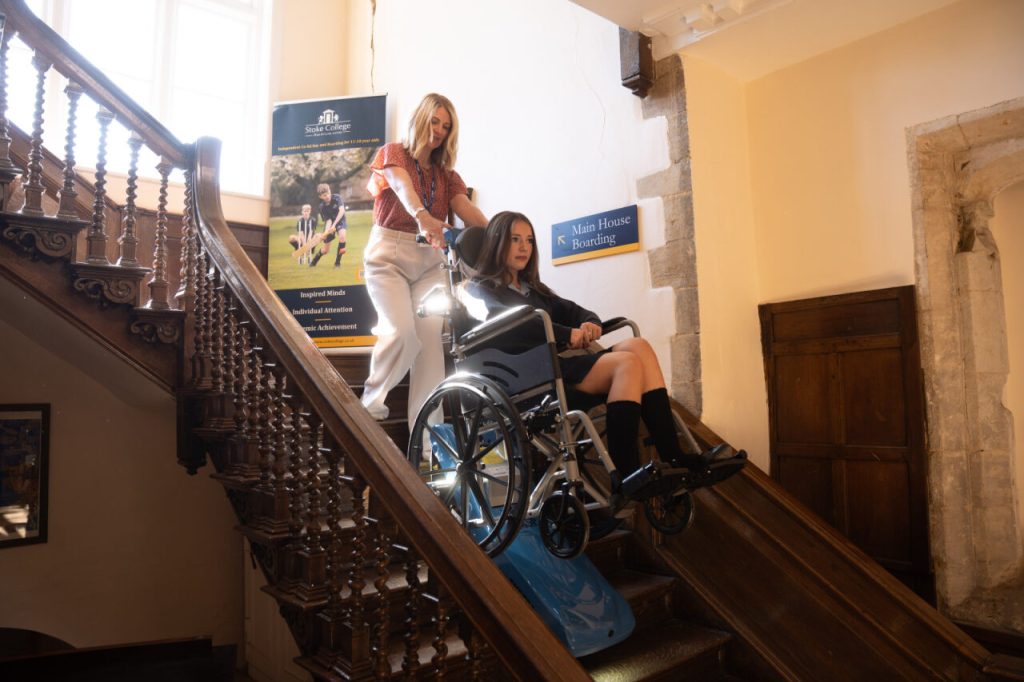
Evacuation chairs in schools and evacuation chairs in colleges can provide an essential means of assisting people with reduced mobility along an escape route. However, purchasing a chair is only the beginning. The equipment must be suitable for the person and building, staff must receive practical evacuation chair training, and the chair must be inspected and serviced so that it remains ready for use.
The Evacuation Company supports primary and secondary schools, academies, independent schools, special schools, further education colleges and multi-academy trusts across the UK. We bring together assessment, evacuation equipment, staff training, servicing and ongoing advice, helping education leaders turn written procedures into workable emergency arrangements.
Why evacuation planning is different in education
Educational premises are dynamic environments. Pupils and students move between classrooms, laboratories, libraries, sports areas, workshops and assembly spaces throughout the day. Employees may work across more than one building, while parents, contractors and members of the public can be present for meetings, performances, clubs and evening courses.
School and college sites also vary enormously. One organisation may occupy a modern, purpose-built campus with wide protected stairs. Another may use a Victorian building with narrow landings, changes of level and limited options for structural alteration. Some colleges have several separate buildings, each with different fire precautions and escape arrangements.
An effective plan must therefore consider people, buildings and timetables together. It must remain workable during lessons, breaks, examinations, performances, after-school activities, staff training days and periods when normal staffing is reduced.
What is a school evacuation chair?
A School Evacuation Chair is specialist equipment intended to help a person with reduced mobility move along an emergency escape route, most commonly down a staircase. Many manual chairs use friction-controlled tracks to support a steady descent when operated by trained staff.
Powered Evacuation Chairs and Powered Stairclimbers offer further options. Depending on the product and assessment, powered equipment may reduce operator effort, help manage longer stairways or support upward movement from basements. Some non-transfer solutions can carry a person while they remain in their own wheelchair, which may be important when transfer into a conventional evacuation chair would be unsafe, undignified or impractical.
No one chair is suitable for every pupil or every staircase. The right School Evacuation Equipment depends on the individual’s posture, size, physical and sensory needs, ability to transfer, level of understanding and preferred method of assistance. Stair width, landing dimensions, direction of travel, storage location, operator capability and the final route to safety must also be considered.
Our complete guide to Powered Evacuation Chairs in the UK explains the role powered equipment can play within an inclusive evacuation strategy.
Why equipment alone does not create safety
An unused chair mounted beside a staircase may give the appearance of preparedness, but it cannot confirm that the school or college is ready. Staff may not know who is expected to operate it, how to deploy it or whether it can negotiate the full escape route. The people named in a plan may work in another building, be teaching a class or be absent when an incident occurs.
The Government’s fire safety risk assessment guidance for educational premises is intended for employers, head teachers, governors, occupiers, owners and others responsible for educational buildings in England. It supports responsible persons in meeting their duties under the Regulatory Reform (Fire Safety) Order 2005.
Government guidance on means of escape for disabled people also makes an important principle clear. Suitable evacuation arrangements are a management responsibility and should not rely upon the Fire and Rescue Service arriving to complete an evacuation on the organisation’s behalf.
A refuge can provide a relatively safe waiting area and a means of communication, but it is not normally the final destination of an evacuation. The plan should establish who will communicate with the person, who will provide assistance and how the journey to a place of safety will be completed if evacuation becomes necessary.
PEEPs for pupils, students and staff
A Personal Emergency Evacuation Plan, usually known as a PEEP, sets out the arrangements for an identified person who may require assistance during an emergency. In a school or college, a PEEP may be needed for a pupil, student or employee with a permanent or temporary condition.
The plan should be developed with the individual wherever possible. For a child or young person, parents, carers and relevant professionals may also need to contribute. The process should respect the person’s dignity, communication needs, abilities and preferences rather than treating disability as a standard category.
A useful PEEP considers where the person is likely to be throughout the day, how they will recognise and respond to the alarm, which escape route is available, what equipment is required and who will assist. It should also address alternative routes, staffing absence and changes to the person’s mobility or timetable.
PEEPs should be reviewed when circumstances change and tested through suitable exercises. Consultation is essential. A disabled person should not be expected to take part in repeated transfers or stair descents merely to demonstrate that the institution has held a drill.
GEEPs for visitors and changing populations
Schools and colleges also welcome people whose needs are not known in advance. Parents attend consultations and performances, prospective students visit open days, contractors work on site and members of the community may use the premises outside teaching hours.
A General Emergency Evacuation Plan, or GEEP, establishes how the organisation will support visitors who may need assistance. It should explain how a person can request help, where suitable equipment is located, which staff roles can respond and what accessible information is available.
PEEPs and GEEPs should align with the fire risk assessment, safeguarding arrangements, emergency procedures and staff training. They are working plans, not documents to be completed once and filed away.
What evacuation chair training should include
Professional evacuation chair training gives employees the knowledge and practical experience required to act calmly. Delegates should understand why the equipment has been provided, how it relates to the building’s fire strategy and where its limitations lie.
Practical instruction should use the model installed at the premises wherever possible. Staff need to learn how to remove it from storage, deploy it, complete basic safety checks, position and secure the passenger, approach a staircase and maintain control throughout the route. The procedure for returning the chair to a ready condition should also be understood.
Training must give proper attention to communication. Children and young people may be frightened by alarms, crowds or unfamiliar movement. Some pupils with autism, learning disabilities or sensory differences may require a carefully planned approach to explanation and reassurance. Staff should know how to communicate clearly without speaking over the person being assisted.
Operators must also understand safe boundaries. Not every passenger can transfer into a manual evacuation chair, and not every staff member will be physically or psychologically suited to operating one. Training can help identify these issues, but equipment selection and individual risk assessment must come first.
The Evacuation Company offers group training, one-to-one instruction and train-the-trainer programmes. For larger colleges and multi-academy trusts, train-the-trainer support can help maintain competence across departments and new starters. Internal delivery still requires governance, refresher learning and accurate training records.
Manual or powered evacuation chairs for education
Manual evacuation chairs remain effective in many schools and colleges. They are generally compact, relatively simple to store and suitable for controlled downward travel when the route, passenger and operators have been properly assessed.
A Powered Evacuation Chair may be more appropriate where the journey is physically demanding, where greater control is required or where staff capability makes a manual chair less suitable. Powered Stairclimbers can be especially valuable for basement classrooms, workshops, theatres or sports areas where the escape route requires upward travel.
Powered Evacuation Chairs require their own management arrangements. Batteries must be charged and checked, staff must train on the specific controls, and the equipment must fit every part of the designated route. Their benefits are significant only when the unit is ready and suitable.
The Evacuation Company assesses traditional chairs, powered chairs and non-transfer equipment. This breadth of knowledge allows us to recommend the solution that matches the actual need rather than assuming that one familiar product will work everywhere.
The importance of Evac chair servicing
Evac chair servicing is an essential part of readiness. Equipment may remain unused for long periods, but straps can deteriorate, tracks can become damaged, wheels and brakes can develop faults and batteries can lose capacity. Storage conditions, accidental knocks and unauthorised use may also affect reliability.
Where an evacuation chair is provided as work equipment, schools and colleges should consider the Provision and Use of Work Equipment Regulations 1998. PUWER covers matters including suitability, inspection, maintenance, information, instruction and training.
Servicing frequency should follow applicable legal duties, the manufacturer’s instructions, the risk assessment and the equipment’s condition and use. Annual Evac chair servicing is a widely used management interval, but it should not replace routine checks or additional attention after deployment, damage or suspected deterioration.
The Evacuation Company services suitable existing equipment as well as products supplied by us. If a chair has degraded beyond economical or dependable maintenance, we provide clear advice rather than allowing an old service label to create false reassurance.
Special schools and pupils with complex needs
Special schools and mainstream settings supporting pupils with complex needs require particularly careful planning. A conventional evacuation chair may not provide adequate postural support, and transferring a pupil from specialist seating may introduce avoidable risk. Medical equipment, communication aids and the effect of unfamiliar movement may also need consideration.
Planning should involve the appropriate people around the pupil and reflect professional moving and handling advice where relevant. Powered or non-transfer evacuation equipment may provide a more practical solution, but it must still be assessed on the intended stairs and used by trained staff.
Why The Evacuation Company excels in schools and colleges
The Evacuation Company combines extensive experience in access and evacuation with a detailed understanding of education premises. We recognise that a primary school, further education college and special school will not share the same occupants, equipment or staffing structure.
Our service can begin with an assessment of the building and existing arrangements. We help education leaders examine escape routes, likely users, operator requirements and equipment positioning. We can then recommend appropriate manual or powered equipment, deliver practical training and provide ongoing servicing and refresher support.
Training is tailored to the equipment and environment wherever possible. We focus on usable competence, respectful communication and clear roles rather than a generic demonstration. We can also train and service suitable existing chairs, helping schools and colleges improve readiness without replacing equipment unnecessarily.
For academy groups and organisations with several campuses, our joined-up approach can support consistency while respecting the differences between individual buildings. Clear records, planned servicing and scalable training options make ongoing management easier.
This combination of assessment, equipment choice, evacuation chair training and aftercare is why The Evacuation Company is trusted as a leading specialist in educational evacuation. We do not simply supply a School Evacuation Chair. We help build the procedure around it.
Protect every member of your education community
Inclusive emergency planning is part of safeguarding. Pupils, students, staff, parents and visitors should be confident that their needs have been considered and that trained people can provide assistance when it matters.
An effective solution connects PEEPs and GEEPs with suitable equipment, staff availability, drills, servicing and regular review. When any one part is missing, the plan is weaker. When every part works together, the school or college is better prepared to act safely and calmly.
Book Evacuation Training for Your School or College or contact The Evacuation Company for a free assessment today.
Suggested SEO details
Focus keyphrase: Evacuation chairs in schools and colleges
SEO title: Evacuation Chairs in Schools and Colleges | Training and Servicing
Meta description: Discover why evacuation chairs, staff training, PEEPs, GEEPs and professional servicing are essential for safer schools and colleges across the UK.
Suggested slug: evacuation-chairs-schools-colleges-training
Keyphrase synonyms: Evacuation chairs in schools, evacuation chairs in colleges, evacuation chair training, Evac chair servicing, School Evacuation Chair, School Evacuation Equipment, Powered Evacuation Chair
Key Takeaways
- Evacuation chairs are crucial for assisting individuals with reduced mobility during emergencies in schools and colleges.
- Effective evacuation plans must integrate training, servicing of equipment, and consideration of diverse building layouts.
- Personal Emergency Evacuation Plans (PEEPs) and General Emergency Evacuation Plans (GEEPs) are essential for accommodating varying needs.
- Training should be practical, involve communication strategies, and respect the unique needs of students and staff.
- Regular servicing and proper assessment of evacuation chairs ensure they remain safe and functional for emergencies.
Estimated reading time: 11 minutes
Table of contents
- Evacuation Chairs in Schools and Colleges: Why Training, Planning and Servicing Matter
- Evacuation Training
- Why evacuation planning is different in education
- What is a school evacuation chair?
- Why equipment alone does not create safety
- PEEPs for pupils, students and staff
- GEEPs for visitors and changing populations
- What evacuation chair training should include
- Manual or powered evacuation chairs for education
- The importance of Evac chair servicing
- Special schools and pupils with complex needs
- Why The Evacuation Company excels in schools and colleges
- Protect every member of your education community
- Suggested SEO details