

evacuation-chair-training-london-education-blog.md
Evacuation Chair Training in London Educational Settings: Creating Safer Schools, Colleges and Universities
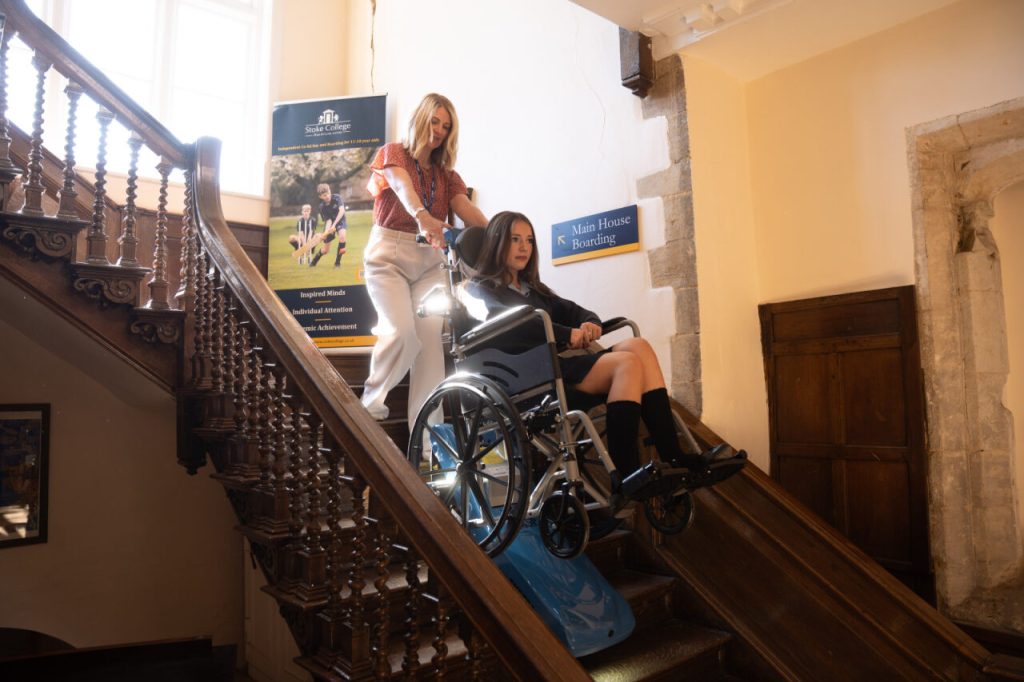
Every student, member of staff and visitor should have a realistic way to leave an educational building during an emergency. For schools, colleges and universities in London, achieving this can be complicated. Campuses may include modern teaching blocks, Victorian buildings, listed properties, laboratories, halls of residence, libraries, theatres and sports facilities. The people using them can change throughout the day, and some may need assistance to use stairs.
This makes professional evacuation chair training an essential part of inclusive fire-safety planning. An evacuation chair stored beside a staircase cannot protect anyone unless it is suitable for the building and the intended user, maintained correctly and supported by trained, confident staff.
The Evacuation Company works with educational establishments to connect equipment, site assessment, evacuation planning and practical staff training. Its Powered Evacuation Solutions pillar page explains how manual evacuation chairs, powered chairs and non-transfer powered stairclimbers can support people with different mobility and postural needs.
For education providers looking for Evac chair training in London, the aim should not be to obtain certificates and then forget about the equipment. The aim is to create a dependable, person-centred system that staff can put into practice when an alarm sounds.
Why evacuation chair training matters in education
Schools, colleges and universities have a clear responsibility to consider how everyone will evacuate safely. This includes pupils and students with permanent disabilities, temporary injuries or medical conditions, as well as staff, parents, contractors and visitors who may require assistance.
Government guidance on workplace fire risk assessments states that the responsible person must consider emergency routes and exits, evacuation plans, staff training and the needs of vulnerable people, including people with disabilities. The findings should be recorded, reviewed and translated into practical arrangements.
Article 21 of the Regulatory Reform (Fire Safety) Order 2005 also requires employees to receive adequate safety training when they start work and when new or increased risks arise, with training repeated periodically where appropriate.
Within an educational setting, this means any plan that relies on staff operating an evacuation chair must be backed by meaningful instruction and practice. A written procedure cannot compensate for staff who are unsure how to release the chair, position a user, control the equipment on stairs or reach the final exit.
Effective training provides more than technical ability. It clarifies who is responsible, encourages calm communication and helps the establishment find gaps in its plan before they become dangerous.
The particular challenges faced by London education providers
London’s education estate is exceptionally diverse. A primary school may occupy a converted nineteenth-century building with narrow staircases. A secondary school may have several blocks connected by ramps, bridges and external routes. A university can operate across an entire district, combining lecture theatres, laboratories, residences and heritage buildings under different management arrangements.
Many sites have been expanded in stages, so accessibility and escape provisions can vary from one part of the estate to another. Busy corridors, security-controlled doors, split levels and limited storage can further affect an assisted evacuation.
Timetables also matter. A student may attend lessons on several floors and in different buildings. Staff coverage changes during breaks, after-school activities and evening events. Universities may operate late into the night, while halls of residence remain occupied around the clock. Contractors, visiting lecturers and members of the public may be present without detailed knowledge of the site.
For these reasons, Evac chair training in London should be site-specific. Participants need to understand the equipment installed at their premises, the staircases on which it may be used, the designated routes and what happens after reaching the bottom of the stairs. Training should reflect real staffing patterns rather than assuming the same team will always be available.
Supporting pupils and students with additional needs
Inclusive evacuation starts with the individual. Some pupils and students may use manual or powered wheelchairs. Others may have cerebral palsy, muscular conditions, neurological conditions, sensory impairments, fatigue, anxiety, learning disabilities or temporary injuries. Their requirements should not be reduced to a single label such as “mobility impaired”.
A standard evacuation chair may be appropriate for someone who can transfer safely and tolerate the seating position. It may be unsuitable for a person who needs specialist postural support, cannot be transferred without a hoist or relies on equipment attached to their wheelchair.
The Government’s guidance on means of escape for disabled people covers assisted escape, refuges, evacuation lifts, evacuation chairs and Personal Emergency Evacuation Plans. Crucially, an organisation’s strategy should not depend on the Fire and Rescue Service arriving to complete a planned evacuation.
Where a conventional chair is not suitable, a powered or non-transfer solution may offer a safer and more dignified option. A non-transfer powered stairclimber can allow some wheelchair users to remain in their own wheelchair while trained operators support movement on stairs. This can reduce the risks and distress associated with an unnecessary transfer.
Equipment selection must follow a proper assessment of the individual, the wheelchair, the staircase and the route. It should never be based solely on convenience or the assumption that one chair can meet every need.
PEEPs in schools, colleges and universities
A Personal Emergency Evacuation Plan, usually known as a PEEP, records how a known person who needs assistance will reach safety. In an educational establishment, the plan should be developed with the pupil, student or employee and, where appropriate, their parent, carer, occupational therapist or other relevant professional.
A useful PEEP should explain the available routes, the assistance required, the equipment to be used, who will provide support and what alternatives apply if the normal route or personnel are unavailable. It should take account of the individual’s daily movements rather than covering only their main classroom or office.
If the PEEP includes an evacuation chair, it should establish that the user can transfer into it safely, that the chair supports them appropriately and that enough trained operators will be available. The route should be assessed from the person’s likely location to the final place of safety, including corridors, doors, landings and any further changes of level.
PEEPs should also be reviewed. A student’s needs, timetable, wheelchair or educational location may change. Building work, room changes and new equipment can make an earlier plan ineffective. Training sessions and drills are valuable opportunities to test whether the written arrangements remain realistic.
GEEPs for visitors and the wider education community
Education sites are not used only by enrolled pupils and employed staff. Parents attend meetings and performances, prospective students visit open days, community groups hire facilities and external speakers use lecture spaces. Universities may operate museums, cafés, conference centres and libraries that are open to the public.
A General Emergency Evacuation Plan, or GEEP, provides arrangements for people whose needs are not known in advance. It should be supported by accessible information, clear methods of requesting help and trained personnel who understand the assistance and equipment available.
Reception teams, security staff, facilities personnel and event organisers should know how a visitor can disclose an evacuation requirement and how that information will reach the right people. Privacy and dignity should be respected throughout.
London Fire Brigade provides broader information about fire safety and evacuation in the workplace. Education providers should use relevant official guidance alongside competent advice that reflects their premises and occupants.
What professional evacuation chair training should include
Good evacuation chair training combines explanation, demonstration and supervised practice. Although the exact content depends on the model and site, training should normally cover:
- how the chair fits into the fire strategy, PEEPs and GEEPs
- the chair’s intended use, limitations and key components
- pre-use checks and safe removal from its storage position
- communication with the person receiving assistance
- safe transfer, seating and restraint use where applicable
- movement along corridors and across landings
- controlled operation on an appropriate staircase
- operator posture, teamwork and manual-handling considerations
- safe progress from the stairs to the designated final destination
- post-use checks, fault reporting and returning the chair to readiness
- practical assessment to confirm that participants can use the equipment safely
The training should make clear that evacuation chairs are not interchangeable. Staff trained on one model should not automatically be assumed competent on another with different controls or operating characteristics.
Participants should also know when not to use a chair. A course should never encourage staff to improvise a transfer, exceed equipment limits or use a route that has not been assessed.
Powered evacuation equipment in larger education buildings
Traditional manual evacuation chairs continue to be useful in many educational settings. However, they normally require the user to transfer and can place a significant physical and psychological demand on operators, particularly across several floors.
Powered evacuation chairs and powered stairclimbers can reduce reliance on operator strength and provide controlled movement on stairs. This may be valuable in multi-storey universities, large secondary schools, specialist colleges and sites where longer staircases form part of the escape route.
Powered equipment does not remove the need for competent operators. Staff must understand its controls, battery status, positioning and emergency procedures. The equipment also needs a suitable storage and charging arrangement, regular checks and servicing.
The Health and Safety Executive’s PUWER overview explains that work equipment should be suitable, properly maintained and used by people who have received adequate information, instruction and training. The specific inspection and servicing regime should follow the equipment manufacturer’s instructions and the establishment’s risk assessment.
The Evacuation Company’s powered evacuation solutions can help educational establishments consider whether manual, powered or non-transfer equipment best meets the needs identified on their site.
Maintaining competence across the academic year
Evacuation-chair skills can fade when equipment is rarely used. Education providers should therefore plan refresher training and safe familiarisation rather than treating an initial course as permanent competence.
The correct frequency will depend on the risk assessment, manufacturer guidance, staff turnover, changes to the premises and the complexity of the equipment. Refresher action should also follow any incident, drill or practical session that identifies uncertainty.
Staffing coverage needs particular attention. A school should consider absences, lunch duties, trips and after-school clubs. Colleges and universities must account for part-time staff, evening teaching, security shifts, examinations and holiday periods. A long list of trained employees is of limited value if none is reliably available where and when assistance is required.
Training records should show who attended, which chair model and location were covered, the practical competence demonstrated and when refresher action is due. These records should support, rather than replace, ongoing operational checks.
Common weaknesses in educational evacuation arrangements
Recurring problems include:
- buying an evacuation chair without assessing the intended users or staircase
- placing equipment where it is blocked, unsecured or difficult to reach
- relying on one trained member of staff who may be absent
- failing to cover clubs, events, examinations and out-of-hours activities
- PEEPs that do not reflect a student’s full timetable or changing needs
- expecting a wheelchair user to transfer without assessing whether this is safe
- using different chair models across a campus without model-specific training
- failing to coordinate between teaching, premises, security and residential teams
- overlooking inspection, charging, maintenance or servicing
- running drills that never examine assisted evacuation arrangements
These weaknesses can usually be addressed through a coordinated audit, clear plans, suitable equipment and a structured training programme.
Choosing Evac chair training in London
When selecting a provider, schools, colleges and universities should look for practical, site-aware training rather than a generic product demonstration. The provider should be able to work with the establishment’s actual equipment, explain limitations and identify where a different solution or further assessment may be necessary.
Ask how participant competence is checked, what records are supplied and how refresher requirements are determined. For a campus with several buildings or chair types, the training plan should distinguish between general awareness and practical competence on specific equipment.
The Evacuation Company supports educational establishments with equipment and access audits, PEEPs and GEEPs, evacuation-chair supply, practical operator training and ongoing servicing. Bringing these services together helps prevent gaps between what the plan says and what staff can achieve.
Building safer and more inclusive places of education
Effective evacuation planning is ultimately about people. It should enable a pupil, student, employee or visitor to reach safety without being treated as an afterthought. Suitable equipment matters, but assessment, communication, maintenance and confident staff are equally important.
Professional evacuation chair training gives education teams the practical knowledge to operate equipment safely and the opportunity to identify weaknesses in a controlled environment. It also reassures pupils, students, families and staff that individual needs have been considered seriously.
If your school, college or university is reviewing Evac chair training in London, begin by examining the whole arrangement: the people, buildings, routes, equipment and staff coverage. The Evacuation Company can assess existing provision and help create a solution that combines suitable equipment, person-centred planning, practical training and ongoing readiness.
Key Takeaways
- Evacuation chair training in schools is crucial for ensuring everyone can evacuate safely during emergencies.
- Training should be professional and site-specific, covering equipment use, safety procedures, and communication.
- London’s diverse educational settings require tailored evacuation plans and regular refresher training for staff.
- Personal Emergency Evacuation Plans (PEEPs) should address individual needs and be regularly reviewed for effectiveness.
- Choosing the right provider for evacuation chair training in schools is essential for practical, site-aware training that enhances safety.
Estimated reading time: 11 minutes
Table of contents
- evacuation-chair-training-london-education-blog.md
- Evacuation Chair Training in London Educational Settings: Creating Safer Schools, Colleges and Universities
- Why evacuation chair training matters in education
- The particular challenges faced by London education providers
- Supporting pupils and students with additional needs
- PEEPs in schools, colleges and universities
- GEEPs for visitors and the wider education community
- What professional evacuation chair training should include
- Powered evacuation equipment in larger education buildings
- Maintaining competence across the academic year
- Common weaknesses in educational evacuation arrangements
- Choosing Evac chair training in London
- Building safer and more inclusive places of education