


Estimated reading time: 15 minutes
Table of contents
- Inclusive Evacuation in Schools, Colleges and Universities
- Why Education Requires Specialist Evacuation Planning
- What Is a Powered Evacuation Chair?
- Why a Standard Evacuation Chair May Not Meet Every Need
- PEEPs in Educational Establishments
- GEEPs for Visitors and Unfamiliar Building Users
- BEEPs and the Whole-Building Strategy
- Reducing Transfers During Evacuation
- Powered Evacuation for Basement Areas
- The Importance of Staff Training
- Servicing and Equipment Readiness
- Safeguarding, Dignity and Inclusion
- Educational Premises and Residential Accommodation
- Hiring Powered Evacuation Chairs
- Why Choose The Evacuation Company?
- Building an Evacuation Plan That Works
Suggested URL: /powered-evacuation-chairs-education-peeps-geeps-beeps/
Inclusive Evacuation in Schools, Colleges and Universities
Schools, colleges and universities have a responsibility to consider how everyone will leave their buildings safely during an emergency. This includes pupils, students, employees, contractors and visitors who may be unable to use the stairs independently.
Most educational establishments have well-established procedures for sounding the alarm, leaving classrooms and reporting to an assembly point. However, the evacuation of a wheelchair user or someone with reduced mobility can require a much more detailed plan.
A conventional evacuation chair may provide a suitable answer for some people and buildings. In other situations, a powered evacuation chair or powered stairclimber may offer a safer, more dignified and more practical solution.
Powered equipment can reduce the physical effort required from staff, support movement across longer or more complicated staircases and, with the correct model, allow a wheelchair user to remain in their own chair.
The important point is that evacuation equipment must be connected to a workable plan. A chair stored beside a staircase does not create an effective evacuation procedure on its own.
This supporting article explores how educational establishments can use powered evacuation chairs to turn PEEPs, GEEPs and BEEPs into realistic procedures. For a broader introduction to the equipment, read our pillar guide to powered evacuation chairs for schools.
Why Education Requires Specialist Evacuation Planning
Educational buildings are rarely simple environments. A single school may contain an original Victorian building, a modern teaching block, temporary classrooms, outdoor steps and specialist facilities spread across different levels.
Colleges and universities can be even more complicated. A campus may include lecture theatres, laboratories, libraries, workshops, sports centres, offices, student services and historic buildings. Occupancy can change throughout the day as people move between lessons and activities.
This creates a challenge for evacuation planning. A pupil might be in an accessible ground-floor classroom during the morning but attend a lesson on an upper floor later in the day. A university student may move between several buildings, each with a different staircase and evacuation strategy.
Visitors also need to be considered. Parents, prospective students, guest speakers, contractors and members of the public may enter the premises without having an individual evacuation plan in place.
The official fire safety risk assessment guidance for educational premises applies to settings including schools, academies, universities, adult education centres, music schools and outdoor education centres in England. It is intended to help responsible persons meet their duties under the Regulatory Reform (Fire Safety) Order 2005.
An effective plan must reflect how the educational establishment really operates. It should account for changing classrooms, different building users and the possibility that the usual passenger lift will be unavailable during a fire.
What Is a Powered Evacuation Chair?
A powered evacuation chair is an electrically operated device designed to assist the evacuation of a person who cannot use the stairs independently.
Traditional evacuation chairs usually rely on gravity and a controlled tracking system to move a passenger downstairs. They can be effective on suitable staircases when operated by properly trained people.
A powered evac chair uses a motorised system to assist movement. Depending on the design, it may support controlled descent, upward travel or movement in both directions. This can be valuable in basement classrooms, underground facilities, split-level buildings and locations where the escape route requires travel upwards.
Some powered evacuation chairs include an integrated seat. The passenger must transfer from their wheelchair or other seating before evacuation begins.
Other powered stairclimbers attach to a compatible wheelchair. These non-transfer solutions may enable the pupil or student to remain within their own seating system throughout the evacuation.
This can be especially important for people with complex physical disabilities, specialist seating, poor trunk control, pain, fatigue or anxiety about being transferred. However, wheelchair compatibility and the passenger’s individual needs must always be assessed professionally.
Why a Standard Evacuation Chair May Not Meet Every Need
Standard evacuation chairs remain an important part of many emergency plans. They are compact, familiar and effective for downward evacuation on suitable staircases.
The difficulty arises when an educational establishment assumes that the same chair will work for every person.
A pupil with complex postural needs may not be supported adequately by a basic evacuation chair seat. A wheelchair user may require a difficult transfer before the chair can be used. The transfer may also need staff with specialist moving and handling skills.
There can be additional challenges when the escape route is long, the pupil is heavier or the building has several floors. Staff may be expected to control the chair while managing the physical and emotional pressure of a real emergency.
Powered evacuation chairs can reduce some of this physical demand. The motor controls the climbing or tracking mechanism, allowing the operator to concentrate on guiding the equipment, communicating with the passenger and following the planned route.
Powered does not mean automatic. The equipment still requires trained operators, regular inspection and a suitable staircase. However, it can make an evacuation plan more achievable for the people expected to deliver it.
PEEPs in Educational Establishments
A Personal Emergency Evacuation Plan, commonly known as a PEEP, is created for an individual who may need assistance to evacuate.
Within education, a PEEP might be required for a pupil who uses a wheelchair, a student with a visual or hearing impairment, an employee with a long-term health condition or someone recovering from an injury.
The plan should be developed with the person wherever possible. For a child, this may also involve parents or carers, the Special Educational Needs Coordinator, Occupational Therapist and relevant school staff.
A useful PEEP considers more than the person’s diagnosis. It examines where they are likely to be in the building, how they will recognise the alarm, which escape routes are available and what assistance they need.
Where a powered evacuation chair is proposed, the PEEP should identify the specific equipment, suitable routes, trained operators and any transfer or wheelchair attachment procedure.
It must also consider what happens if the primary route is blocked or the nominated operator is absent. A plan that relies completely on one member of staff is vulnerable whenever that person is unavailable.
PEEPs should be reviewed when circumstances change. A pupil may grow, their mobility may alter or their wheelchair may be replaced. A timetable change can place them in a different building, while construction work may affect the intended escape route.
The physical evacuation method must evolve alongside the individual and the educational environment.
GEEPs for Visitors and Unfamiliar Building Users
A General Emergency Evacuation Plan, or GEEP, supports people who may require assistance but do not have a named individual PEEP.
This is particularly relevant to universities, colleges and larger schools with frequent visitors. An open day, parents’ evening, graduation ceremony or public performance may bring hundreds of people onto the premises.
The establishment may not know in advance who will require assistance. A GEEP provides general information about accessible escape routes, refuges, communication methods and available evacuation equipment.
A powered evacuation chair may form part of this arrangement. However, the establishment must consider how a visitor will request assistance and how trained staff will be deployed.
Information should be visible and easy to understand. Reception teams, event staff, security personnel and building managers should know what support is available.
A GEEP is not a substitute for a PEEP when the educational establishment knows that a particular pupil, student or employee needs individual support. The two plans perform different roles and should work together.
BEEPs and the Whole-Building Strategy
A Building Emergency Evacuation Plan, often referred to as a BEEP, considers evacuation arrangements across the entire building.
In education, the BEEP connects the fire risk assessment, escape routes, staff responsibilities, alarm procedures, assembly points, equipment and arrangements for people who need assistance.
Powered evacuation chairs should fit into this wider system. Their storage positions must make sense in relation to the identified routes. They must not obstruct corridors or staircases, but they also need to be accessible quickly.
The plan should establish how staff will retrieve the equipment, reach the person requiring assistance and begin the evacuation without creating confusion.
Communication is particularly important in schools. Staff may be responsible for supervising an entire class while also supporting an individual pupil. The BEEP should clarify how these responsibilities will be divided.
Practice drills can reveal difficulties that are not obvious on paper. The equipment might be stored too far from the relevant staircase, the landing might become congested or the nominated operators might normally work in another part of the building.
A successful BEEP turns written procedures into a coordinated response that can be delivered under pressure.
Reducing Transfers During Evacuation
The transfer from a wheelchair into an evacuation chair can be one of the most difficult parts of an evacuation plan.
A person may have limited balance, involuntary movement, fragile joints or specialist postural requirements. A hurried transfer can cause distress and increase the risk of injury to both the passenger and staff.
It may also take valuable time. Staff need to position the evacuation chair, use the correct handling method, secure the passenger and arrange for another wheelchair to be available at the destination.
A non-transfer powered stairclimber can offer an alternative by attaching directly to a compatible wheelchair. The passenger remains in their usual seating, which may provide greater comfort, stability and reassurance.
The suitability of this approach depends on the wheelchair, staircase, escape route and individual. Powered stairclimbers should never be assumed to fit every wheelchair without assessment.
For educational establishments supporting pupils with complex disabilities, the ability to avoid a transfer may significantly improve the realism of the PEEP. The procedure can be practised using the person’s actual equipment rather than relying on an arrangement that becomes difficult to reproduce during an emergency.
The Stair Climbing Company provides specialist wheelchair stairclimbers and can support assessments where a non-transfer evacuation method is being considered.
Powered Evacuation for Basement Areas
Not every evacuation route leads downwards. Schools and universities may have music rooms, workshops, laboratories, kitchens, archives or lecture facilities below ground level.
A conventional gravity-based evacuation chair is designed primarily for descending stairs. It may not provide a suitable method when the only safe route requires upward movement.
A powered evacuation chair or stairclimber can support travel up the stairs, subject to the equipment specification and site assessment.
This capability should be considered during the building fire risk assessment. If a basement is accessible to wheelchair users during normal operation, the establishment must examine how those people would leave when the passenger lift is unavailable.
The solution should be in place before the space is used. Relying on staff to carry a wheelchair or passenger during an emergency is not a dependable evacuation strategy.
The Evacuation Company specialises in powered evacuation solutions for buildings where upward movement is necessary. This includes assessing the route, recommending equipment and developing the training required to make the procedure workable.
The Importance of Staff Training
Even the best powered evacuation chair will be ineffective if staff are not confident using it.
Training should give operators meaningful practical experience. They need to understand how to inspect the equipment, prepare it for use, position the passenger and control movement on the stairs.
Where a wheelchair carrier is used, training should include the correct attachment process. Staff must be able to recognise whether the wheelchair and equipment are connected securely before approaching the staircase.
Communication with the passenger is equally important. An emergency evacuation can be frightening, particularly for a child or someone with sensory or cognitive needs. The operator should explain what is happening and provide reassurance throughout the procedure.
Training should take place within the educational establishment where possible. Practising on the actual staircase helps staff understand turns, landings, doorways and other features that affect the route.
The Evacuation Company provides evacuation equipment training ranging from individual sessions to group training and train-the-trainer programmes.
Training must also be refreshed. Staff leave, change departments or lose confidence when equipment is not used regularly. Annual refresher training, practical drills and reviews following staffing changes help maintain competence.
Servicing and Equipment Readiness
Powered evacuation chairs depend on batteries, motors, controls, tracks and safety features. These components must be maintained if the equipment is expected to work immediately during an emergency.
A chair can remain unused for long periods. This makes regular checking more important, not less important. Batteries can lose charge, components can be damaged and equipment can be moved from its designated storage position.
Educational establishments should establish a recorded inspection routine. The frequency and scope should reflect the manufacturer’s instructions, risk assessment and applicable work-equipment requirements.
The Evacuation Company provides equipment servicing and PUWER testing for existing and newly supplied evacuation equipment.
Servicing should be connected to the wider evacuation plan. When equipment is removed for repair or inspection, the establishment must consider whether temporary cover is required.
The PEEP cannot simply remain unchanged if the equipment named within it is unavailable.
Safeguarding, Dignity and Inclusion
Evacuation planning in education must protect people physically, but it should also respect their dignity.
A pupil should not be made to feel like a problem because they require assistance. They should not discover during a fire drill that the school has no realistic method of helping them leave.
Involving pupils, students and families in planning can reduce anxiety and improve the procedure. They can explain what support feels safe, how they prefer to communicate and whether a proposed transfer is realistic.
Current Department for Education guidance on SEN and disability responsibilities states that governing boards should help create an environment in which pupils with SEN and disabilities can thrive and play a full part in school life.
Inclusive evacuation is part of that environment. Access to an upstairs classroom means little if the pupil cannot leave it safely during an emergency.
Powered evacuation chairs can support a more person-centred approach by widening the range of practical evacuation methods available.
Educational Premises and Residential Accommodation
Schools, colleges and universities should recognise that different parts of an institution may fall within different guidance.
The government guidance for educational premises covers the main educational use of buildings but does not apply to residential areas such as university halls of residence or boarding-school sleeping accommodation.
Residential buildings may require separate consideration. The Fire Safety (Residential Evacuation Plans) (England) Regulations 2025 came into force on 6 April 2026 and apply to specific residential buildings in England.
This does not mean that the residential regulations automatically apply to every classroom, lecture theatre or school building. Educational establishments with boarding accommodation or student residences should identify which legal and guidance framework applies to each part of their estate.
RPEEPs are specifically associated with applicable residential settings. PEEPs, GEEPs and the educational-premises fire risk assessment remain central to non-residential teaching environments.
Professional advice can help a multi-use education provider avoid applying the wrong terminology or procedure to the wrong building.
Hiring Powered Evacuation Chairs
Some education providers need evacuation equipment for a temporary situation rather than permanent provision.
A passenger lift may be awaiting repair, a building may be undergoing refurbishment or an event may attract visitors with additional evacuation requirements. A new pupil or member of staff may also need an interim solution while permanent equipment is sourced.
Powered evacuation chair hire can provide short-term support, but the process must still include assessment and training. Delivering a chair without confirming the route, user requirements and operator competence does not create a safe plan.
The Evacuation Company provides maintained and safety-checked evacuation equipment for hire, supported by on-site familiarisation and professional advice.
For permanent requirements, purchase or longer-term arrangements may offer greater continuity. The right option depends on the expected duration, building, frequency of use and individual evacuation needs.
Why Choose The Evacuation Company?
The Evacuation Company is a leading UK specialist in evacuation planning, powered evacuation equipment, evacuation chair training and servicing.
The company works with schools, colleges, universities, facilities teams and responsible persons to move evacuation planning beyond basic compliance.
Its service can begin with an equipment and access audit, followed by support with PEEPs, GEEPs and wider building procedures. Where equipment is required, the team can recommend traditional evacuation chairs, powered evacuation chairs or non-transfer powered stairclimbers.
Training is delivered around the chosen equipment and environment. Ongoing servicing and refresher training help keep the system ready after the initial installation.
This complete approach is particularly important in education, where the people, timetables and buildings can change frequently.
Building an Evacuation Plan That Works
Powered evacuation chairs can transform emergency planning across schools, colleges and universities, but their value depends on how they are implemented.
The starting point should always be a suitable fire risk assessment and an honest examination of who may be unable to self-evacuate.
PEEPs should provide a practical method for known individuals. GEEPs should support visitors and other people whose needs may not be known in advance. The BEEP should connect these arrangements to the building’s overall emergency procedure.
The selected equipment should match the person, wheelchair, staircase and direction of travel. Staff must be trained, batteries kept charged and servicing completed at suitable intervals.
When these parts work together, a powered evacuation chair becomes more than a product attached to a wall. It becomes part of a clear, inclusive and deliverable emergency plan.
For schools, colleges and universities looking to review existing arrangements, contact The Evacuation Company to arrange an evacuation assessment and discuss powered evac chairs, powered stairclimbers, PEEPs, GEEPs, BEEPs, training and servicing.
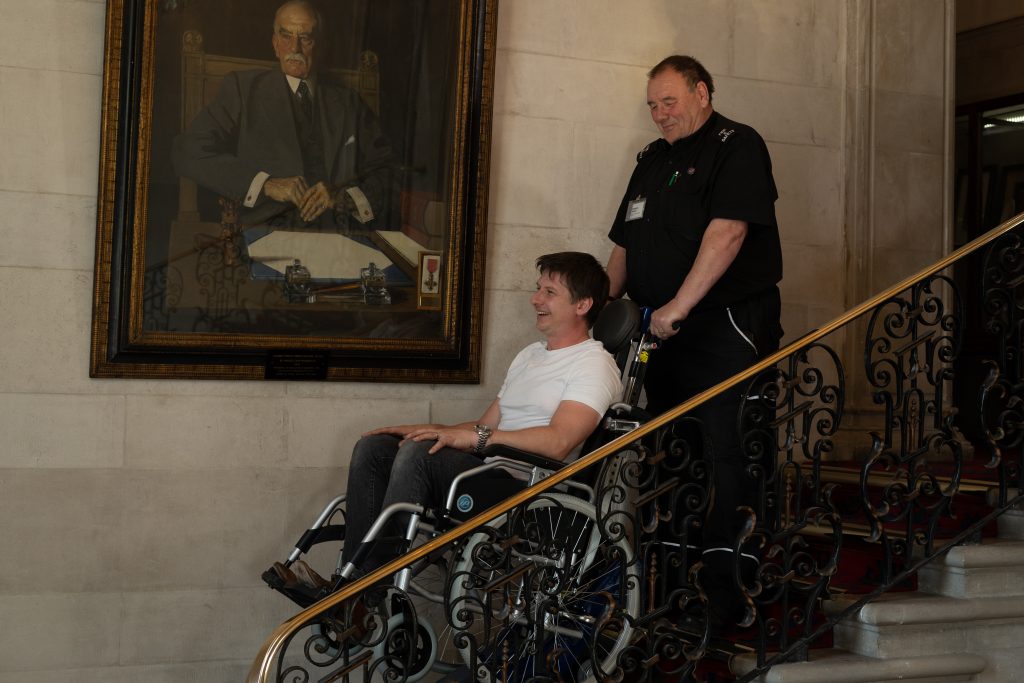
Powered Evacuation Chair for Dignified Evacuations – The Evacuation Company The Evacuation Company
Key Takeaways
- Educational institutions must have effective evacuation plans for individuals with mobility challenges.
- Powered evacuation chairs provide safer and more dignified solutions compared to conventional chairs.
- Personal Emergency Evacuation Plans (PEEPs) should accommodate individual needs and adjust as circumstances change.
- General Emergency Evacuation Plans (GEEPs) guide unregistered visitors on evacuation methods, while Building Emergency Evacuation Plans (BEEPs) ensure overall cohesion in emergency strategies.
- Regular training and maintenance for powered evacuation chairs are essential for effective emergency responses in education.