

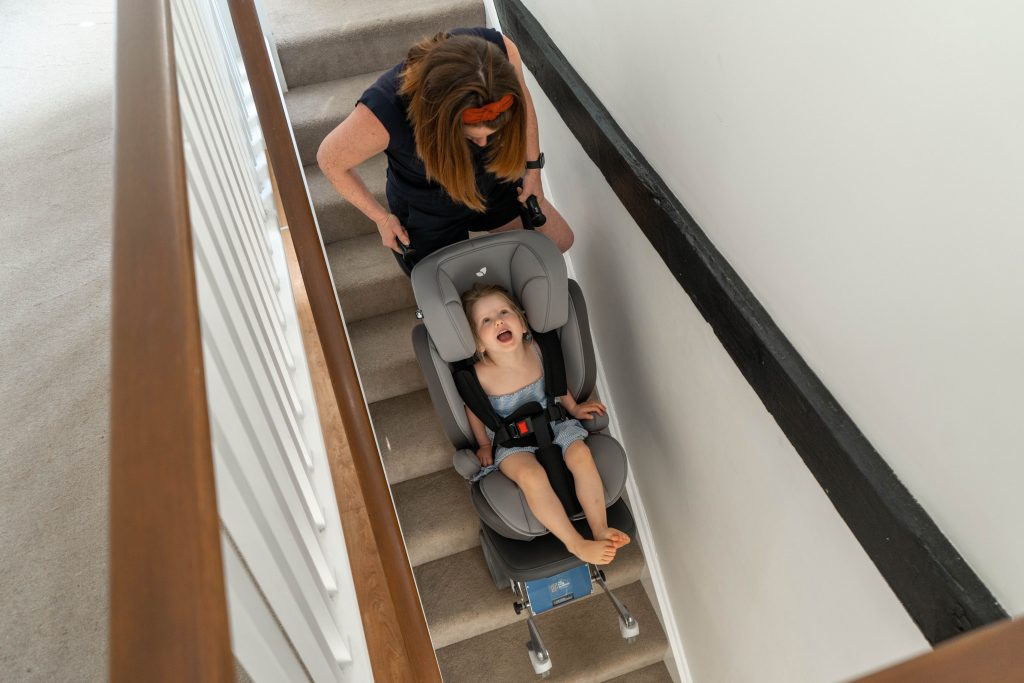
Occupational Therapists and Powered Evacuation Chairs: Assessing Access as Well as Emergency Escape
Occupational therapists understand that access is not simply about entering a building. It is about being able to carry out the activities that matter, whether that means attending work, joining a class, visiting family, receiving care or taking part in community life.
Stairs can interrupt that participation. A person may be able to use most of a building but remain excluded from one essential floor. A passenger lift may be unavailable, structurally impractical or unsuitable during an emergency. In these situations, powered stair equipment can become part of the conversation.
Powered Evacuation Chairs are designed primarily to help people move on stairs during an emergency. Some powered devices can also support controlled access during normal building use, while Powered Stairclimbers are often designed more specifically for everyday access. The distinction matters because equipment should only be used for purposes covered by its design, manufacturer’s instructions and risk assessment.
Occupational therapists can add particular value to this decision. Their contribution goes beyond checking whether a person is within a weight limit. They can examine the relationship between the person, their occupations, the wheelchair, the task, the physical environment and the people expected to provide assistance.
The best outcome is not always a powered chair. It may be a lift, a room move, a building alteration or a different way of delivering the activity. Where powered equipment is appropriate, OT-led reasoning can help ensure that the solution is safe, dignified and relevant to real life.
Why occupational therapy matters in stair access
A staircase can create several different problems. It may prevent a wheelchair user from reaching an upstairs workplace, stop a resident visiting a communal room or leave an employee without a realistic emergency route.
These are not identical needs. Everyday access concerns participation and routine movement. Emergency evacuation concerns rapid movement to safety under unfamiliar and potentially stressful conditions.
Occupational therapists are well placed to separate the two while considering how they interact. They can identify the occupations being restricted, understand what the individual wants to achieve and explore the least restrictive effective solution.
Technical feasibility does not guarantee a good outcome. A machine may fit the stair but provide inadequate support, require a painful transfer or take too long for the intended activity.
The OT can help turn a product discussion into an occupational-performance assessment.
What is a Powered Evacuation Chair?
A Powered Evacuation Chair is a motor-assisted chair used to move a person on stairs during an emergency. Different models may provide powered descent, ascent or both.
Traditional evacuation chairs remain effective in many buildings. Their operation can, however, place substantial physical demands on staff, particularly with heavier passengers, several flights or upward travel.
Powered Evac Chairs use motorised assistance to help control movement and reduce dependence on operator strength. This can improve consistency and confidence when the equipment, route and operator are compatible.
The word “powered” does not mean fully automatic. Staff may still need to transfer and position the passenger, deploy the chair, negotiate landings and communicate throughout the journey. These tasks require assessment, training and competence.
Capacity, seating, restraints, stair dimensions, turns, batteries and direction of travel all influence suitability. A product brochure is not an assessment.
Powered Evacuation Chairs versus Powered Stairclimbers
The difference between Powered Evacuation Chairs and Powered Stairclimbers should be made clear from the beginning.
Powered Stairclimbers are commonly intended for planned access. Some attach to a compatible manual wheelchair, allowing the person to remain in their own seating system. Others include an integrated seat and require a transfer.
Powered Evacuation Chairs are selected around emergency use. They need to be available quickly, suitable for the escape route and incorporated into a fire-safety procedure.
Some equipment is promoted for both access and evacuation. Dual-purpose use should never be assumed from appearance or climbing ability. The manufacturer must permit each intended use, and the separate conditions of routine access and emergency evacuation must be assessed.
A device that works during a scheduled appointment may not be suitable on a busy escape stair. Equally, an evacuation chair stored for rare emergency use may not provide the seating, wheelchair compatibility or operational convenience required for everyday access.
An OT can define the goal before a category is chosen, preventing emergency equipment becoming an improvised access solution.
Starting with occupation rather than equipment
Good assessment begins by asking what the person needs and wants to do. Is the goal to attend work every day, reach an occasional medical appointment, visit a relative or access an upstairs activity once a week? How important is independent timing? How often will the journey occur?
Frequency changes the suitability of a solution. A staff-operated stair chair may be acceptable for rare access to a specific room but intrusive and unreliable for somebody making the journey several times each day.
The OT should also explore alternatives. Moving a service to an accessible floor may remove the barrier. A platform lift may provide greater independence. A building alteration may benefit many people rather than creating a procedure around one person.
Alternatives must be equivalent, not merely convenient. Remote participation may not be genuine access if the person loses equipment, colleagues or the social experience.
Where powered stair equipment remains appropriate, the occupational goal gives the assessment a clear standard. The question becomes whether the proposed system enables the activity safely, reliably and with acceptable effort.
Assessing the person
The person’s weight and dimensions are essential, but they are only a starting point. The OT may need to consider posture, balance, muscle tone, joint range, pain, fatigue, breathing, cardiac health, neurological symptoms, skin integrity and fracture risk.
Seating support is particularly important. A person who depends on customised lateral supports, a headrest or pressure management may not tolerate an integrated evacuation-chair seat. Moving them away from their configured wheelchair could increase pain, instability or tissue risk.
Cognition and communication affect use. The person may need tailored information, preparation or consistent staff, particularly during an alarm.
The person’s experiences and concerns provide evidence that measurements cannot. A journey that feels insecure or humiliating is not successful access.
Assessment must remain current. A change in health, medication, mobility, body weight, wheelchair or support needs may require the process to be repeated.
Wheelchair compatibility and transfer analysis
Remaining in a personal wheelchair can reduce transfers and preserve posture, but only if the Powered Stairclimber or dual-purpose device is approved and compatible with that chair.
Frame design, width, total weight, footplates, anti-tip components, powered functions and attachment points all matter. Powered wheelchairs are often heavier than manual chairs and may exceed equipment limits or lack suitable connection points.
Where an integrated seat is used, the transfer becomes a separate occupational and moving-and-handling task. The OT should consider the starting surface, method, staff assistance, transfer aids and how the person will move back into their wheelchair at the destination.
A landing transfer introduces particular issues involving space, privacy, lighting and proximity to the stair edge.
HSE guidance says moving-and-handling equipment in health and social care should be introduced after assessment and used in accordance with the care plan and manufacturer’s instructions. This principle is equally valuable wherever powered stair equipment is proposed for a person with complex needs.
Assessing the building and complete journey
The staircase must be assessed on site. Width, pitch, treads, nosings, turns, surfaces, headroom and landings can determine suitability.
The OT should look beyond the steps. The route may include heavy doors, narrow corridors, thresholds, slopes and insufficient turning space. The destination must allow the person to complete the intended activity, use facilities and leave safely.
Storage and charging affect reliability. A machine kept in another building or locked behind an unavailable key holder may not deliver real access. The chair should remain ready without obstructing the escape route.
An on-site demonstration is essential. It allows the supplier, OT, person, facilities team and moving-and-handling adviser to observe the complete task. Measurements can be confirmed, but the demonstration also reveals practical details such as approach angles, turning effort, passenger experience and operator posture.
For emergency use, a competent fire-safety professional must assess the equipment within the fire strategy. The OT informs the person-specific elements but does not own the building’s evacuation arrangements.
Balancing dignity, independence and risk
Risk management in occupational therapy should support participation rather than eliminate activity without considering its value. At the same time, a stair journey involving a person and powered equipment can have serious consequences if poorly planned.
The assessment should consider benefits, injury, operator strain, equipment failure, dignity and the exclusion caused by providing no solution.
Independence is not a simple yes-or-no concept. A person may accept staff operation while retaining choice over when and why they travel. Another may find the need to book assistance unacceptable for daily employment.
The least restrictive effective option may be powered equipment, but a permanent adaptation can provide more freedom and less repeated handling.
The rationale should be recorded clearly, including alternatives considered and the person’s views. This supports continuity when staff change and helps prevent equipment being used for unassessed people or tasks.
Everyday access needs a dependable operating system
Equipment only provides access when competent operators are available at the required time. The organisation should identify who will help, how they are contacted and what happens during sickness, leave or shift changes.
Frequent access may require a larger group of trained staff than emergency-only provision. The person should not repeatedly arrive early, wait after others have left or disclose personal information to find an operator.
Training should occur on the actual route wherever possible. Operators need supervised practice with checks, deployment, wheelchair attachment or transfers, passenger communication, stair travel, landings and unexpected stops.
Competence should be observed and recorded. Refresher training is important where the device is used infrequently, and procedures need review when staff, equipment or the environment changes.
Maintenance, charging and pre-use checks must have named ownership. If the device fails, a realistic contingency is needed. Simply cancelling the person’s access is unlikely to be an acceptable long-term backup.
Emergency evacuation remains a separate assessment
Using powered equipment for everyday access does not automatically establish an emergency plan. During a fire, lifts may be unavailable, escape routes may be crowded and the normal operator may not be present.
A Personal Emergency Evacuation Plan, or PEEP, may be needed for an employee, resident, student or regular visitor who cannot use the standard route independently. It should be developed with the person and identify assistance, communication, equipment, operators, escape routes and backup arrangements.
A Generic Emergency Evacuation Plan, or GEEP, supports visitors whose individual requirements are not known beforehand. A Building Emergency Evacuation Plan, or BEEP, coordinates the wider strategy for the premises.
The OT can inform transfers, positioning and communication. The responsible person and fire-safety professionals must make the plan work with alarms, refuges and escape arrangements.
Government guidance on means of escape for disabled people makes clear that organisations must plan rather than rely on the Fire and Rescue Service to make arrangements work.
If one device is intended for access and evacuation, emergency availability must be protected. It cannot be elsewhere in the building, attached to a different wheelchair or left uncharged when an alarm occurs.
Working as part of a multidisciplinary team
Powered stair access often sits between professional responsibilities. The OT brings person-centred functional analysis, but safe implementation may also require a moving-and-handling adviser, physiotherapist, wheelchair service, fire-safety professional, facilities manager, structural adviser and specialist supplier.
Clear roles prevent gaps. The supplier confirms product limits, the OT assesses function and occupational impact, and the fire-safety professional addresses the building strategy.
The person remains a central member of the team. Their feedback during a trial can change the recommendation, identify unacceptable discomfort or reveal a better alternative.
The HCPC standards of proficiency set the threshold for safe and effective occupational therapy practice. OTs should work within their scope, recognise limits and seek appropriate expertise where the equipment, building or fire context goes beyond it.
Enabling access with clinical and practical confidence
Powered Evacuation Chairs can play an important role in inclusive emergency planning. Certain powered systems may also support everyday access where they are designed and approved for that purpose. In many access situations, a Powered Stairclimber will be the more appropriate category.
Occupational therapists help ensure that the decision begins with the person and the occupation rather than the machine. Their assessment can connect posture, transfers, wheelchair configuration, cognition, dignity, activity and environment with the practical realities of staff-operated equipment.
The Evacuation Company works with occupational therapists, moving-and-handling teams, employers, care providers and building managers. We provide site assessments, demonstrations, equipment guidance and training while recognising the boundaries between product expertise, clinical judgment and fire-safety responsibility.
If you are assessing a powered stair solution for access, evacuation or both, contact The Evacuation Company to arrange a site demonstration. The right solution should enable meaningful participation, protect the person and operator, and remain dependable when it is needed.
Frequently asked questions
Can a Powered Evacuation Chair be used for everyday access?
Only where the specific model is designed and approved for that use and the person, route and operating system have been assessed. A Powered Stairclimber may be more appropriate for routine access.
Should an occupational therapist recommend the product alone?
No. The OT can lead the person-centred functional assessment, but input may also be needed from the supplier, moving-and-handling adviser, wheelchair service, facilities team and fire-safety professional.
Can the person remain in their own wheelchair?
Some Powered Stairclimbers and dual-purpose devices accept compatible manual wheelchairs. The exact chair, attachments, combined weight and user support needs must be checked.
Does a successful access trial prove evacuation suitability?
No. Emergency conditions are different. Evacuation use requires assessment within the fire strategy and any relevant PEEP, GEEP or BEEP.
How often should the arrangement be reviewed?
Review frequency should reflect the person’s condition, use of the equipment and local policy. Any change to health, wheelchair, route, staffing or equipment should prompt reassessment.
Authoritative external references
HCPC, Standards of proficiency for occupational therapists: https://www.hcpc-uk.org/standards/standards-of-proficiency/occupational-therapists/
Royal College of Occupational Therapists, Standards and guidelines resources: https://www.rcot.co.uk/explore-resources/standards-guidelines
HSE, Moving and handling in health and social care: https://www.hse.gov.uk/healthservices/moving-handling/
HSE, Moving and handling equipment: https://www.hse.gov.uk/healthservices/moving-handling/moving-handling-equipment.htm
GOV.UK, Fire safety risk assessment: means of escape for disabled people: https://www.gov.uk/government/publications/fire-safety-risk-assessment-means-of-escape-for-disabled-people
Key Takeaways
- Occupational Therapists and Powered Evacuation Chairs assist in ensuring safe and dignified access for individuals with mobility challenges.
- Powered Evacuation Chairs are designed for emergency use, whereas Powered Stairclimbers focus on everyday access.
- Assessing the individual’s needs, environment, and equipment compatibility is essential for effective use of powered stair devices.
- Collaboration with professionals and the person involved is crucial for making informed decisions about equipment and emergency plans.
- Regular reviews and assessments ensure that equipment suitability adapts to any changes in the user’s condition or environment.
Estimated reading time: 12 minutes
Table of contents
- Occupational Therapists and Powered Evacuation Chairs: Assessing Access as Well as Emergency Escape
- Why occupational therapy matters in stair access
- What is a Powered Evacuation Chair?
- Powered Evacuation Chairs versus Powered Stairclimbers
- Starting with occupation rather than equipment
- Assessing the person
- Wheelchair compatibility and transfer analysis
- Assessing the building and complete journey
- Balancing dignity, independence and risk
- Everyday access needs a dependable operating system
- Emergency evacuation remains a separate assessment
- Working as part of a multidisciplinary team
- Enabling access with clinical and practical confidence
- Frequently asked questions
- Authoritative external references
For more great reading on Powered Evacuation chairs at home for access click on our Pillar link below.
Powered Evacuation Chair for Dignified Evacuations – The Evacuation Company The Evacuation Company