

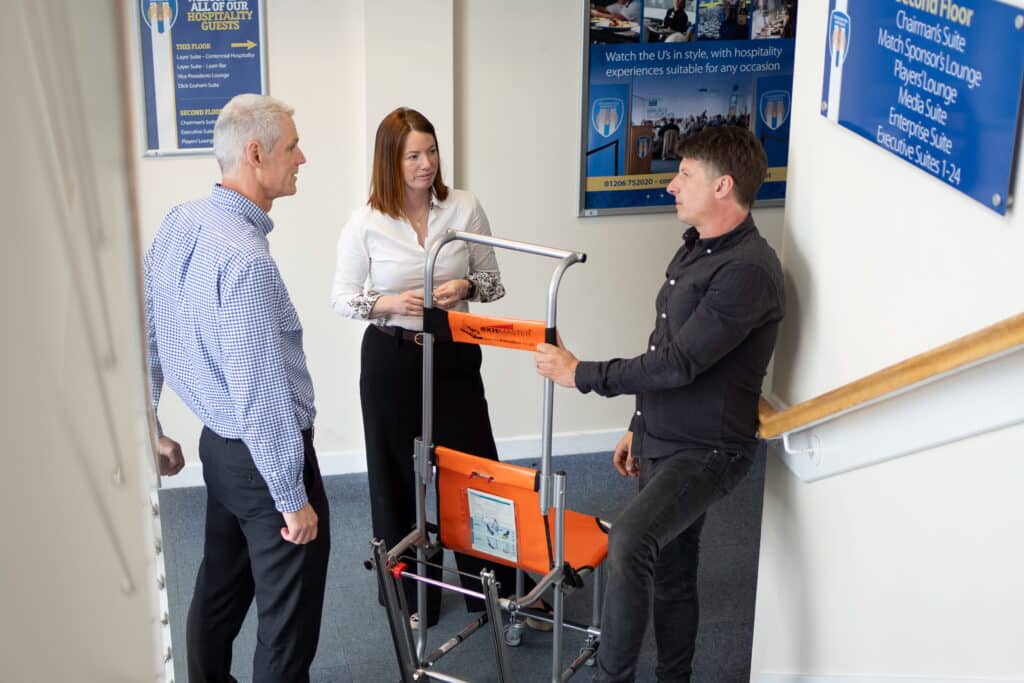
Evacuation Chair Training in London: Build a Safer, More Inclusive Workplace
Need evacuation chair training in London? Book professional evacuation chair training with The Evacuation Company or contact our team for a free assessment. We provide practical training, equipment assessments, servicing and complete evacuation support for organisations across London.
London buildings create some of the most demanding emergency evacuation challenges in the UK. Modern office towers sit alongside listed buildings, converted townhouses, schools, universities, hotels, theatres, healthcare settings and mixed-use developments. Every property has its own staircases, escape routes, staffing levels and accessibility requirements.
For a person who cannot use stairs independently, an alarm can create an immediate barrier to reaching safety. An evacuation chair may form an important part of the solution, but simply mounting equipment on a wall does not make a building prepared. The chair must be suitable for the route and its intended users, correctly maintained and supported by people who have been trained to operate it confidently.
Professional evacuation chair training in London turns equipment into a practical and dependable part of an emergency plan. It helps staff understand their responsibilities, gives them supervised experience and exposes gaps before an actual evacuation occurs.
The Evacuation Company is one of London’s top specialist providers of evacuation chair training and inclusive evacuation solutions. We support offices, residential buildings, schools, universities, hotels, healthcare organisations, heritage venues and public buildings with training designed around their real environment. Our service can also bring together evacuation equipment, PEEPs, GEEPs, access audits, servicing and powered solutions rather than treating each element in isolation.
For a wider look at equipment selection, planning and powered technology, read our complete guide to Powered Evacuation Chairs in the UK. This pillar guide explains how traditional and powered evacuation solutions can support safer escape from a broad range of buildings.
Why evacuation chair training matters
During an emergency, staff may need to make decisions in a noisy and stressful environment. An operator who has only watched a short demonstration may struggle to release the chair from its storage position, deploy it correctly, secure the passenger or control it on the stairs. Even a well-designed evacuation chair can be ineffective when the people expected to use it lack practical competence.
The Health and Safety Executive’s guidance on emergency procedures explains that people are more likely to respond reliably when they are well trained and competent, take part in realistic practice, and work to agreed and rehearsed plans. It also makes clear that emergency arrangements must consider disabled people and vulnerable workers.
Good evac chair training in London should therefore be practical. Delegates need the opportunity to handle the equipment, understand its controls, learn the correct operating position and recognise when it may not be appropriate to proceed. Training should also cover communication with the person being assisted. A passenger should be treated with dignity, told what is happening and given the opportunity to raise concerns about transfers, posture, pain, anxiety or other needs.
Training is not about encouraging staff to improvise. Its purpose is to create a clear and repeatable procedure in which equipment, people and routes have already been considered.
London buildings require a site-specific approach
A generic course delivered away from the workplace can explain the principles of evacuation chair use. It cannot, on its own, prove that a chair will work in a particular London building.
The capital contains steep and narrow staircases, small landings, basement levels, protected heritage features, long high-rise escape routes and buildings shared by several employers. Some premises operate around the clock, while others depend heavily on temporary, contract or agency staff. Hotels and venues must also plan for guests and visitors whose needs may not be known in advance.
Effective evacuation chair training should connect the equipment to the designated escape route. Trainers and responsible persons must consider where the chair is stored, how quickly trained operators can reach it, whether landings provide enough manoeuvring space and where the passenger will go after leaving the staircase. If the route includes several flights, the physical demands on operators must be realistic.
The Government’s detailed guidance on means of escape for disabled people reinforces the need to plan for assisted escape rather than assume that the Fire and Rescue Service will carry it out. It discusses management arrangements, refuges, evacuation lifts, equipment and personal emergency evacuation plans as connected parts of an overall strategy.
This is why The Evacuation Company takes a wider view. We do not see training as an isolated certificate. We help clients assess whether the chair, route, staffing arrangement and emergency plan work together.
What professional evacuation chair training should cover
A strong course begins with the role of the evacuation chair within the building’s fire strategy. Staff should understand which routes are intended for assisted evacuation, who can authorise or begin the procedure, how responsibilities are allocated and how communication will be maintained.
The practical session should cover removing the chair from storage, opening and checking it, preparing it for the passenger, using its restraints and operating it on stairs under controlled conditions. Delegates should learn how to maintain safe posture and control, how to coordinate with another member of staff where the procedure requires it, and how to return the chair to a ready condition after practice or use.
Operators also need to understand limitations. A manual evacuation chair will not suit every person, transfer or escape route. Some wheelchair users cannot transfer safely from their own seating system. Other people may have postural, medical, sensory or communication needs that affect the chosen method. Training cannot compensate for unsuitable equipment, an inaccessible route or insufficient staffing.
The best courses allow questions and supervised repetition. Competence develops through doing, not simply watching. Organisations should record attendance, identify people who require more support and make arrangements for refresher instruction. New starters and changes to staff roles must also be considered, particularly in buildings where turnover is high.
Article 21 of the Regulatory Reform (Fire Safety) Order 2005 requires employees to receive adequate safety training when they are first employed and when exposed to new or increased risks, with training repeated periodically where appropriate. The course must therefore sit within an ongoing system rather than being treated as a one-off event.
PEEPs and GEEPs must connect with training
A Personal Emergency Evacuation Plan, commonly known as a PEEP, records how a particular person will reach a place of safety. It may address alarm information, assistance, equipment, transfers, routes, refuges and the people responsible for supporting the evacuation.
The individual should be involved in preparing the plan. Assumptions based only on a diagnosis or visible impairment can lead to an unsafe or undignified procedure. One wheelchair user may transfer comfortably into an evacuation chair, while another may require a non-transfer solution that allows them to remain in their own wheelchair. Someone who normally walks independently may need assistance during an emergency because of fatigue, medication, injury or anxiety.
A General Emergency Evacuation Plan, or GEEP, can help a building make suitable arrangements for visitors whose requirements are not known beforehand. Reception procedures, accessible information, staff roles and a clear method of requesting assistance all matter in busy London premises.
The Government’s guide for people with duties under fire safety legislation provides a useful overview of the duties placed on responsible persons. In practice, plans must be communicated to the employees expected to carry them out. If a PEEP names evacuation chair use but there are too few trained operators available, the plan is not operationally dependable.
The Evacuation Company can support the development and review of PEEPs, GEEPs and wider building evacuation arrangements alongside staff training. This joined-up approach helps ensure that written procedures reflect the building as it is actually used.
Manual and powered evacuation chairs
Manual evacuation chairs remain an effective choice in many buildings. They are compact, familiar and can provide controlled downward travel when the equipment, staircase, passenger and operators have been properly assessed.
However, London premises are not all built around a simple downward escape route. Basement workspaces, underground teaching areas, theatres and service levels may require assisted upward travel. Tall buildings can also place considerable physical demands on staff, especially where several people may require assistance.
A Powered Evacuation Chair or Powered Stairclimber may be more appropriate in these circumstances. Motorised assistance can reduce operator effort and provide controlled movement, with some models capable of travelling both up and down stairs. Non-transfer powered equipment may also allow a person to remain in their own wheelchair, subject to compatibility, route assessment and the chosen model.
Powered equipment still requires training. Operators must understand the controls, battery management, attachment points, safe positioning and emergency procedures. The unit must be charged, checked and accessible when required. Our Powered Evacuation Solutions service explains the options available for straight, curved, indoor and outdoor staircases.
Because The Evacuation Company works with both traditional and powered equipment, we can recommend training and products based on the real requirement rather than forcing every building into one standard solution.
Training, drills and competence over time
Training should lead to an evacuation procedure that staff can recall and perform under pressure. That means competence must be maintained.
Refresher training is valuable when staff have had little opportunity to use the equipment, when operators change or when a chair is replaced. A building refurbishment, altered escape route, new tenant or revised PEEP may also create the need for further instruction. Records should show who has trained, which equipment was covered and when skills are due to be reviewed.
Drills allow organisations to test the wider arrangement. They can reveal delays in contacting operators, confusion over keys or access, blocked routes and weaknesses in communication. A drill should be planned sensitively. A disabled person should not be expected to undergo repeated transfers or stair descents merely so others can practise. Appropriate training aids, volunteers or simulated stages can often test the process without causing unnecessary discomfort or risk.
The London Fire Brigade’s business fire-safety resources offer further guidance for those responsible for protecting workplaces across the capital. Fire safety is a continuous management responsibility, so lessons from practice should feed back into risk assessments, evacuation plans and staff instruction.
Equipment inspection and servicing
An evacuation chair may remain untouched for months or years, but it must be ready immediately when required. Tracks, belts, buckles, brakes, wheels and frames can deteriorate or be damaged. Powered units add batteries, controls and charging arrangements that require appropriate checks.
Routine visual checks can identify obvious damage, missing components or poor storage. Planned servicing provides a more detailed examination and should follow the manufacturer’s guidance. Where evacuation equipment is used at work, the HSE’s information on the Provision and Use of Work Equipment Regulations is also relevant to the selection, maintenance and use of work equipment and the training of those who operate it.
The Evacuation Company provides evacuation chair servicing and PUWER-focused equipment support alongside training. Combining these services reduces the risk of a familiar but defective chair remaining in place simply because nobody has taken ownership of its condition.
Why choose The Evacuation Company for evacuation chair training in London?
The Evacuation Company is a top provider for London organisations because our support goes beyond a standard demonstration. We understand that an effective evacuation depends on the relationship between the person, the equipment, the building, the route and the operators.
Our practical training can be delivered for groups, individuals or internal trainers. We can work with suitable existing equipment as well as chairs supplied by us, helping clients improve what they already have while identifying gaps that require attention. For larger organisations and multi-site operators, train-the-trainer programmes can help develop internal capability, supported by clear governance and refresher arrangements.
Our team can also assist with equipment access audits, PEEPs, GEEPs, powered evacuation solutions, servicing and ongoing review. This gives facilities managers and responsible persons one specialist partner for the key parts of inclusive evacuation planning.
London clients also benefit from experience across very different settings. A high-rise office in the City, a Kensington hotel, a university campus and a listed cultural venue do not need identical answers. We tailor our advice to the people, property and operational realities of each location.
Most importantly, our approach is human. The objective is not merely to place a certificate in a compliance folder. It is to give staff confidence, protect the person being assisted and create a procedure that can work when every second matters.
Arrange evacuation chair training in London
If your building has evacuation chairs but staff are not confident using them, the risk has not been fully addressed. The same applies when training records are out of date, operators have left, equipment has changed or a PEEP depends on a procedure that has never been practised.
The Evacuation Company can review your current arrangements, train your team and help you connect evacuation equipment with realistic plans, competent operators and dependable servicing. Whether you manage a single London building or a portfolio of sites, we can provide a proportionate solution shaped around your needs.
Book evacuation chair training in London or contact The Evacuation Company for a free assessment today. Give your staff the practical confidence to act and give every building user a safer, more inclusive route to emergency evacuation.
Key Takeaways
- Evacuation chair training in London ensures staff can effectively use evacuation chairs during emergencies.
- Proper training enhances staff competence, addresses planning needs, and considers the unique layouts of London’s buildings.
- The Evacuation Company combines training with equipment assessments, PEEPs, and GEEPs for a comprehensive evacuation solution.
- Regular drills and refresher training keep staff prepared and capable in real-life situations.
- Choosing The Evacuation Company means tailored support that prioritizes human safety and effective procedures.
Estimated reading time: 11 minutes
Table of contents
- Evacuation Chair Training in London: Build a Safer, More Inclusive Workplace
- Why evacuation chair training matters
- London buildings require a site-specific approach
- What professional evacuation chair training should cover
- PEEPs and GEEPs must connect with training
- Manual and powered evacuation chairs
- Training, drills and competence over time
- Equipment inspection and servicing
- Why choose The Evacuation Company for evacuation chair training in London?
- Arrange evacuation chair training in London