

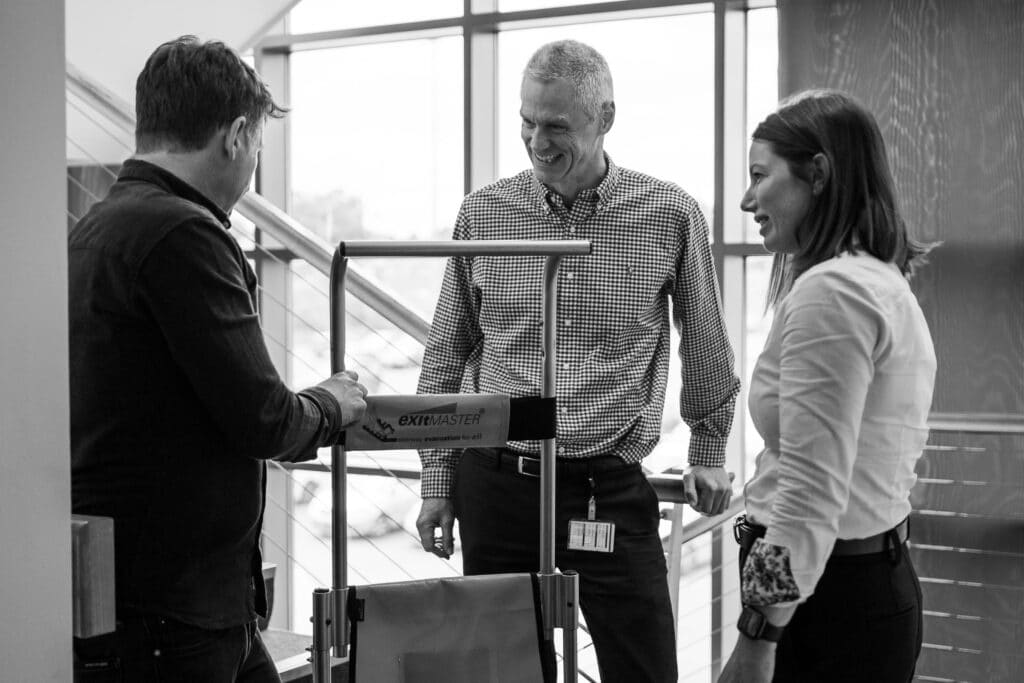
Evacuation Chair Training in London: Building Real Emergency Preparedness
Evacuation chair training in London should never be treated as a simple box-ticking exercise. An evacuation chair may be correctly installed, clearly signed and regularly serviced, but it will only become an effective part of an emergency plan when trained and confident people are available to use it.
London presents a particularly complex evacuation environment. The capital contains modern office towers, historic buildings, hotels, schools, universities, hospitals, theatres, residential blocks and mixed-use developments. Many have multiple floors, narrow staircases, high numbers of visitors or several organisations sharing responsibility for the same building.
When lifts cannot be used during an emergency, stairs may become the principal means of escape. This can create a serious barrier for wheelchair users and people with reduced mobility. Effective evacuation chair training in London gives staff the practical skills and confidence needed to assist someone safely while following the building’s agreed evacuation procedures.
The Evacuation Company provides practical, building-specific training for organisations throughout London. Our approach connects the equipment, the operators and the evacuation plan, helping clients move beyond basic compliance towards genuine emergency preparedness.
Why Evacuation Chair Training in London Is So Important
London buildings can be difficult environments in which to organise an assisted evacuation. An office in the City of London may occupy several floors of a shared tower. A Westminster hotel may have guests who are unfamiliar with the building. A Kensington school may need to consider children with permanent or temporary mobility requirements. A historic venue may have narrow staircases that cannot be structurally altered.
These situations cannot be addressed simply by purchasing an evacuation chair.
The responsible person must understand where the equipment will be located, who is expected to use it, which staircase is suitable and how the chair forms part of the wider fire strategy. The availability of trained operators must also be considered across working hours, shift patterns, holidays and periods of staff absence.
Government guidance on the means of escape for disabled people states that responsibility for an emergency evacuation plan rests with the people responsible for the building. The plan should include everyone likely to be on the premises, including disabled people, and should not depend on intervention by the Fire and Rescue Service to make it work.
This makes practical evac chair training in London an important part of a building’s own emergency arrangements.
An Evacuation Chair Alone Is Not an Evacuation Plan
A common problem is the assumption that owning an evacuation chair automatically provides a suitable solution. In reality, a chair is only one component of a much wider system.
A workable arrangement must identify the people who may require assistance, the operators responsible for providing that assistance, the route they will use and the actions to be taken if the preferred route becomes unavailable. Staff must also understand communication procedures, refuge arrangements and where responsibility passes between different teams.
The chair itself must be suitable for the staircase, building and anticipated user. A standard manual evacuation chair may be appropriate in some locations, while a powered evacuation chair or alternative stair-climbing solution may be more suitable in another.
Our pillar article, Technology, Training and the Future of Evacuation: How Powered Evacuation Chairs Are Changing Safety Planning, explains how powered equipment, appropriate planning and effective training can work together to improve inclusive evacuation.
The correct solution should always follow an assessment of the building and its users. Equipment should not be selected first and expected to solve every evacuation challenge afterwards.
What Should Evacuation Chair Training Cover?
Professional evacuation chair training should combine explanation, demonstration and supervised practical use. Watching a video or reading the manufacturer’s instructions may provide background knowledge, but it does not show whether an operator can deploy and control the chair safely on the building’s own staircase.
Training should begin by explaining the purpose and limitations of the equipment. Operators need to understand when the chair may be required, how it relates to the fire strategy and why a person-centred evacuation plan is essential.
The practical part should cover removing the chair from its storage point, unfolding and checking it, preparing it for use, securing the passenger correctly and maintaining communication throughout the movement. Operators should learn the correct posture, hand position and control technique for their particular model.
Participants should then practise moving the chair on an appropriate staircase under controlled supervision. This is important because stair width, pitch, landings, turns and surface materials can all affect how the equipment behaves.
Training should also address the end of the route. Staff must know where the chair is expected to go after leaving the staircase and how the passenger will reach a place of ultimate safety. Reaching the ground floor does not necessarily complete the evacuation if the exit remains some distance away.
A well-designed course also explains pre-use checks, reporting damage, storage, servicing and the importance of keeping the approach to the equipment unobstructed.
Building-Specific Evac Chair Training in London
Evac chair training in London is most effective when it takes place in the building where the equipment will be used.
Generic training in an external classroom can explain the fundamentals, but it cannot reproduce the exact staircase, storage position or operational challenges of a particular workplace. On-site training allows staff to practise in the environment they must navigate during a real emergency.
This can reveal practical issues that might otherwise remain hidden. A chair may be mounted too high for some operators to remove comfortably. Furniture might restrict access to the storage position. A landing could be too tight for the intended manoeuvre. The nominated operators may work in a different part of the building or may not always be present.
These findings are valuable because training should test the plan rather than simply confirm that a course has been completed.
London’s multi-occupied buildings require particular attention. Landlords, managing agents, tenants, security teams and facilities-management contractors may all have separate responsibilities. Government guidance explains that organisations in multi-occupancy buildings should co-operate and co-ordinate their evacuation plans.
Training can help establish who collects the chair, who communicates with the person requiring assistance, who manages the stairs and who confirms that the evacuation has been completed.
Connecting Training With PEEPs, GEEPs, BEEPs and RPEEPs
Evacuation chair training should support the plans used within the building.
A Personal Emergency Evacuation Plan, commonly known as a PEEP, is developed for a known person who may require assistance. It should reflect the individual’s needs, preferences and usual locations within the premises. The person should be included in the planning process wherever possible.
A General Emergency Evacuation Plan, or GEEP, may be used to establish arrangements for visitors and other people whose individual requirements are not known in advance. This is especially relevant to London hotels, theatres, museums, shopping areas, universities and public buildings.
Building Emergency Evacuation Plans, often referred to as BEEPs, consider the overall procedures and resources available within a building. In residential settings, Residential Personal Emergency Evacuation Plans, or RPEEPs, may also apply.
The London Fire Brigade provides dedicated information on Residential Personal Emergency Evacuation Plans. In addition, the Fire Safety (Residential Evacuation Plans) (England) Regulations 2025, which came into force on 6 April 2026, introduced specific requirements for certain residential buildings in England.
Training does not replace any of these plans. It helps turn their written procedures into actions that staff understand and can perform.
The Legal Context for Evacuation Chair Training
The principal fire-safety framework for many non-domestic premises in England is the Regulatory Reform (Fire Safety) Order 2005. It places duties on the responsible person concerning fire precautions, risk assessment, emergency procedures and employee instruction and training.
Where evacuation equipment is provided for use at work, the Provision and Use of Work Equipment Regulations 1998 may also be relevant. The Health and Safety Executive’s guidance on training and competence explains that people using work equipment must receive adequate training in its safe use, associated risks and appropriate precautions. HSE also advises that refresher training may be necessary when equipment, working systems or circumstances change.
The Equality Act 2010 provides an additional context for organisations’ responsibilities towards disabled people. Making access into a building possible without considering how people will leave during an emergency does not provide a complete approach to accessibility.
The legislation does not mean that every London building requires the same number or type of evacuation chairs. Requirements must be determined through a suitable fire-risk assessment, inclusive evacuation planning and an assessment of the premises.
Training for Manual and Powered Evacuation Chairs
Manual and powered evacuation chairs can require different operating techniques.
A manual descending chair normally uses tracks or belts to travel down stairs under the control of a trained operator. The operator must understand deployment, passenger security, balance and controlled movement on the staircase.
Powered evacuation chairs can reduce some of the physical demands placed on operators and may offer controlled movement on stairs. Certain models may also support upward movement, which can be valuable in basements or other areas where the escape route rises towards the exit.
However, powered equipment still requires properly trained operators. Staff must understand controls, batteries, charging, emergency procedures and the particular limitations of the model. The equipment must also be matched to the staircase and intended evacuation scenario.
The objective is not to declare one category universally better. It is to identify the equipment and training programme that best support the building’s risk assessment and evacuation plans.
Who Should Receive Evacuation Chair Training?
Training should be provided to the people who may realistically be expected to operate or manage the equipment during an emergency.
In a London office, this could include fire marshals, facilities staff, security personnel and nominated departmental employees. In a hotel, operators may need to be available throughout the day and night. Schools and universities must consider teaching hours, evening events, student accommodation and staff turnover. Healthcare and residential environments may require coverage across several shifts.
Relying on one or two individuals can leave a serious gap when they are working remotely, attending a meeting, on annual leave or absent through illness.
The operator group should therefore be large enough to provide dependable coverage. Training records should identify who attended, which chair they used, when the course took place and whether practical competence was demonstrated.
How Often Should Training Be Refreshed?
Evacuation chair training should not be regarded as permanent after one session. Practical skills can deteriorate when equipment is rarely used, and evacuation chairs are deliberately intended for situations that do not occur every day.
The appropriate refresher interval should be determined by the fire-risk assessment, manufacturer’s guidance, staff turnover and the complexity of the procedure. Government means-of-escape guidance recommends that evacuation plans are practised regularly and notes that PEEP arrangements should generally be practised at least every six months, although simulation may be more appropriate where a live practice could create unnecessary risk.
Additional training should be considered when a chair is replaced, a staircase or escape route changes, staff responsibilities are reorganised or a drill identifies uncertainty. New operators should receive proper instruction before being added to the team.
Short internal familiarisation sessions between formal courses can help staff remain comfortable with deployment and basic checks, provided these sessions follow the agreed procedure and do not replace competent instruction.
Common Evacuation Chair Training Mistakes
One of the most frequent mistakes is delivering training without reference to the building’s fire strategy. Operators may learn how to move the chair but remain unclear about when they should act, where the passenger will be waiting or which staircase they should use.
Another problem is training too few people. A certificate has little operational value if the trained person is not present when an emergency occurs.
Organisations may also overlook communication and dignity. A person using an evacuation chair is not simply a load to be moved. Operators should explain what is happening, seek consent where circumstances allow and provide reassurance throughout the evacuation.
Using an untrained person as a passenger during practice can create unnecessary risk. Training should be planned and supervised carefully, using suitable simulation where appropriate.
Finally, equipment should not be left unchecked between training sessions. Storage, inspection, servicing and operator competence must be considered together.
Evacuation Chair Training Across London
The Evacuation Company supports organisations throughout Central London, the City of London and the surrounding boroughs. This includes offices, hotels, educational establishments, healthcare settings, heritage buildings, residential developments and public venues.
Every site presents different questions. Is the evacuation chair compatible with the nominated staircase? Can trained operators reach it quickly? Is there coverage across all shifts? Does the procedure support employees, residents and visitors? Can a person be evacuated from a basement as well as from an upper floor?
Our evacuation chair training in London is designed around these practical realities. We can support clients with equipment assessment, manual and powered evacuation-chair options, operator training, evacuation planning, servicing and PUWER-related inspection requirements.
The aim is to create a joined-up arrangement in which equipment, people and procedures support one another.
Frequently Asked Questions About Evacuation Chair Training in London
Is evacuation chair training a legal requirement?
Fire-safety and work-equipment legislation require responsible persons and employers to provide suitable procedures, information and training. Whether an evacuation chair is required, and how many people should be trained, depends on the building’s fire-risk assessment, users and evacuation strategy.
Can staff use an evacuation chair without training?
Staff should not be expected to operate unfamiliar evacuation equipment during an emergency. Practical training helps them deploy the chair correctly, secure the passenger, control movement on stairs and understand the risks involved.
Should training take place on our own staircase?
Where possible, yes. On-site training allows operators to understand the actual chair, route, landings and storage arrangements they would encounter during an evacuation.
Does evacuation chair training include PEEPs?
Equipment training and PEEP development are different services, but they should be connected. A PEEP identifies how a particular person will evacuate, while training prepares the nominated staff to perform their part of that plan.
Can powered evacuation chairs be included?
Yes. Powered evacuation chairs require model-specific training covering controls, batteries, passenger security and movement on the intended staircase.
How long does evacuation chair training remain valid?
There is no universal expiry period suitable for every site. Refresher arrangements should reflect the risk assessment, manufacturer’s recommendations, staff turnover, drills and changes to equipment or procedures.
Arrange Evacuation Chair Training in London
An evacuation chair can be an important part of an inclusive fire-safety strategy, but the equipment must be supported by trained people and a realistic plan.
The Evacuation Company provides practical evacuation chair training in London for organisations that want staff to be prepared, competent and confident. We can assess existing arrangements, train operators on manual or powered equipment and help connect training with PEEPs, GEEPs, BEEPs and RPEEPs.
If your organisation has evacuation chairs but is uncertain whether enough people can use them safely, now is the time to review the arrangement. Effective evacuation chair training turns equipment mounted on a wall into a practical part of a safer and more inclusive evacuation plan.
Contact The Evacuation Company to discuss evacuation chair training for your London building.
Key Takeaways
- Evacuation chair training in London is crucial for ensuring effective emergency preparedness, not just compliance.
- Organizations must understand their building’s evacuation needs, including the limitations of their evacuation chairs and operators.
- Training should take place on-site to address real challenges, fostering familiarity with staircases and storage locations.
- Regular refresher training is essential, as skills can deteriorate without practice; training records should be maintained.
- The Evacuation Company offers tailored evacuation chair training in London, connecting equipment, operators, and evacuation plans.
Estimated reading time: 13 minutes
Table of contents
- Evacuation Chair Training in London: Building Real Emergency Preparedness
- Why Evacuation Chair Training in London Is So Important
- An Evacuation Chair Alone Is Not an Evacuation Plan
- What Should Evacuation Chair Training Cover?
- Building-Specific Evac Chair Training in London
- Connecting Training With PEEPs, GEEPs, BEEPs and RPEEPs
- The Legal Context for Evacuation Chair Training
- Training for Manual and Powered Evacuation Chairs
- Who Should Receive Evacuation Chair Training?
- How Often Should Training Be Refreshed?
- Common Evacuation Chair Training Mistakes
- Evacuation Chair Training Across London
- Frequently Asked Questions About Evacuation Chair Training in London
- Arrange Evacuation Chair Training in London