
Powered Stairclimbers for Schools, Colleges and Universities: Improving PEEPs, GEEPs and BEEPs Across London
Key Takeaways
- Powered stairclimbers enhance emergency evacuation plans, ensuring safe access for individuals with reduced mobility in educational settings.
- They assist with PEEPs, GEEPs, and BEEPs for a comprehensive evacuation strategy, addressing unique needs of students and visitors.
- These devices reduce manual handling risks for staff, allowing them to focus on supporting evacuees rather than physical demands.
- Educational institutions in London must prioritize inclusive evacuation planning to comply with legal obligations and ensure safety for all.
- Investing in powered stairclimbers demonstrates a commitment to inclusive education and effective safety measures during emergencies.
Estimated reading time: 6 minutes
Educational establishments have a duty to ensure every student, member of staff and visitor can be evacuated safely during an emergency. For schools, colleges, universities and multi-academy trusts across London, effective evacuation planning is no longer simply a compliance exercise. It is a fundamental part of safeguarding, accessibility and risk management.
As buildings become more complex and student populations become increasingly diverse, powered stairclimbers are emerging as one of the most effective solutions for inclusive emergency evacuation. When integrated into Personal Emergency Evacuation Plans (PEEPs), Generic Emergency Evacuation Plans (GEEPs) and Building Emergency Evacuation Plans (BEEPs), powered stair climbers and powered evacuation chairs can significantly improve safety outcomes while helping educational organisations meet their legal obligations.
What Are Powered Stairclimbers?
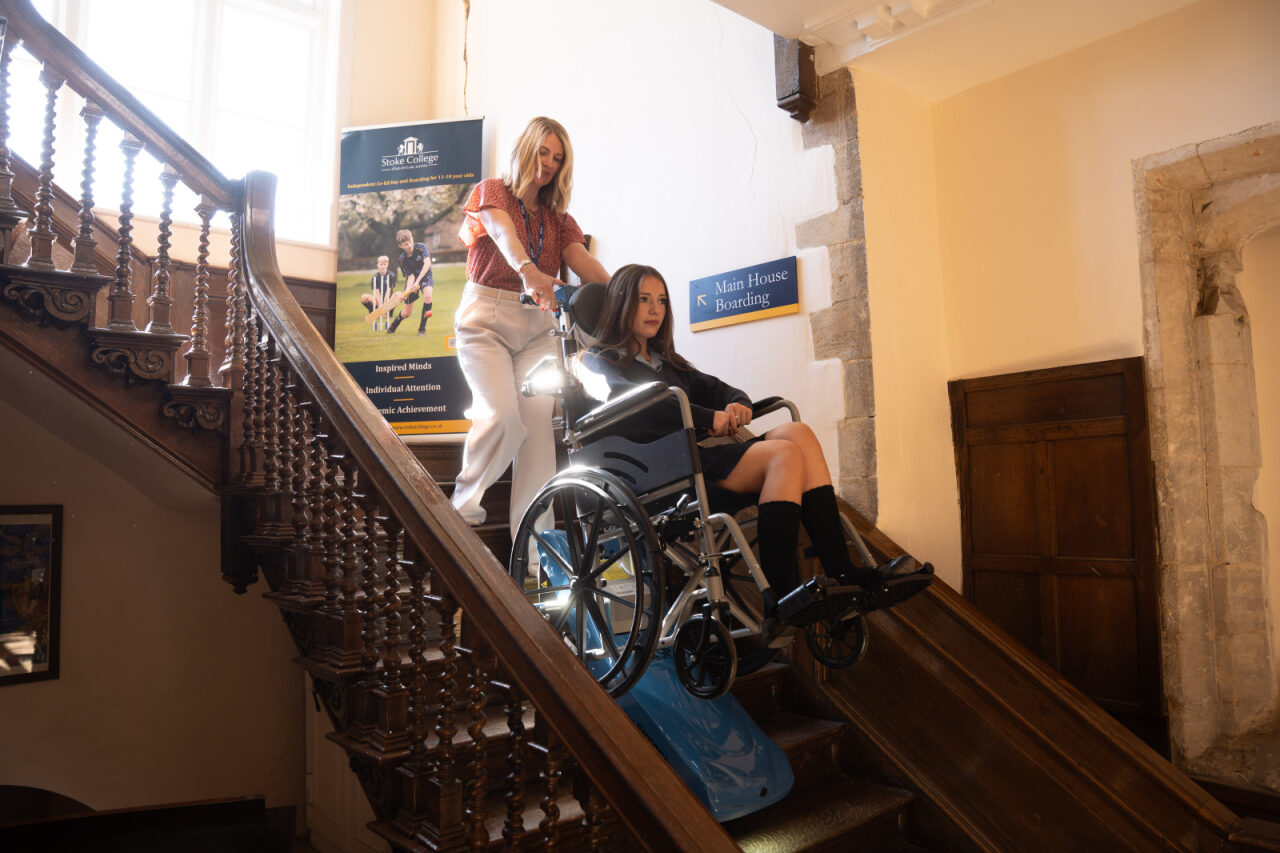
Powered stairclimbers are motorised devices designed to safely transport wheelchair users and individuals with reduced mobility up or down staircases. Unlike traditional evacuation equipment that relies heavily on operator strength, powered stairclimbers use advanced technology to provide controlled movement while reducing manual handling risks.
Many educational establishments are now choosing powered stair climbers as part of their wider accessibility and emergency evacuation strategies because they offer greater flexibility, increased user comfort and improved operator safety.
In emergency situations where lifts cannot be used, powered evacuation chairs and powered stairclimbers provide a practical route to safety for students, staff and visitors who cannot independently use stairs.
Why Emergency Evacuation Planning Is Critical in Education
Schools, colleges and universities have unique evacuation challenges. Multi-storey teaching blocks, historic buildings, sports facilities, libraries, laboratories and student accommodation can all create barriers during emergency evacuations.
London’s educational sector includes many older buildings where evacuation lifts are unavailable or limited. During a fire alarm, power failure or other emergency, staircases often become the only viable means of escape.
The Equality Act 2010 requires educational providers to make reasonable adjustments for disabled people. The Regulatory Reform (Fire Safety) Order places responsibilities on building operators to provide suitable evacuation arrangements for all occupants.
Guidance from the London Fire Brigade, the National Fire Chiefs Council and the Health and Safety Executive reinforces the need for inclusive evacuation planning that addresses the needs of wheelchair users and people with mobility impairments.
Understanding PEEPs in Schools and Universities
A Personal Emergency Evacuation Plan, or PEEP, is an individual evacuation strategy developed for a specific student, employee or regular visitor who may require assistance during an emergency.
PEEPs are particularly important for:
Students who use wheelchairs
Students with temporary injuries
Staff members with mobility impairments
Individuals with medical conditions affecting mobility
Students living in university accommodation
An effective PEEP identifies evacuation routes, designated assistants, refuge areas and evacuation equipment requirements.
Powered stairclimbers can strengthen a PEEP by providing a reliable and dignified means of evacuation. Many wheelchair users prefer solutions that allow them to remain safely supported throughout the evacuation process, reducing stress and improving confidence.
Why GEEPs Matter in Educational Environments
Generic Emergency Evacuation Plans are designed for people whose specific needs may not be known in advance.
Schools and universities regularly welcome:
Parents and guardians
Prospective students
Contractors
Visiting lecturers
Community groups
Conference attendees
Sports spectators
These visitors may require evacuation assistance but may not have a pre-arranged PEEP.
Powered stair climbers provide educational establishments with the flexibility needed to support a wide range of users. This makes them a valuable component of any GEEP strategy and helps ensure visitors can be evacuated safely regardless of their mobility requirements.
How Powered Stairclimbers Improve BEEPs
Building Emergency Evacuation Plans establish the procedures that apply to an entire facility or campus.
For multi-storey schools, colleges and universities, BEEPs must consider:
High occupancy levels
Multiple evacuation routes
Disabled access requirements
Refuge point management
Staff responsibilities
Equipment availability
Emergency response coordination
Powered evacuation chairs and powered stairclimbers can enhance BEEPs by improving evacuation efficiency and reducing reliance on physically demanding manual handling techniques.
Educational establishments that strategically position powered stairclimbers throughout their buildings can improve response times and provide greater reassurance to students, parents and staff.
Reducing Manual Handling Risks for Teachers and Support Staff
One of the most overlooked aspects of emergency evacuation planning is the risk presented to staff members responsible for assisting others.
Traditional evacuation methods can place significant strain on teachers, facilities teams and support staff. Moving an individual down several flights of stairs manually can create risks for both the evacuee and the operator.
Powered stairclimbers reduce these risks through controlled motorised operation. This allows trained personnel to focus on supporting the individual rather than managing the physical demands of the evacuation.
For schools and universities committed to staff wellbeing and health and safety compliance, powered evacuation chairs provide a significant operational advantage.
Supporting Inclusive Education Beyond the Classroom
Accessibility is often associated with teaching, learning and campus facilities. However, true inclusion extends to emergency preparedness.
Parents increasingly ask schools how disabled pupils will be evacuated during an emergency. Universities are expected to demonstrate comprehensive support for disabled students throughout every aspect of campus life.
Investing in powered stairclimbers demonstrates a commitment to inclusive education, safeguarding and student welfare. It shows that an organisation has considered not only how students access education, but also how they remain safe when unexpected situations occur.
Choosing the Right Powered Stairclimber for Your Educational Establishment
The most suitable powered stairclimber will depend on several factors including building layout, stair configuration, user requirements and emergency procedures.
Key considerations include:
The number of floors within the building
Expected user profiles
Storage requirements
Operator training requirements
Weight capacity
Frequency of use
Compatibility with existing evacuation procedures
Working with specialist providers ensures that educational establishments receive expert guidance tailored to their specific environment and risk profile.
The Stair Climbing Company is a leading UK specialist in powered stairclimbers and powered stair climbers, supporting schools, colleges, universities and public sector organisations with expert advice, demonstrations, training and ongoing support.
Learn more about powered stairclimbers and accessibility solutions at https://www.stairclimbingcompany.com
For specialist advice on evacuation planning, PEEPs, GEEPs, BEEPs and powered evacuation chairs, visit https://www.evacuationcompany.co.uk
Educational organisations can also access valuable fire safety and evacuation guidance through resources provided by the London Fire Brigade, the Health and Safety Executive, Disability Rights UK, the Fire Protection Association, the Institution of Fire Engineers and the National Fire Chiefs Council.
Future-Proofing School and University Evacuation Procedures
As educational establishments continue to improve accessibility and inclusion, evacuation planning must evolve alongside these priorities.
Powered stairclimbers are helping schools, colleges and universities move beyond basic compliance towards genuinely inclusive emergency preparedness. By integrating powered stair climbers and powered evacuation chairs into PEEPs, GEEPs and BEEPs, organisations can improve safety, reduce risk and create greater confidence among students, parents, staff and visitors.
For educational establishments across London, investing in powered stairclimbers is not simply about meeting legal requirements. It is about ensuring that every person, regardless of mobility, has a safe and effective route to safety when it matters most.