
Evacuation Chair Training in London Buildings: Turning Equipment into Real Emergency Readiness
Evacuation Training
London buildings present some of the most complex evacuation challenges in the UK. High-rise offices, listed properties, hotels, universities, schools, hospitals, residential blocks and busy public venues can all contain stairs, narrow escape routes and large numbers of people whose needs vary from one day to the next. In this environment, simply buying an evacuation chair is not enough. The equipment must form part of a properly assessed plan, and staff must know how to use it safely and confidently.
Professional evacuation chair training in London helps turn a piece of emergency equipment into a practical means of escape. It gives employees direct experience of deploying and operating the chair, helps managers test whether their arrangements are realistic and supports a more inclusive approach to fire safety.
The Evacuation Company provides specialist evacuation equipment, assessments, training and servicing throughout London. Our approach considers the building, the people using it, the chosen escape routes and the staff who will be expected to act. This joined-up service is particularly important in the capital, where no two buildings or operating environments are quite the same.
Why evacuation chairs are so important in London buildings
London combines modern towers with historic buildings, converted townhouses, complex transport-linked developments and mixed-use premises. A building in Bishopsgate may have advanced fire engineering systems and multiple tenants, while a hotel in Kensington may include narrow staircases and protected heritage features. A school, university or care setting will face a different combination of occupants, staffing patterns and assistance requirements.
In all of these settings, some people may be unable to use stairs independently during an emergency. This can include wheelchair users, people with permanent or temporary mobility impairments, older people, pregnant occupants and anyone affected by injury, illness, fatigue or anxiety. The requirement for assistance may be known in advance or may arise without warning.
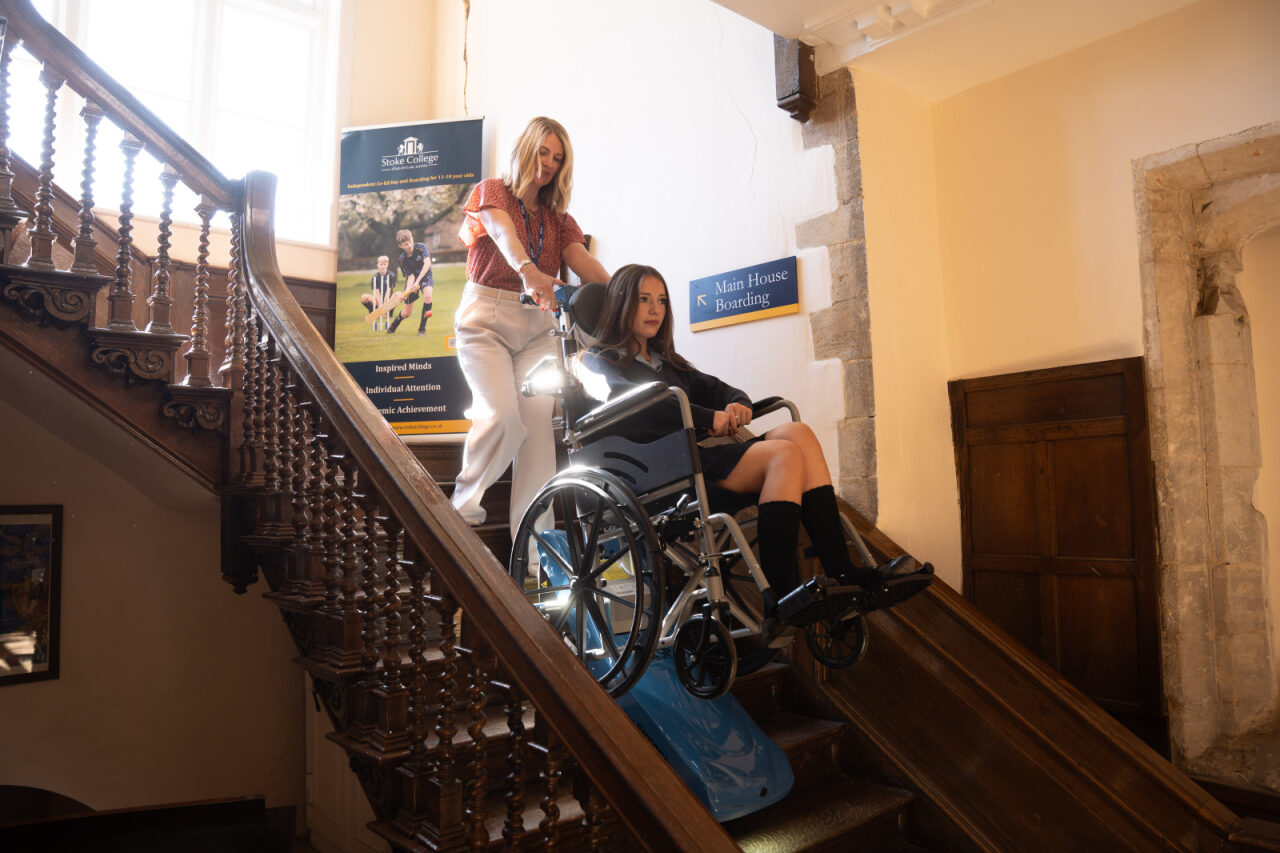
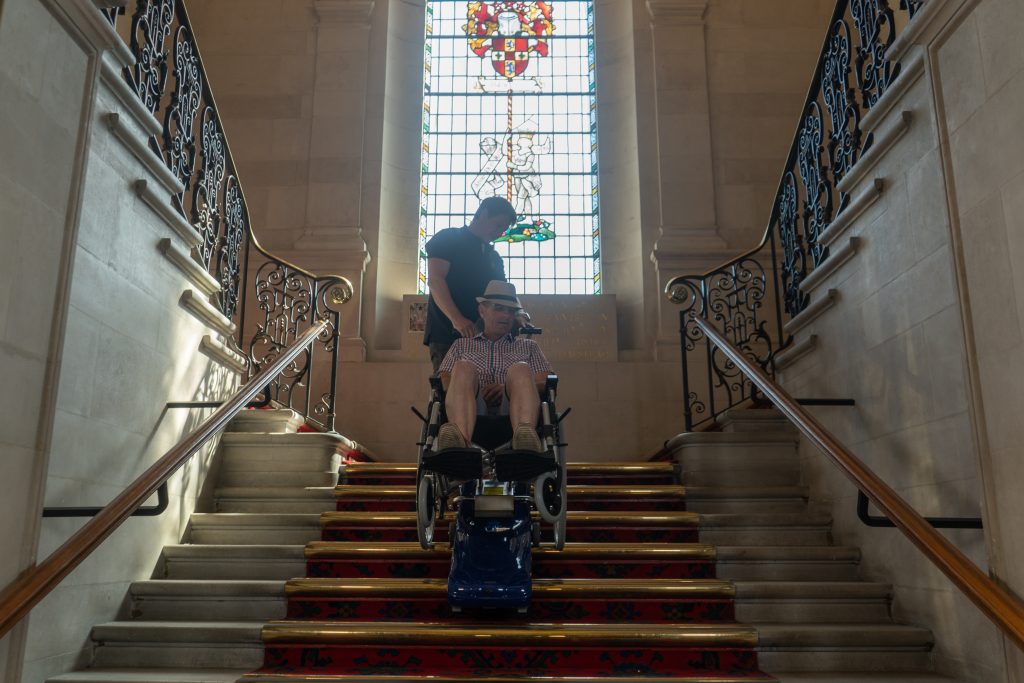
An evacuation chair can help move a person along a designated escape route when stairs form part of that route. Manual chairs commonly use friction-controlled tracks to support a steady descent. Powered Evacuation Chairs and Powered Stairclimbers may reduce some of the physical demands placed on operators and, subject to the model and assessment, can sometimes support upward as well as downward travel.
The choice must be based on the individual situation. Building managers can learn more about the available options in our complete guide to Powered Evacuation Chairs in the UK, which acts as the central pillar resource for organisations reviewing their evacuation equipment.
An evacuation chair is only one part of the plan
Installing a chair beside a staircase may look like a completed action, but it does not prove that anyone can be evacuated safely. The chair may be the wrong size for the landing, positioned too far from the likely user or unsuitable for the available operators. Staff may not know how to open it, secure the passenger or control it on the stairs. In a multi-tenanted building, nobody may be certain which organisation is responsible for providing trained operators.
The Government’s guidance on means of escape for disabled people explains that suitable evacuation arrangements are a management responsibility. Organisations should not create plans that depend on the Fire and Rescue Service arriving to carry out an evacuation that should already have been considered.
Refuges can play an important role by providing a relatively safe waiting area and a means of communication, but a refuge is not normally the final destination. The plan must establish what happens after a person reaches it, who will communicate with them and how they will continue to a place of safety if evacuation becomes necessary.
The legal context for London premises
The Regulatory Reform (Fire Safety) Order 2005 is central to fire safety in non-domestic premises and the relevant common parts of many residential buildings in England and Wales. It requires the responsible person to carry out a suitable and sufficient fire risk assessment and implement appropriate precautions. The assessment must consider people who may be especially at risk.
The Equality Act 2010 is also relevant to many London organisations. Its requirements concerning disability discrimination and reasonable adjustments reinforce the need to consider access and safety inclusively. A person should not be placed at an avoidable disadvantage simply because they cannot use a conventional staircase without assistance.
Where evacuation chairs are supplied for use at work, the Provision and Use of Work Equipment Regulations 1998 may apply. PUWER addresses the suitability, maintenance and inspection of work equipment, together with information, instruction and training. A certificate alone is not enough. The organisation must be able to show that its equipment is appropriate, maintained and used by people with suitable knowledge and capability.
London also contains a very large number of high-rise and multi-occupied residential buildings. The Fire Safety (Residential Evacuation Plans) (England) Regulations 2025, in force from 6 April 2026, introduce specific duties for certain residential buildings. They apply to high-rise residential buildings and to multi-occupied residential buildings over 11 metres where a simultaneous evacuation strategy is in place.
The London Fire Brigade has published specific guidance on Residential PEEPs. It provides a valuable reference for responsible persons, although professional advice should always reflect the precise building, evacuation strategy and legal duties involved.
PEEPs, RPEEPs, GEEPs and BEEPs in London buildings
A Personal Emergency Evacuation Plan, or PEEP, records the arrangements for an identified person who may need help to reach safety. A good PEEP is developed with the individual rather than imposed upon them. It considers their abilities, preferences, working or living location, alarm communication, escape route, assistance and any equipment that may be required.
Residential PEEPs, often shortened to RPEEPs, relate to the new statutory arrangements for relevant residents in specified residential buildings. The associated person-centred fire risk assessment and emergency evacuation statement should lead to practical and proportionate measures. An evacuation chair may be part of the solution, but it should never be selected without considering transfer, operator availability, storage, maintenance and the actual escape route.
A General Emergency Evacuation Plan, or GEEP, supports environments where the needs of visitors may not be known in advance. London hotels, museums, theatres, shopping destinations, event spaces and public offices need a way to help people who arrive without a pre-existing individual plan. Staff should know how a visitor can request assistance and what resources are available.
A Building Emergency Evacuation Plan, or BEEP, records building-wide arrangements. Under the 2025 residential regulations, specified information must be prepared, reviewed and shared in the required way. The BEEP connects the overall strategy with the presence of relevant residents and other evacuation provisions within the building.
These documents should not sit in isolation. PEEPs, RPEEPs, GEEPs and BEEPs must connect with the fire risk assessment, staff responsibilities, equipment provision, training, drills and servicing. The Evacuation Company helps clients translate these terms into a coordinated system that can work under real pressure.
What evacuation chair training in London should achieve
Effective training should give staff both understanding and practical ability. Delegates need to know why the chair has been provided, where it fits into the evacuation strategy and what its limitations are. They should then practise using the exact equipment installed at the premises wherever possible.
A professional session covers safe deployment, pre-use checks, the chair’s controls and safety features, communication with the passenger, positioning, movement across level floors, the approach to stairs and controlled travel along the designated route. The details vary between products, which is why training on one brand or model cannot automatically be treated as competence on every evacuation chair.
Training should also test staffing assumptions. London premises often operate beyond normal office hours. Cleaners, security staff, night teams, contractors and event staff may be present when the usual fire wardens are not. Hybrid working can make daily attendance unpredictable. A training plan must therefore create adequate coverage for the way the building is actually occupied.
Manual and powered evacuation solutions
Traditional manual evacuation chairs remain a valuable option in many London buildings. They are compact, straightforward to store and effective for controlled downward movement when the staircase, passenger and trained operators are suitable. For straightforward routes and organisations with reliable staffing, they can provide a practical and cost-effective solution.
Powered Evac Chairs offer a different range of benefits. Motorised track systems may provide greater control, reduce operator effort and assist with more demanding journeys. Powered Stairclimbers may be particularly relevant where upward evacuation is required from a basement, where the person needs to remain in their own wheelchair or where a long route makes a manual solution impractical.
Powered equipment is not automatically right for every building. It can be heavier, require sufficient manoeuvring space and depend on battery management. The operators still require high-quality training, and storage and charging must be incorporated into routine checks. Equally, a manual chair should not be chosen simply because it is familiar or less expensive if the real evacuation task exceeds what staff can safely deliver.
London offices and high-rise commercial buildings
Commercial centres such as the City of London, Canary Wharf, Bishopsgate, Liverpool Street, Broadgate and the West End include complex buildings with multiple employers, visitors and contractors. Responsibility can become blurred when tenants assume that the landlord or facilities-management team will provide everything required.
High-rise buildings may have specially designed evacuation lifts as part of their strategy. These are different from ordinary passenger lifts and may support the evacuation of disabled occupants when used under the building’s planned procedures. A standard statement that lifts can never be used in a fire is therefore too simplistic. The correct arrangement must be confirmed by the building’s fire strategy and competent advisers.
Hotels, education, healthcare and heritage properties
London hotels face the challenge of supporting guests whose needs may only become known at check-in or during an incident. Reception and night staff need a clear process for recording assistance requirements and connecting them to practical emergency arrangements. A chair locked in a cupboard several floors away is not a meaningful solution.
Universities and schools may operate across historic and modern buildings, with changing timetables, events and large visitor populations. Healthcare and care environments must consider people with complex physical, cognitive or medical needs. Heritage properties can introduce narrow stairs, tight turns and restrictions on structural alterations. In every case, equipment and training must be matched to the actual people, premises and operating hours.
Training must be supported by servicing and drills
Staff competence and equipment readiness are inseparable. A well-trained operator cannot rely on a chair with damaged tracks, worn restraints, faulty wheels or an unmaintained battery. Chairs should be checked, inspected and serviced in accordance with the manufacturer’s information, the fire risk assessment and applicable work-equipment duties.
Regular drills allow managers to test communication, staffing and route assumptions. They can reveal that a nominated operator works from home on particular days, a landing has become obstructed or a new access-control door changes the planned route. Exercises should be designed carefully and should not expose a disabled participant to unnecessary transfers or stair travel merely to demonstrate activity.
Why The Evacuation Company excels in London
The Evacuation Company understands the pace, variety and complexity of London buildings. We provide a complete service that brings together equipment access audits, PEEPs, GEEPs, RPEEPs and BEEPs, manual and powered equipment, evacuation chair training and ongoing servicing.
Our trainers work with the actual environment and equipment wherever possible. This makes the session relevant to the people who will be expected to act. We can train staff on suitable existing chairs as well as equipment supplied by us, helping clients obtain genuine value from what is already installed while identifying products that are no longer dependable or appropriate.
We offer group instruction, one-to-one support and train-the-trainer programmes. This flexibility helps single premises, multi-tenanted buildings and organisations operating across several London sites establish the right level of internal capability. Training is practical, engaging and focused on safe performance rather than simply issuing certificates.
Our experience in both access and evacuation also gives us a wider understanding of powered mobility equipment. Working alongside the expertise developed through The Stair Climbing Company, we can consider conventional Evacuation Chairs, Powered Evacuation Chairs and non-transfer Powered Stairclimbers rather than approaching every situation with one predetermined product.
For clients seeking evacuation chair training in London quotes, we provide clear advice based on the number of chairs, equipment type, location, staff numbers and preferred training model. Competitive pricing matters, but it must be matched by high training standards, knowledgeable instructors and support that continues after the course.
Build a safer evacuation strategy today
London buildings cannot afford to treat evacuation equipment as a wall-mounted symbol of compliance. An effective plan requires appropriate equipment, trained people, clear responsibilities, inclusive communication, dependable maintenance and regular review.
The Evacuation Company helps facilities managers, responsible persons, landlords, employers and education, hospitality, healthcare and heritage organisations create evacuation arrangements that are both compliant and workable. Whether you need a first assessment, replacement equipment, Powered Evac Chairs, refresher training, servicing or a wider review of PEEPs, RPEEPs, GEEPs and BEEPs, our specialists can help.
Book Evacuation Training in London or contact The Evacuation Company for a free assessment and take the next step towards a safer, more inclusive building.
Key Takeaways
- Evacuation chair training in London is crucial for using emergency equipment effectively during complex evacuations.
- It ensures staff are familiar with operating evacuation chairs and aware of their limitations within varied building environments.
- A comprehensive evacuation strategy must involve proper assessment, regular training, and the maintenance of evacuation equipment.
- Legal requirements, such as the Equality Act and fire safety regulations, emphasize the need for inclusive evacuation plans.
- The Evacuation Company offers tailored training and support, helping organizations develop effective evacuation strategies for London buildings.
Estimated reading time: 11 minutes
Table of contents
- Evacuation Chair Training in London Buildings: Turning Equipment into Real Emergency Readiness
- Evacuation Training
- Why evacuation chairs are so important in London buildings
- An evacuation chair is only one part of the plan
- The legal context for London premises
- PEEPs, RPEEPs, GEEPs and BEEPs in London buildings
- What evacuation chair training in London should achieve
- Manual and powered evacuation solutions
- London offices and high-rise commercial buildings
- Hotels, education, healthcare and heritage properties
- Training must be supported by servicing and drills
- Why The Evacuation Company excels in London
- Build a safer evacuation strategy today