

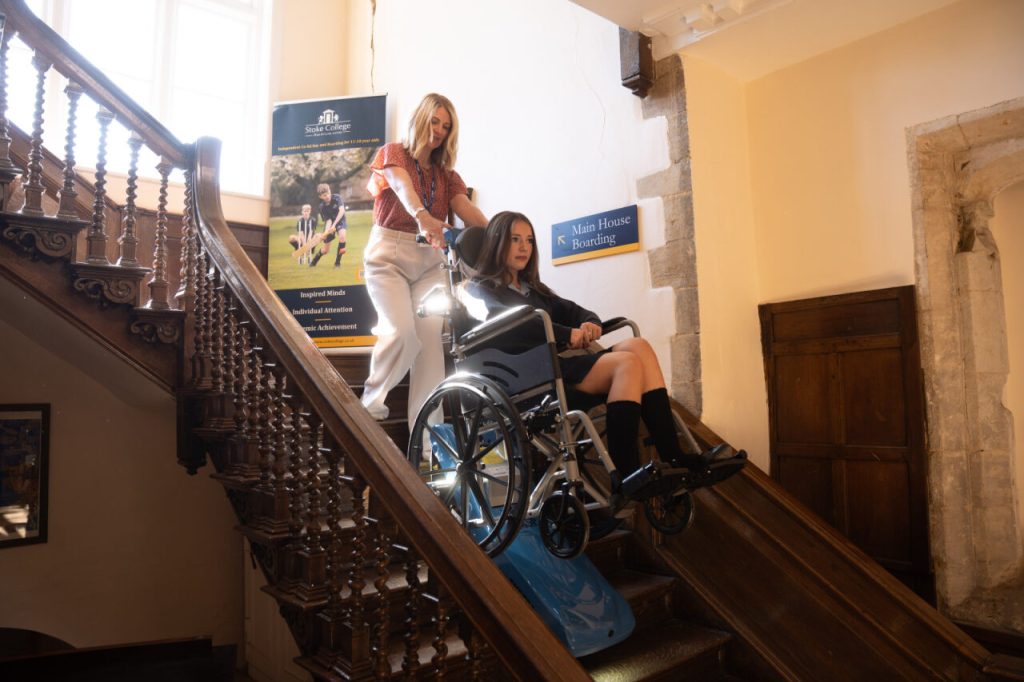
School Evacuation Has Changed: Why Powered Stair Climbers Are Becoming Essential in Modern Schools
There has never been a greater focus on pupil safety than there is today. Schools across England have invested heavily in safeguarding, wellbeing, accessibility and emergency planning to ensure every child has the opportunity to learn in a safe and inclusive environment. While much of the conversation has centred on fire alarms, evacuation procedures and building compliance, another discussion is beginning to gather momentum. Schools are asking whether traditional evacuation methods are still enough or whether modern technology can provide a safer and more practical solution.
Powered Stair Climbers are becoming a significant part of that conversation.
For decades, schools have relied on evacuation chairs to assist people with reduced mobility during emergencies. They remain an important piece of equipment and continue to play an essential role within many evacuation strategies. However, education has changed considerably. Schools now educate more pupils with complex physical disabilities, more students use powered wheelchairs and specialist seating systems, and more schools are committed to ensuring disabled pupils enjoy the same educational experiences as everyone else.
This change means accessibility should not begin when an emergency starts. Accessibility should be considered every day.
A Powered Stairclimber helps schools achieve exactly that.
Rather than remaining locked away until a fire alarm sounds, modern Powered Stair Climbers can become part of everyday school life. They allow trained members of staff to support wheelchair users throughout the building whenever access is required. During lift maintenance, building refurbishment or timetable changes, the same equipment that protects pupils during an emergency can continue supporting inclusion every day of the school year.
This represents a significant shift in thinking.
Instead of purchasing equipment solely for compliance, schools are investing in technology that improves accessibility while strengthening emergency preparedness at the same time.
Across England, many schools continue to occupy buildings that were never designed for modern accessibility. Victorian primary schools, Edwardian grammar schools and post war secondary schools often contain multiple staircases, split level corridors and teaching spaces spread across several floors. Installing passenger lifts throughout these buildings is not always practical, while permanent structural alterations can be prohibitively expensive.
Powered Stair Climbers provide another option.
Because they are portable, they can be used on different staircases throughout the school. One piece of equipment can support several areas of the building rather than being permanently fixed to a single location. For academy trusts managing multiple sites, this flexibility is becoming increasingly attractive.
The Department for Education continues to encourage schools to create environments where every child has the opportunity to participate fully in education. Information on inclusive education and school guidance is available through https://www.gov.uk/government/organisations/department-for-education.
Creating an accessible school is about much more than meeting legislation. It is about ensuring every pupil feels valued, included and able to participate alongside their classmates.
Parents also expect reassurance.
When families choose a school, they want confidence that accessibility has been carefully considered. They want to know their child will not be excluded from lessons because a classroom is located upstairs. They want reassurance that emergency procedures have been planned carefully and that staff have the knowledge and equipment to respond effectively.
Powered Stair Climbers help schools provide that reassurance.
Modern systems reduce the physical effort required from trained operators while providing a smoother and more controlled journey for wheelchair users. This creates a better experience for both pupils and staff.
The importance of manual handling should never be underestimated.
During an emergency, staff may already be responsible for directing hundreds of pupils towards assembly points while maintaining calm throughout the building. Asking those same individuals to carry out physically demanding manual handling tasks increases pressure at precisely the moment clear decision making is needed.
Powered Stairclimbers reduce much of that physical demand.
Battery powered assistance enables trained operators to concentrate on communication, reassurance and safe movement rather than relying solely on physical strength.
The Health and Safety Executive continues to provide guidance on safe manual handling and workplace risk assessment through https://www.hse.gov.uk.
These principles are just as relevant within education as they are within any other workplace.
Another important consideration is familiarity.
Equipment that is only used once every few years during training can quickly become unfamiliar. Confidence naturally decreases if operators have little practical experience.
Powered Stair Climbers encourage regular use because they support everyday accessibility as well as emergency evacuation.
Staff gain confidence through practical experience.
Pupils become familiar with the equipment.
The school develops a culture where accessibility is viewed as part of everyday education rather than something reserved for emergency situations.
This is particularly valuable within specialist schools supporting children with physical disabilities.
Many pupils rely upon customised wheelchairs or specialist seating systems designed specifically for their clinical needs. Remaining within familiar seating whenever possible can improve comfort while reducing anxiety.
Modern Powered Stair Climbers can often accommodate a wide range of wheelchair types, allowing many pupils to remain comfortably within their own wheelchair while moving around the building.
Occupational therapists recognise the importance of matching accessibility solutions to the needs of the individual rather than expecting every individual to adapt to one standard solution.
This person centred approach reflects the wider principles of inclusive education.
School evacuation planning also continues to evolve.
Personal Emergency Evacuation Plans, commonly known as PEEPs, remain an essential part of supporting individuals who may require assistance during an emergency. Schools are increasingly reviewing these plans to ensure they reflect the realities of modern buildings and modern equipment rather than simply existing as documents on file.
Residential schools may also require Residential Personal Emergency Evacuation Plans for pupils who live on site.
The National Fire Chiefs Council provides useful information relating to fire safety and evacuation through https://www.nationalfirechiefs.org.uk while the Fire Industry Association offers additional technical guidance at https://www.fia.uk.com.
Schools are increasingly recognising that effective evacuation planning involves much more than selecting equipment.
It requires understanding the building, identifying individual needs, training staff, maintaining equipment and reviewing procedures regularly.
Powered Stair Climbers become one important part of that wider strategy.
Rather than replacing good planning, they strengthen it.
This is one reason why discussions about school accessibility increasingly include estates managers, responsible persons, occupational therapists, health and safety professionals and fire risk assessors working together.
The best outcomes are achieved when accessibility and fire safety are considered as part of the same conversation rather than separate responsibilities.
That collaborative approach is shaping the future of education throughout England.
Key Takeaways
- Schools prioritize pupil safety and accessibility, leading to a shift towards modern solutions like Powered Stair Climbers.
- Powered Stair Climbers enhance everyday accessibility and improve emergency preparedness, moving beyond traditional evacuation chairs.
- These devices support schools in managing complex physical disabilities and ensure that all pupils can participate fully.
- Trained staff gain confidence and experience with regular use, making emergencies less stressful for both staff and students.
- Collaboration among various professionals is key to effective evacuation planning, integrating accessibility measures with fire safety protocols.
Estimated reading time: 6 minutes