

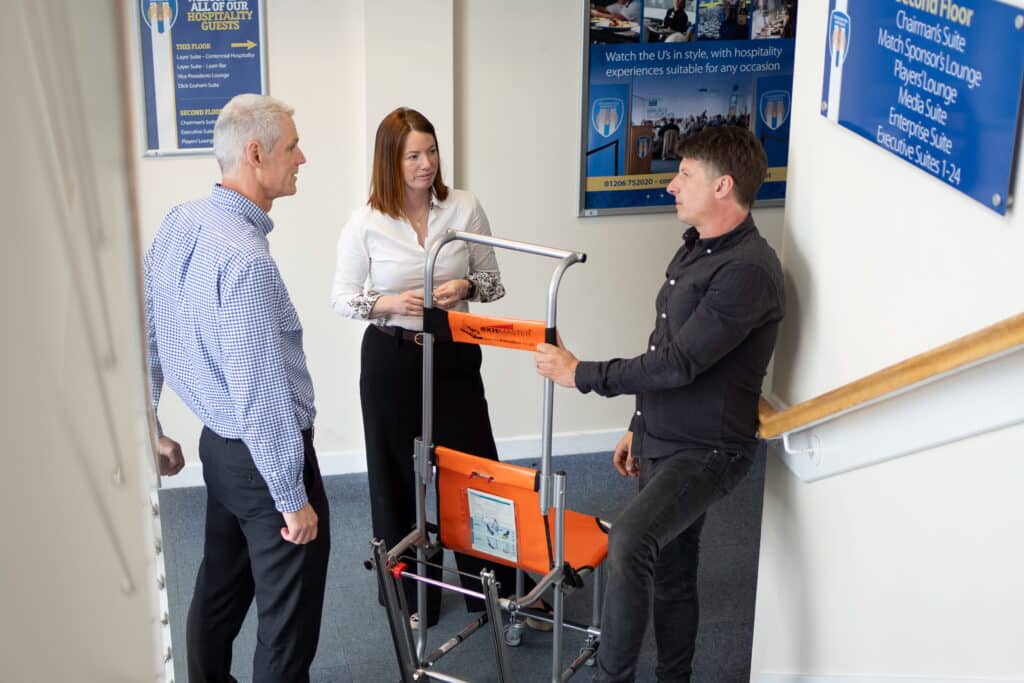
Evacuation Chair Training in Birmingham: Practical Preparation for Safer Buildings
Looking for evacuation chair training in Birmingham? Book practical training with The Evacuation Company or contact our specialists for a free assessment. We provide professional evacuation chair training, equipment assessments, servicing and inclusive evacuation support throughout Birmingham and the West Midlands.
Birmingham is a city of busy offices, universities, hospitals, hotels, schools, shopping centres, entertainment venues and residential developments. Its building stock ranges from modern city-centre towers to historic properties and converted industrial premises. These varied environments create very different fire-safety and evacuation challenges.
When stairs form part of an escape route, some building users may be unable to reach safety without assistance. This can include wheelchair users, people with permanent or temporary mobility impairments, older people, pregnant occupants and anyone affected by injury, illness or fatigue. An evacuation chair can form an important part of the solution, but equipment alone does not create a reliable evacuation procedure.
The chair must be appropriate for the person and route, maintained in a usable condition and supported by trained staff who understand how to act. Professional evacuation chair training in Birmingham gives employees the practical knowledge and confidence needed to turn a wall-mounted chair into a working part of the emergency plan.
The Evacuation Company is one of Birmingham’s top specialist providers of evacuation chair training and inclusive evacuation support. We work with organisations across education, hospitality, commercial property, healthcare, heritage and the public sector. Our joined-up service can include equipment assessments, PEEPs, GEEPs, training, servicing and powered evacuation solutions, allowing the complete procedure to be considered rather than focusing on a single product.
For a detailed introduction to equipment, planning and powered technology, read our complete guide to Powered Evacuation Chairs in the UK. This pillar guide explains how traditional and powered evacuation solutions can support safer, more inclusive buildings.
Why Birmingham organisations need practical evacuation chair training
Fire emergencies are unfamiliar, noisy and stressful. Staff may need to respond quickly while alarms sound, people move through escape routes and information remains incomplete. If an operator has only seen an evacuation chair demonstrated once, they may struggle to deploy it, secure the passenger or control it safely on stairs.
The Health and Safety Executive’s guidance on emergency procedures explains that people are more likely to respond reliably when they are trained and competent, participate in realistic practice and work to clearly agreed and rehearsed plans. It also stresses the need to consider disabled people and vulnerable workers.
Effective evac chair training in Birmingham must therefore involve supervised practice. Delegates should handle the actual equipment they may be expected to use. They need to learn how to remove it from storage, open it correctly, complete basic checks, prepare it for the passenger and maintain control on the designated staircase.
Good training also addresses communication and dignity. The person being assisted should be told what is happening and involved in planning wherever possible. Operators must understand that not everyone can transfer safely into a standard chair and that individual medical, postural, sensory or communication needs may affect the procedure.
The purpose is not to encourage improvised action. It is to build a method that has been assessed, discussed, practised and incorporated into the building’s emergency arrangements.
Birmingham’s varied buildings need tailored solutions
A modern office near Colmore Row will not face the same evacuation challenges as a converted Jewellery Quarter workshop, a Digbeth events venue, a university building or a city hotel. Stair widths, landing sizes, protected routes, occupancy levels and staffing arrangements can vary considerably.
Many Birmingham premises are also multi-tenanted. The landlord, managing agent, employers and contractors may all hold different responsibilities. An evacuation chair could be installed in a shared area while nobody is certain who will operate it, who arranges servicing or how tenants coordinate during an alarm.
Site-specific training helps resolve these practical questions. The trainer can consider where the equipment is located, whether operators can reach it promptly, how it will be brought to the person requiring assistance and whether every stage of the planned route is usable. Where a route covers several floors, the number and capability of available operators must also be realistic.
The Government’s guidance on means of escape for disabled people explains that suitable arrangements are a management responsibility. A plan should not depend on the Fire and Rescue Service arriving to undertake an evacuation that the responsible person should already have considered.
The Evacuation Company takes this wider view. We connect training to the building, its users, the evacuation plan and the selected equipment. This makes the session relevant to the people who may actually need to put it into practice.
What should evacuation chair training include?
Professional evacuation chair training should begin by explaining where the chair fits within the fire strategy. Staff need to know which route has been selected, how assistance will be requested, who is expected to respond and where the person will be taken after leaving the staircase.
The practical session should cover safe deployment, visual checks, passenger preparation, restraints, operating position and controlled movement on stairs. Delegates should understand how to coordinate when more than one person is involved and what to do if equipment does not appear safe or the planned route becomes unavailable.
The course should also explain the chair’s limits. A manual evacuation chair may be effective for controlled downward travel, but it will not suit every passenger or staircase. Training cannot make an unsuitable transfer safe, create space on an undersized landing or replace a missing assessment.
Operators need sufficient supervised practice to build familiarity. They should be able to ask questions and repeat key stages rather than simply watch the trainer. Afterwards, the organisation should record who attended, which chair was used and whether any delegate requires further support.
Article 21 of the Regulatory Reform (Fire Safety) Order 2005 requires adequate safety training when employees start work and when they encounter new or increased risks. Training should also be repeated periodically where appropriate. Evacuation chair instruction is therefore best treated as part of a continuing safety system rather than a one-off certificate.
PEEPs, GEEPs and inclusive evacuation planning
A Personal Emergency Evacuation Plan, or PEEP, sets out how a particular person will reach a place of safety. It may cover alarm information, communication, assistance, equipment, transfers, refuges, escape routes and the staff needed to carry out the plan.
The individual should be consulted throughout the process. Two people who appear to have similar mobility needs may require completely different arrangements. One person may transfer confidently into a manual evacuation chair. Another may depend on specialist seating or be unable to transfer without risk, making a non-transfer powered solution more appropriate.
PEEPs also need to consider working patterns. A procedure that depends on two trained colleagues is unreliable if those colleagues are not present during evenings, weekends or hybrid-working days. Birmingham hotels, healthcare settings, residential buildings and entertainment venues must account for changing occupants and staffing levels throughout the day.
A General Emergency Evacuation Plan, commonly known as a GEEP, supports visitors whose needs are not known in advance. It should explain how a person can request help, what assistance is available, where accessible information can be found and which staff roles will respond.
The Government’s guide for people with duties under fire-safety legislation provides a useful overview for responsible persons. The West Midlands Fire Service fire-risk-assessment guidance also outlines the importance of identifying hazards, protecting people and keeping the assessment under review.
The Evacuation Company can help organisations connect PEEPs and GEEPs with suitable equipment and staff training. This ensures that written plans reflect the building and are understood by the people expected to carry them out.
Manual or powered evacuation equipment?
Manual evacuation chairs remain an effective option in many Birmingham buildings. They are generally compact, simple to store and suitable for controlled downward movement when the person, route and operators have been assessed.
They are not the only option. Basement workplaces, underground teaching areas, theatres and some transport-linked environments may require people to travel upwards to reach safety. High-rise routes can also be physically demanding, particularly when several building users require assistance or when staff capability is limited.
A Powered Evacuation Chair or Powered Stairclimber may offer a better solution in these situations. Motorised assistance can reduce physical demand and support controlled movement, with some equipment capable of travelling both up and down stairs. Certain non-transfer systems can attach to a compatible wheelchair so the user does not have to move into a separate chair.
Powered equipment does not remove the need for planning or training. Operators must learn the controls, safe positioning, attachment procedure and battery management. The equipment must fit the entire route and be charged, checked and accessible when required.
Our Powered Evacuation Solutions service covers equipment for straight, curved, indoor and outdoor stairs. Because The Evacuation Company supports both manual and powered options, our recommendations are based on the building and the people using it rather than a predetermined product.
Why refresher training and drills matter
Evacuation-chair competence can fade when equipment is rarely used. Staff move roles, new employees join and the details of a procedure are forgotten. Refresher training helps operators rebuild familiarity and gives the organisation an opportunity to address changes.
Further training may be required after refurbishment, a revised escape route, the installation of different equipment or a change to a person’s PEEP. Multi-site organisations should also check whether staff are familiar with the different chair models and layouts they may encounter.
Drills test the wider system. They can reveal delays in contacting trained operators, uncertainty about responsibilities, restricted access to equipment or problems with the route. Any lessons should be recorded and used to update the risk assessment and emergency plan.
Practice must remain proportionate and respectful. Disabled employees, residents or students should not be expected to undergo repeated transfers or stair descents simply to prove that a drill has occurred. Training aids, volunteers and carefully designed simulations can test many parts of the procedure without placing a person at unnecessary risk.
Servicing keeps evacuation equipment ready
An evacuation chair may remain unused for long periods. That does not mean it can be ignored. Tracks, belts, buckles, brakes, wheels and frames may deteriorate, while powered units depend on batteries, chargers and controls remaining serviceable.
Regular visual checks help identify obvious damage, missing parts, poor storage or a flat battery. Planned servicing provides a more thorough examination and should follow the manufacturer’s instructions. Where the equipment is used at work, the HSE’s guidance on the Provision and Use of Work Equipment Regulations is relevant to suitable work equipment, maintenance, inspection and operator training.
The Evacuation Company can train and service suitable existing chairs as well as equipment supplied by us. This is particularly useful for organisations that have inherited several models across a property portfolio and are unsure whether they remain reliable or appropriate.
Combining training with servicing also helps establish clear ownership. Staff know who manages the equipment, how defects are reported and when the next formal inspection or course review is due.
Why choose The Evacuation Company in Birmingham?
The Evacuation Company stands out as a top provider of evacuation chair training in Birmingham because we consider the complete evacuation arrangement. We do not simply demonstrate a chair and leave the client to work out how it fits the building.
Our training can be provided for groups, individuals and internal trainers. We work with suitable existing equipment and can recommend traditional or powered replacements where the current provision no longer meets the need. Sessions are practical, engaging and focused on building usable confidence.
We also provide equipment access audits, PEEPs, GEEPs, powered evacuation solutions, hire, servicing and ongoing advice. For facilities managers, responsible persons, schools, universities, hotels, healthcare providers and managing agents, this creates one knowledgeable partner for the key elements of inclusive evacuation.
Our broad experience helps us adapt to Birmingham’s different settings. A high-rise commercial building, a heritage venue, a school and a care environment should not receive identical advice. Each organisation needs a solution based on its occupants, staffing patterns, stairs, escape strategy and operational pressures.
Above all, we keep the person at the centre of the plan. Effective evacuation is not only about compliance. It is about making sure people are not left behind because a foreseeable need was never translated into a workable procedure.
Book evacuation chair training in Birmingham
If your organisation owns evacuation chairs but staff are unsure how to use them, the system is incomplete. The same is true when trained operators have left, records are out of date, equipment has changed or a PEEP relies on a method that has never been tested.
The Evacuation Company can review your existing provision, train your people and help integrate equipment, procedures, staffing and servicing. Whether you manage one Birmingham site or multiple premises across the West Midlands, we can develop a proportionate approach around your real requirements.
Book evacuation chair training in Birmingham or contact The Evacuation Company for a free assessment today. Build staff confidence, strengthen your emergency arrangements and provide a safer route to evacuation for everyone who uses your building.
Key Takeaways
- Evacuation chair training in Birmingham is essential for staff to assist individuals with mobility challenges during emergencies.
- The Evacuation Company offers practical training, assessments, and inclusive evacuation support tailored to various building types.
- Professional training includes hands-on practice with equipment and emphasizes communication, dignity, and site-specific solutions.
- Regular refresher training, drills, and proper maintenance ensure that evacuation procedures remain effective and reliable.
- For comprehensive support, contact The Evacuation Company to enhance your building’s evacuation strategies and staff preparedness.
Estimated reading time: 11 minutes
Table of contents
- Evacuation Chair Training in Birmingham: Practical Preparation for Safer Buildings
- Why Birmingham organisations need practical evacuation chair training
- Birmingham’s varied buildings need tailored solutions
- What should evacuation chair training include?
- PEEPs, GEEPs and inclusive evacuation planning
- Manual or powered evacuation equipment?
- Why refresher training and drills matter
- Servicing keeps evacuation equipment ready
- Why choose The Evacuation Company in Birmingham?
- Book evacuation chair training in Birmingham