
When it comes to safely moving people on stairs, especially during emergencies or in buildings without lift access, the terminology can quickly become confusing. Terms like stair climber, powered evacuation chair, and evacuation chair are often used interchangeably — but they are designed for very different purposes.
In this guide, we’ll break down the differences, explain when each solution should be used, and help you understand which option is best for different environments and users.
Key Takeaways
- Stair climbers are designed for everyday accessibility, allowing wheelchair users to move up and down stairs safely.
- Evacuation chairs are specifically for emergency situations and primarily serve to move individuals downstairs.
- Powered evacuation chairs enhance safety with battery assistance and can be used for both evacuation and transport.
- Choosing the right mobility device depends on user needs, building requirements, and the frequency of use.
- Understanding the differences between evacuation chairs, powered evacuation chairs, and stair climbers improves safety and accessibility.
Estimated reading time: 6 minutes
Watch the Video Comparison
The following video by Chris from The Stair Climbing Company provides an excellent visual explanation of the differences between these three mobility solutions:
The video compares how each device operates, who it is designed for, and the environments where it performs best. (YouTube)
What Is an Evacuation Chair?
An evacuation chair is a lightweight device specifically designed to move mobility-impaired individuals down stairs during an emergency. These chairs are commonly found in:
- Offices
- Hospitals
- Schools
- Hotels
- Public buildings
Traditional evacuation chairs use friction belts or tracks to control descent down staircases safely and smoothly. Most models are manually operated and designed primarily for emergency evacuation situations such as fires or power outages. (YouTube)
Key Features of Evacuation Chairs
- Manual operation
- Designed mainly for downward evacuation
- Lightweight and foldable
- Wall-mounted for rapid deployment
- Typically used only in emergencies
- Usually require trained operators
Advantages
Simple and Reliable
Because they are mechanical rather than powered, standard evacuation chairs are dependable and easy to maintain.
Fast Emergency Deployment
Most models can be deployed within seconds and stored discreetly when not in use. (YouTube)
Cost Effective
They are generally the most affordable evacuation solution for buildings needing emergency evacuation compliance.
Limitations
Downward Movement Only
Most standard evacuation chairs are designed only for descending stairs.
Physical Effort Required
The operator still needs confidence and physical capability to manage the chair safely.
Not Ideal for Everyday Use
These chairs are emergency tools, not daily accessibility devices.
What Is a Powered Evacuation Chair?
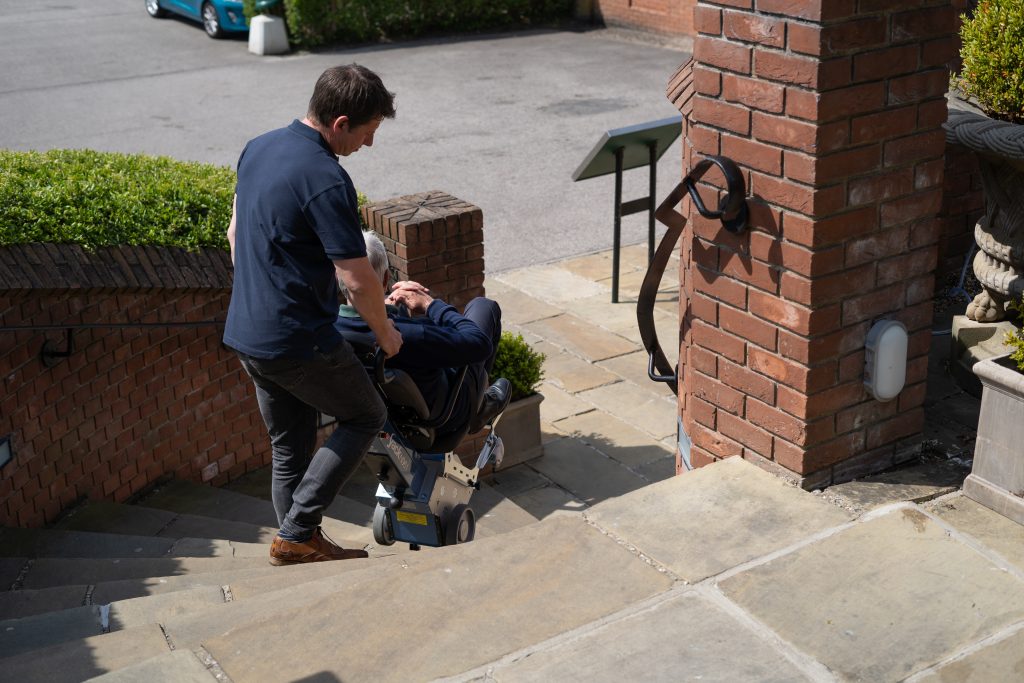
A powered evacuation chair combines the emergency functionality of a traditional evac chair with battery-powered assistance.
These chairs use motorised tracks or powered systems to reduce operator strain and improve safety during stair descent — and in some cases ascent. (Evacuation Chairs by Evac+Chair)
Powered evacuation chairs are becoming increasingly popular in:
- Hospitals
- Care homes
- Airports
- High-rise buildings
- Facilities with heavier users or complex stairways
Key Features of Powered Evacuation Chairs
- Battery-powered operation
- Reduced manual handling
- Enhanced control on stairs
- Can often travel both up and down stairs
- Suitable for more frequent use
- Higher passenger weight capacities
Advantages
Reduced Physical Strain
The powered tracks do much of the work, making operation easier and safer for staff. (Evacuation Chairs by Evac+Chair)
Improved Safety
Motorised braking and controlled movement help reduce the risk of slips or sudden movement.
Greater Versatility
Many powered models can be used for both evacuation and non-emergency patient transport.
Limitations
Higher Cost
Powered systems are more expensive than manual evacuation chairs.
Requires Battery Maintenance
Regular charging and servicing are essential.
Heavier Equipment
Powered models tend to weigh more and may require additional storage considerations.
What Is a Stair Climber?
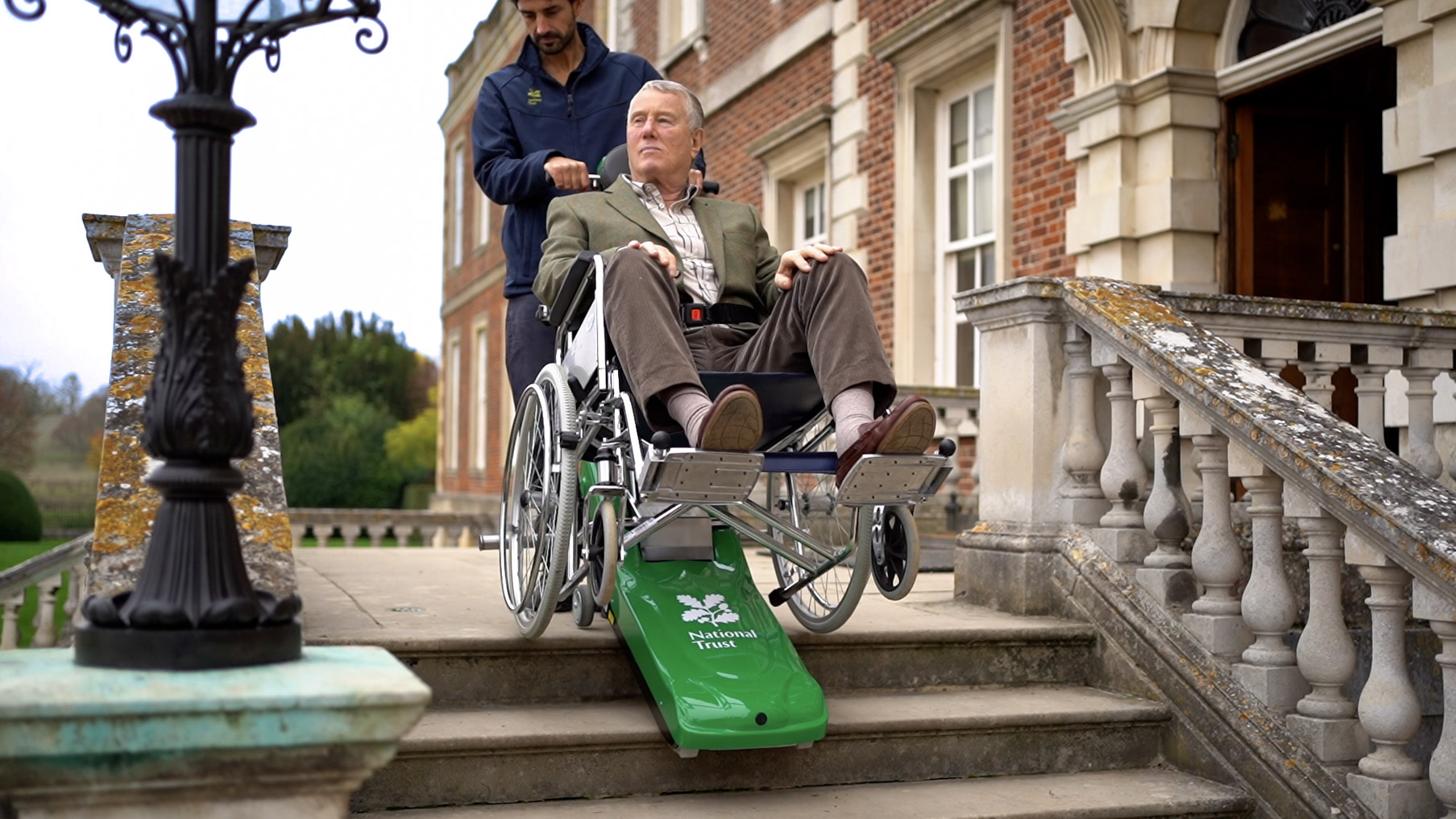
A stair climber is different from both evacuation chairs and powered evacuation chairs because it is designed primarily for everyday accessibility, not just emergencies.
Stair climbers are powered mobility devices that transport wheelchair users up and down stairs safely while remaining seated in their own wheelchair or in a transport chair. (YouTube)
They are commonly used in:
- Homes
- Community venues
- Historic buildings
- Schools
- Temporary access situations
- Ambulance and patient transport services
Key Features of Stair Climbers
- Battery-powered tracked systems
- Designed for regular use
- Can travel upstairs and downstairs
- Allows access where lifts are unavailable
- Often portable and transportable
Advantages
Everyday Accessibility
Unlike evacuation chairs, stair climbers are intended for frequent daily use.
Greater Independence
They allow wheelchair users to access buildings and spaces that would otherwise be inaccessible.
Portable Access Solution
Many stair climbers fold down for transport in vehicles. (YouTube)
Reduced Lifting
Tracked stair climbers eliminate much of the manual lifting associated with carrying someone upstairs.
Limitations
Not Always Suitable for Emergency Evacuation
Some stair climbers are not specifically certified as evacuation devices.
Operator Training Still Required
Although easier to use than manual carrying methods, proper training remains essential.
Higher Initial Investment
Quality stair climbers can represent a significant purchase.
Side-by-Side Comparison
| Feature | Evacuation Chair | Powered Evacuation Chair | Stair Climber |
|---|---|---|---|
| Primary Purpose | Emergency evacuation | Emergency evacuation + assisted transport | Daily accessibility |
| Power Source | Manual | Battery-powered | Battery-powered |
| Direction of Travel | Mostly downward only | Up and down | Up and down |
| Everyday Use | Rarely | Sometimes | Frequently |
| Physical Effort Required | Moderate to high | Low | Low |
| Typical Users | Building occupants | Hospitals, care facilities | Wheelchair users |
| Portability | High | Moderate | Moderate to high |
| Cost | Lower | Medium to high | Higher |
Which Solution Is Right for You?
Choose an Evacuation Chair If:
- You need a compliant emergency evacuation solution
- Budget is a major factor
- The equipment will only be used occasionally
- You primarily need downward stair evacuation
Choose a Powered Evacuation Chair If:
- Staff need reduced physical strain
- You regularly move people on stairs
- You require enhanced safety and control
- Your building has multiple floors or heavier users
Choose a Stair Climber If:
- You need everyday accessibility
- Users need access both up and down stairs regularly
- You want a portable alternative to installing a lift
- You support wheelchair users in homes or public spaces
Final Thoughts
Although evacuation chairs, powered evacuation chairs, and stair climbers may appear similar, they serve very different purposes.
- Evacuation chairs are emergency-only solutions.
- Powered evacuation chairs improve safety and reduce operator effort during evacuations.
- Stair climbers are designed for ongoing accessibility and independence.
Choosing the correct equipment depends on your building, your users, your emergency procedures, and how often the device will be used.
For organisations, care providers, and families alike, understanding these differences is essential for improving both safety and accessibility. (YouTube)