
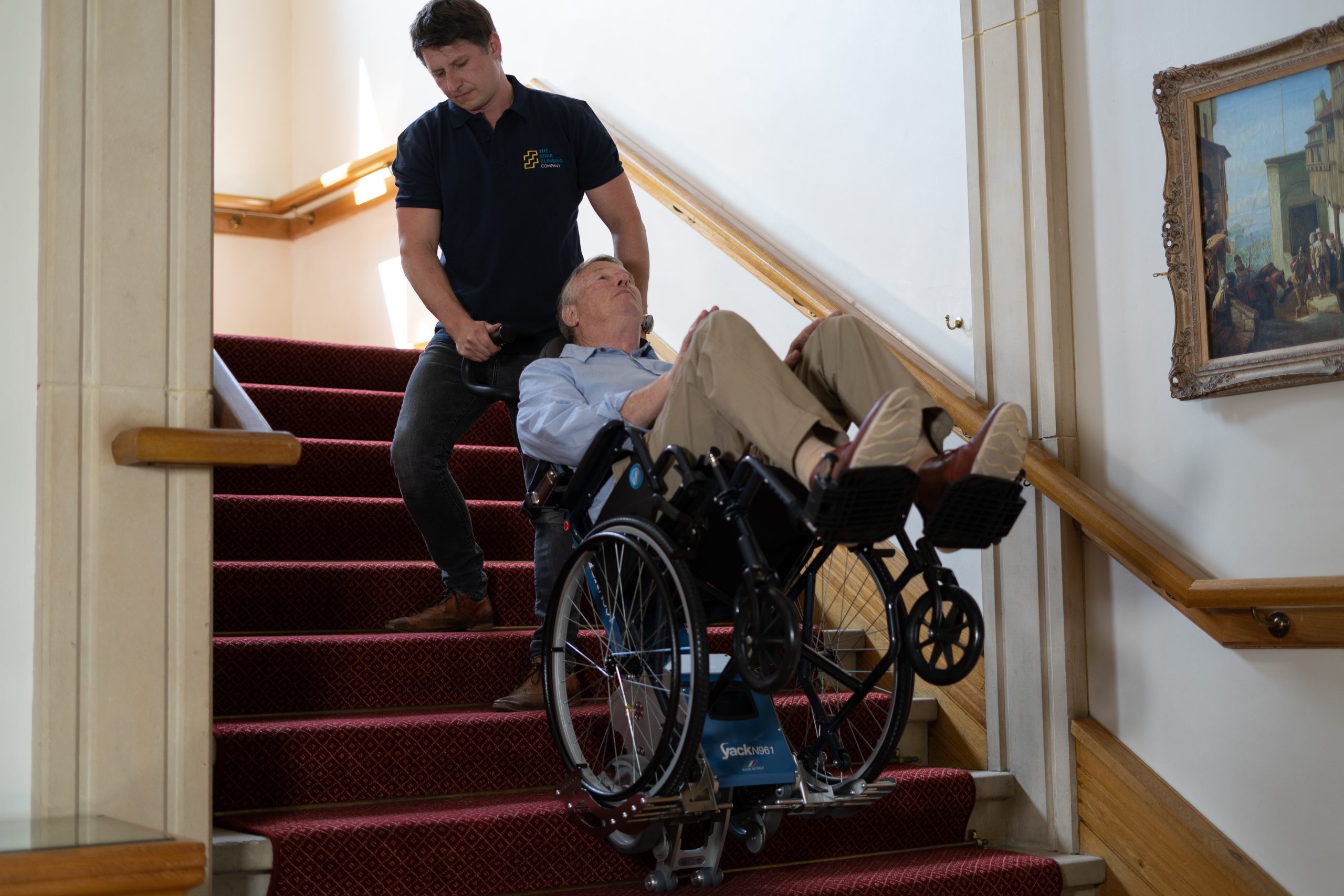
Evacuation Chair Training: Why Effective Evac Chair Training Is Essential for Safe Evacuation
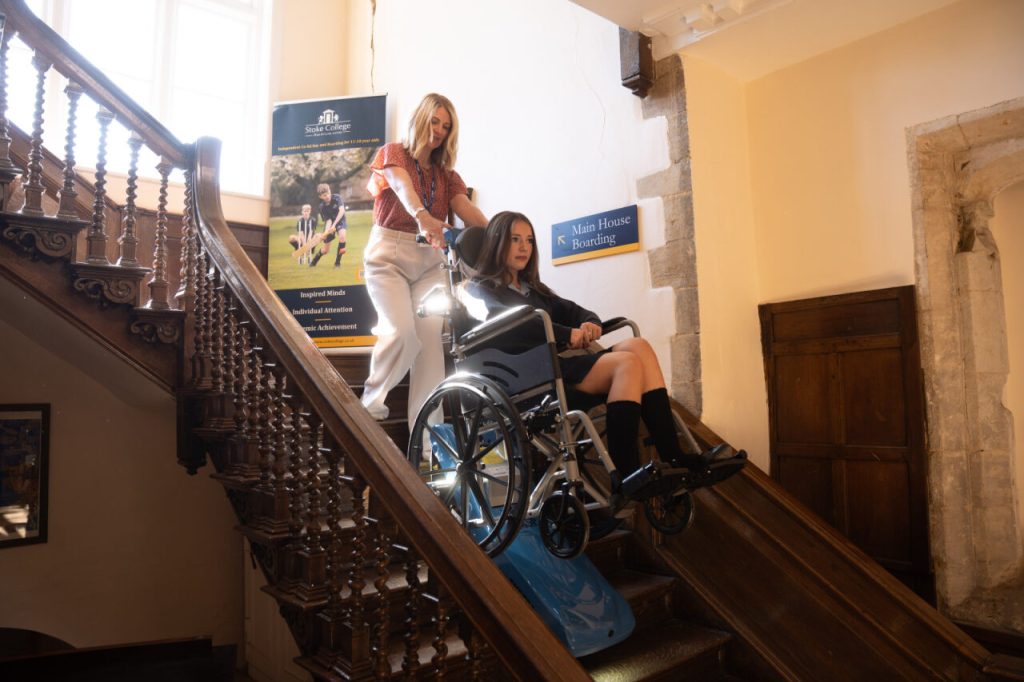
Installing an evacuation chair in a building is an important step towards providing an inclusive emergency evacuation strategy. But simply having the equipment available is not enough.
In an emergency, people need to know where the evacuation chair is located, who is expected to operate it, how to prepare it for use, how to transfer or secure the person where appropriate and how to safely negotiate the evacuation route.
This is where professional Evacuation chair training becomes essential.
Good Evac chair training should transform an unfamiliar piece of emergency equipment into something trained staff can use confidently and competently as part of a wider evacuation procedure.
Government guidance on means of escape for disabled people specifically states that evacuation chairs require training and practice, and that suitable training should accompany their introduction. It also highlights the importance of regular practice.
For organisations responsible for workplaces, educational establishments, hotels, public buildings, residential settings and other premises, this is an important distinction.
An evacuation chair should never simply be purchased, placed beside a staircase and forgotten.
It needs to become part of an effective evacuation system.
For a broader understanding of evacuation equipment, powered evacuation solutions and planning for people who may require assistance, read The Evacuation Company’s Powered Evacuation Chairs pillar guide.
What Is Evacuation Chair Training?
Evacuation chair training teaches designated members of staff how to safely and effectively use evacuation chair equipment within an emergency evacuation procedure.
The exact training should reflect the equipment, building and people involved.
A good training session should go considerably further than simply demonstrating how a chair moves down a staircase.
Staff need to understand the complete process.
That begins with identifying when an evacuation chair may form part of someone’s evacuation arrangements.
It continues through retrieving and preparing the equipment, communicating with the person requiring assistance, using the restraints or support systems correctly and safely negotiating the designated route.
Training should also consider what happens when the chair reaches the bottom of the staircase.
Where does the evacuation continue?
How does the person reach the final place of safety?
Who communicates that the evacuation has taken place?
How does the procedure interact with the building’s wider emergency plan?
These are operational questions rather than simply equipment questions.
That is why effective Evac chair training should be considered part of evacuation planning rather than a standalone product demonstration.
Why Owning an Evacuation Chair Is Not Enough
It is easy to see why organisations focus initially on purchasing equipment.
A fire risk assessment identifies a potential requirement. An evacuation chair is purchased. It is mounted beside the stairs and signs are installed.
The organisation can now physically point to an evacuation chair.
But could staff actually use it?
That is the more important question.
Official Government guidance on the means of escape for disabled people makes the position particularly clear. It states that evacuation chairs are unlikely to be useful unless both the user and operator are well trained and familiar with the equipment, and that regular staff training is essential.
This makes practical sense.
A fire alarm is not the moment for somebody to read instructions attached to the wall and attempt to work out how an unfamiliar evacuation chair operates.
Training needs to happen before the emergency.
Evacuation Chair Training and Fire Risk Assessments
Evacuation equipment should form part of a wider fire safety strategy.
Government guidance on workplace fire risk assessments states that the Responsible Person must carry out and regularly review a fire risk assessment.
That assessment needs to consider emergency routes and exits, emergency evacuation plans and the needs of people who may be particularly at risk, including people with disabilities.
Importantly, the Government’s fire risk assessment process includes preparing an emergency plan and providing training.
An evacuation chair therefore should not exist separately from the fire risk assessment.
If the evacuation strategy relies upon staff using a particular piece of equipment, those people need to understand how that equipment works.
The evacuation procedure should also be realistic.
If the plan states that a person will be assisted using an evacuation chair, who will provide that assistance?
Have those people received Evacuation chair training?
Are sufficient trained operators available across different shifts?
What happens during annual leave?
What happens during evenings or weekends?
What if the usual operator is absent?
These practical considerations can determine whether an evacuation plan works in reality.
Evac Chair Training and Inclusive Evacuation
Inclusive evacuation means recognising that people may respond to an emergency in different ways.
Mobility impairment is an obvious example, but evacuation requirements can be influenced by many factors.
A person may use a wheelchair.
Someone may normally walk independently but be unable to negotiate multiple flights of stairs.
Another person may have a temporary injury.
Someone else may experience fatigue, balance problems or another condition that affects their ability to evacuate at the same speed as other occupants.
The important point is that an evacuation chair is not automatically the answer for every person who has difficulty using stairs.
Government guidance specifically warns against treating evacuation chairs as an automatic solution for wheelchair users. Some people may be unable to transfer safely into a conventional evacuation chair or maintain a suitable seated position.
This is why Evac chair training should sit alongside good evacuation planning.
The organisation first needs to understand the individual’s needs.
Only then can suitable equipment and procedures be identified.
PEEPs and Evacuation Chair Training
Personal Emergency Evacuation Plans, commonly known as PEEPs, can help establish the assistance a particular person may require during an emergency.
Where a PEEP identifies an evacuation chair as part of the agreed procedure, training becomes particularly important.
A plan that says:
“Use the evacuation chair located beside Staircase A”
is not sufficient if nobody knows how to use it.
The plan needs to work operationally.
The organisation should know who will assist the individual, how they will communicate, which route will be used and whether the proposed equipment is actually appropriate.
Where practical and appropriate, familiarisation can also help the person who may use the chair understand what the procedure involves.
Not everyone will want or need to physically participate in repeated drills, and this should be approached sensitively. However, the trained operators themselves need sufficient practical experience to remain competent.
Residential PEEPs and the Changing Evacuation Landscape
Evacuation planning has become particularly significant following the introduction of the Fire Safety (Residential Evacuation Plans) (England) Regulations 2025.
The Regulations came into force on 6 April 2026 and apply to specified residential buildings in England.
They introduce new requirements around residents who may experience difficulty evacuating independently.
Official Government guidance on Residential PEEPs explains that Responsible Persons must make reasonable endeavours to identify relevant residents and offer them a person-centred fire risk assessment.
The assessment considers risks arising from the resident’s compromised ability to evacuate without assistance and can lead to measures designed around the individual.
The Regulations also introduce requirements relating to building emergency evacuation plans in buildings within scope.
For building managers and Responsible Persons, this reinforces a fundamental principle.
Evacuation arrangements for people requiring assistance need to be planned rather than improvised.
Where an evacuation chair forms part of those arrangements, competent operators and effective Evacuation chair training become integral to making the procedure workable.
What Should Good Evacuation Chair Training Include?
The quality of training matters.
An evacuation chair training course should not simply consist of an instructor demonstrating the chair while staff watch.
Participants need practical experience.
They should become familiar with the specific model of evacuation chair used within their building and understand its controls, restraints and operating procedure.
Training should explain how the chair is removed from storage and prepared for use.
Participants should understand how to position the equipment appropriately and communicate with the person being assisted.
They should practise negotiating stairs in a controlled environment.
Training should also address movement on level surfaces and what happens once the staircase has been negotiated.
The objective is not to turn employees into emergency service professionals.
It is to give designated staff sufficient knowledge and practical familiarity to fulfil their role within the organisation’s evacuation procedure.
Training on the Actual Equipment
Evacuation chairs are not all identical.
Different manufacturers and models use different mechanisms, braking systems, tracks, restraints and operating procedures.
Powered evacuation chairs add another layer of technology.
This is why generic Evac chair training has limitations.
Ideally, operators should train on the same equipment they are expected to use.
If an organisation changes its evacuation chairs, training requirements should be reviewed.
The same applies if powered equipment is introduced alongside conventional gravity-based chairs.
A staff member who has been trained on one model should not automatically be assumed to be competent on every other evacuation chair.
Equipment-specific familiarity matters.
Why Practical Training Matters
There is a significant difference between understanding how an evacuation chair works and actually operating one.
A video can provide useful familiarisation.
Written instructions are valuable as a reference.
But neither replicates physically preparing and controlling the equipment.
During practical Evacuation chair training, operators can experience how the chair behaves as it moves onto the staircase.
They can understand positioning and balance.
They can learn how to communicate with the passenger.
They can practise the sequence repeatedly in a controlled setting.
This repetition is valuable because emergency situations can be stressful.
People perform more effectively when a procedure is familiar.
Confidence for the Person Being Evacuated
Training is not only about the operator.
Think about the experience of the person being assisted.
They may already feel vulnerable because an alarm has activated.
They could then be asked to transfer into unfamiliar equipment and descend a staircase with another person controlling the chair.
The operator’s behaviour matters enormously.
A trained member of staff should be able to explain what is happening clearly and calmly.
They should understand how the chair works.
They should know the route.
They should appear confident because they have practised the procedure before.
Compare this with an operator attempting to unfold and understand an evacuation chair for the first time during an emergency.
The equipment might be identical.
The experience for the passenger will not be.
Professional Evac chair training therefore contributes to confidence as well as operational competence.
How Often Should Evacuation Chair Training Be Refreshed?
Training should not be treated as a one-off exercise.
People forget procedures they rarely use.
Staff change roles.
Employees leave.
New employees join.
Evacuation equipment changes.
Building layouts can also change.
Government guidance recommends regular practice where evacuation chairs form part of the means of escape.
Organisations should therefore establish a suitable refresher training and practice programme based upon their own risk assessment, staff turnover, equipment and evacuation arrangements.
Records should also be maintained so that the organisation knows who has been trained and when.
Rather than discovering during an audit that the only trained operators left the organisation eighteen months ago, training records allow Responsible Persons and Facilities Managers to identify gaps proactively.
Training Across Different Shifts
One of the most common weaknesses in emergency procedures is assuming that the people present during normal office hours will always be available.
Buildings operate differently throughout the day.
Hotels operate overnight.
Universities have evening activity.
Care settings can operate continuously.
Large workplaces may use shifts.
Public buildings can have weekend events.
If an evacuation strategy relies upon trained chair operators, the organisation should consider whether appropriate competence exists whenever the building is occupied.
Training three members of staff may look adequate on paper.
If all three work Monday to Friday between 9am and 5pm, the evacuation strategy may look very different at 8pm.
Effective Evacuation chair training therefore needs to be considered alongside staffing patterns.
Evacuation Chair Training for Visitors
Permanent employees are not the only people who may require assistance.
Customers, students, hotel guests, contractors, patients, event attendees and other visitors may also have mobility requirements.
Government guidance on disabled means of escape specifically discusses the need to consider visitors who may require evacuation assistance.
This creates an important challenge.
An organisation may not know in advance exactly who will need an evacuation chair.
The answer is not necessarily to create an individual plan for every possible visitor.
Instead, the building needs robust procedures and trained staff capable of responding appropriately.
This is particularly important in public-facing environments.
Evacuation Chairs Are Part of a System
Perhaps the most important message around Evacuation chair training is that the chair itself is only one component.
A comprehensive evacuation strategy may include fire detection, alarm systems, escape routes, signage, refuges, communication systems, evacuation lifts, PEEPs, RPEEPs, staff responsibilities and suitable equipment.
Government guidance on disabled means of escape explicitly describes evacuation chairs as only part of the overall solution.
This is why purchasing more chairs is not automatically equivalent to improving evacuation safety.
The right equipment needs to be located in the right place.
The people expected to use it need appropriate training.
The route needs to be suitable.
The evacuation procedure needs to make sense.
And the entire system needs to be reviewed.
Powered Evacuation Chairs and Training
Powered evacuation equipment is increasingly creating additional possibilities for buildings where conventional evacuation chairs may not meet every requirement.
A powered evacuation chair can use battery-powered technology to assist movement on stairs, potentially reducing some of the physical demands placed upon operators.
Some powered systems may also provide upward as well as downward movement, depending upon the equipment and application.
However, powered technology does not remove the need for training.
In many respects, equipment-specific training becomes even more important.
Operators need to understand controls, battery management, positioning, stair engagement and emergency procedures.
For organisations considering these technologies, our Powered Evacuation Chairs pillar guide from The Evacuation Company provides a wider overview of the role powered equipment can play within modern evacuation planning.
Servicing, Inspection and Training Should Work Together
Training staff to use equipment is only effective if the equipment itself remains suitable for use.
Evacuation chairs should therefore form part of an organisation’s inspection and maintenance arrangements.
The chair may spend almost all of its life unused.
That does not mean it can simply be ignored.
Components can deteriorate.
Batteries on powered equipment require attention.
Equipment can be moved, damaged or obstructed.
Accessories can disappear.
Routine servicing, inspections and operator training should therefore support each other.
When an emergency occurs, the organisation needs both functioning equipment and people capable of using it.
Building a Culture of Evacuation Readiness
Effective evacuation planning is not about ticking a compliance box.
It is about being prepared.
A building can have excellent equipment and still have a poor evacuation strategy if staff do not know what to do.
Equally, enthusiastic staff cannot compensate for inappropriate or poorly maintained equipment.
The strongest approach combines assessment, planning, suitable equipment, Evacuation chair training, maintenance and regular review.
This creates a culture where inclusive evacuation is treated as part of everyday building management rather than something considered only after an incident.
Working With The Evacuation Company
The Evacuation Company works with organisations across the UK to develop practical evacuation solutions for people who may require assistance.
Our approach goes beyond simply supplying evacuation chairs.
We can support organisations with evacuation assessments, equipment selection, conventional and powered evacuation solutions, practical Evac chair training, servicing and ongoing support.
Training can be designed around the equipment and environment in which staff will actually operate.
This is important because every building is different.
A five-storey office does not present the same challenges as a university.
A heritage building can have completely different stair geometry from a modern hotel.
A residential building may require a different approach again.
The objective should always be to create a practical evacuation procedure rather than simply installing equipment.
For organisations reviewing their wider strategy, our Powered Evacuation Chairs pillar guide explores the equipment and planning considerations in more detail.
From Equipment Ownership to Evacuation Preparedness
There is a simple question every organisation with an evacuation chair should ask.
If the fire alarm activated today, could the people expected to use that chair operate it confidently?
If the answer is uncertain, the organisation may have equipment without genuine preparedness.
Professional Evacuation chair training bridges that gap.
It gives staff the opportunity to understand the equipment before an emergency occurs, practise the procedure in a controlled environment and recognise their responsibilities within the wider evacuation strategy.
Good Evac chair training also helps organisations move away from viewing evacuation chairs as isolated pieces of equipment.
The chair becomes part of a complete system involving the person, trained operators, escape routes, emergency procedures and ongoing review.
That distinction matters.
Because an evacuation chair mounted on a wall cannot evacuate anyone by itself.
People make the evacuation plan work.
And those people need the right equipment, the right procedures and the right training to do it safely.
For more information about evacuation planning, conventional and powered evacuation equipment and the role of modern evacuation technology, visit The Evacuation Company’s Powered Evacuation Chairs pillar guide or speak to The Evacuation Company about practical Evacuation chair training for your organisation.
Key Takeaways
- Evacuation chair training is crucial for enabling staff to use evacuation chairs effectively during emergencies.
- Organizations must not only purchase evacuation chairs but also ensure staff are trained to operate them confidently.
- Training should include practical experience with the specific equipment used and address the complete evacuation process.
- Personal Emergency Evacuation Plans (PEEPs) should incorporate evacuation chair training for individuals requiring assistance.
- Regular training refreshers are necessary to maintain competence across shifts and respond effectively during emergencies.
Estimated reading time: 14 minutes
Table of contents
- Evacuation Chair Training: Why Effective Evac Chair Training Is Essential for Safe Evacuation
- What Is Evacuation Chair Training?
- Why Owning an Evacuation Chair Is Not Enough
- Evacuation Chair Training and Fire Risk Assessments
- Evac Chair Training and Inclusive Evacuation
- PEEPs and Evacuation Chair Training
- Residential PEEPs and the Changing Evacuation Landscape
- What Should Good Evacuation Chair Training Include?
- Training on the Actual Equipment
- Why Practical Training Matters
- Confidence for the Person Being Evacuated
- How Often Should Evacuation Chair Training Be Refreshed?
- Training Across Different Shifts
- Evacuation Chair Training for Visitors
- Evacuation Chairs Are Part of a System
- Powered Evacuation Chairs and Training
- Servicing, Inspection and Training Should Work Together
- Building a Culture of Evacuation Readiness
- Working With The Evacuation Company
- From Equipment Ownership to Evacuation Preparedness