Evacuation Chair Training in London for Educational Establishments
Effective evacuation chair training in London is essential for schools, colleges, universities and other educational establishments that need to provide a safe means of escape for pupils, students, staff and visitors who cannot use stairs independently.
London’s education sector occupies an extraordinarily varied collection of buildings. It includes modern university campuses, Victorian schools, listed buildings, converted townhouses, specialist education centres, student accommodation and multi-storey teaching facilities. Many of these premises have staircases that become a significant barrier when lifts cannot be used during a fire or another emergency.
Installing an evacuation chair can be an important step, but equipment alone does not create a safe evacuation procedure. Staff must understand when the chair should be used, where it is located, how to operate it and how it connects with the establishment’s fire strategy and individual evacuation plans.
The Evacuation Company provides practical evacuation chair training for educational establishments across London. Our training is designed around the building, its equipment and the people who may need assistance, helping education providers turn written procedures into realistic and workable arrangements.
Why Educational Establishments Need Evacuation Chair Training
Schools, colleges and universities have a duty of care towards everyone using their premises. This includes people with permanent disabilities, temporary injuries, health conditions, mobility limitations, sensory impairments and other circumstances that may affect their ability to evacuate.
A person may usually access an upper floor using a passenger lift but be unable to use that lift during a fire alarm. A pupil may have a broken leg. A university student may use a wheelchair. A member of staff may be recovering from surgery. A visitor attending a parents’ evening, graduation or public lecture may require unexpected assistance.
Educational establishments must therefore plan for both known and unknown needs.
The government’s fire-safety risk-assessment guidance for educational premises is intended for employers, headteachers, governors, vice-chancellors, occupiers and building owners. It applies to settings including schools, academies, universities, crèches, adult education centres, music schools and outdoor education centres.
Evacuation chair training in London helps these responsible individuals demonstrate that the equipment provided within their premises is supported by people who understand how to use it.
The Particular Challenges Facing London Education
London educational establishments often operate from complex buildings and across multiple sites. A single university may have lecture theatres, laboratories, libraries, offices, workshops, accommodation and historic buildings distributed across the city.
Schools may occupy Victorian or Edwardian buildings with narrow staircases, half landings and limited space for structural alterations. Independent schools and colleges may use converted houses or listed premises that were not originally designed to provide modern inclusive access.
The number and location of people within these buildings also change throughout the day. Pupils move between classrooms. University students attend different lectures. Members of staff work across several floors. Visitors arrive for meetings, performances, sporting activities and evening events.
These movements make it important to consider where a person requiring assistance may be when an alarm sounds. Locating one evacuation chair near the main staircase may not be sufficient if the building has several wings, isolated upper floors or basement teaching rooms.
Professional evac chair training in London should examine these site-specific challenges. The purpose is not simply to demonstrate a chair in ideal conditions. It is to establish whether trained staff could find, deploy and use the equipment successfully during a genuine evacuation.
An Evacuation Chair Is Only One Part of the Plan
Purchasing an evacuation chair does not automatically provide a complete evacuation solution. The chair must be suitable for the building, compatible with the intended staircase and supported by an adequate number of trained operators.
The educational establishment should know who will provide assistance, how those people will be alerted and which route they will use. It should also consider what happens if the normal operator is absent, the preferred staircase is unavailable or the person requiring assistance is in an unexpected part of the building.
Communication is particularly important when assisting children, young people or adults who may be anxious or unfamiliar with the equipment. Operators must explain what is happening, provide reassurance and preserve the person’s dignity throughout the procedure.
The government’s guidance on the means of escape for disabled people explains that the person responsible for a building should provide an emergency evacuation plan for everyone likely to be present, including disabled people. That plan should not rely on intervention by the Fire and Rescue Service to make it work.
Our pillar article, Technology, Training and the Future of Evacuation: How Powered Evacuation Chairs Are Changing Safety Planning, explores how equipment, training and person-centred planning can work together to create safer and more inclusive evacuation arrangements.
What Should Evacuation Chair Training Include?
Evacuation chair training should combine theoretical instruction with supervised practical experience. Staff should not be expected to use unfamiliar equipment during an emergency after only watching a video or reading instructions.
Training should explain the role of the evacuation chair within the establishment’s fire strategy. Participants need to understand when the chair may be required, who may use it and how the procedure relates to PEEPs, GEEPs and other emergency plans.
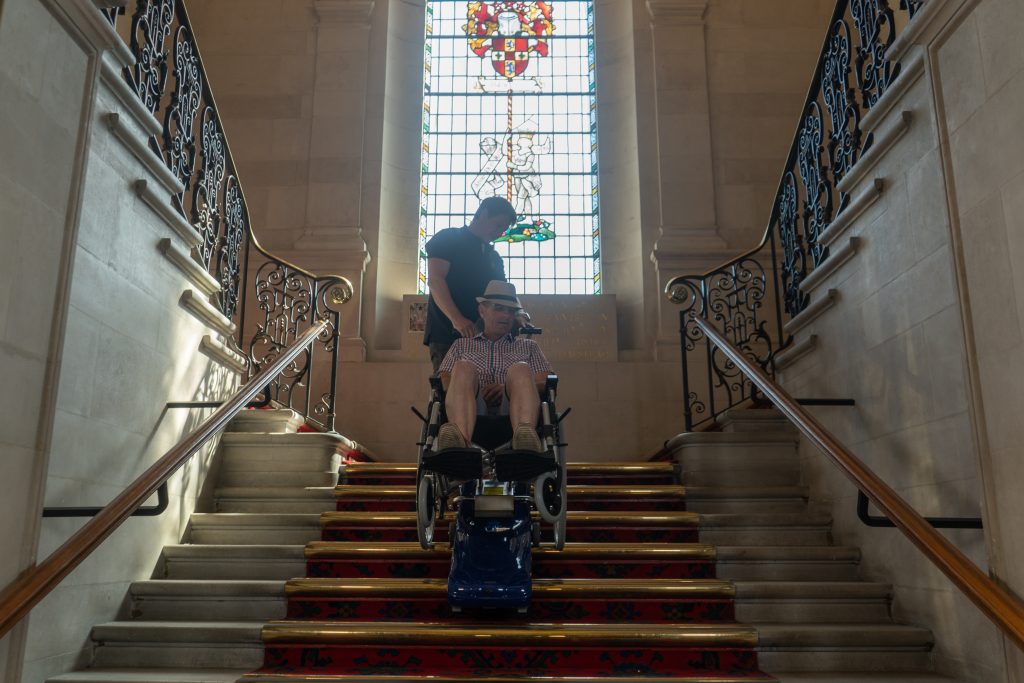
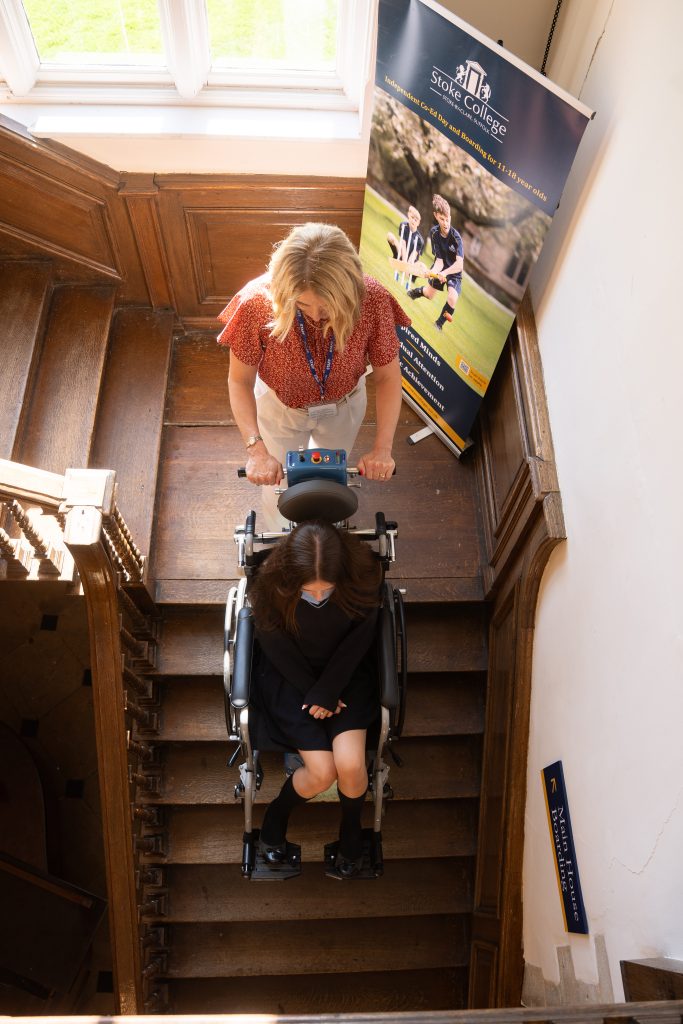
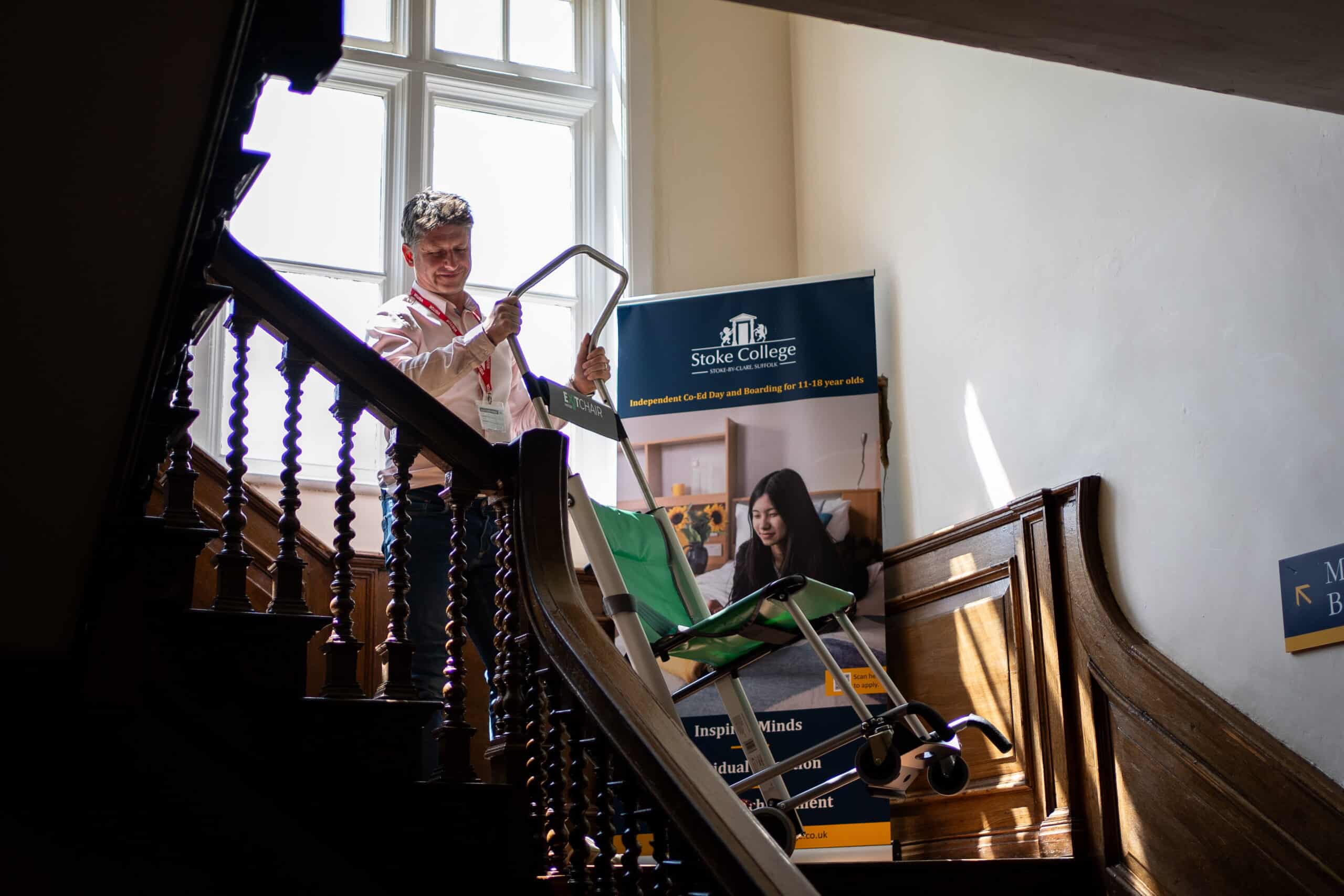
Operators should be shown how to remove the chair from its storage position, deploy it correctly and perform appropriate pre-use checks. They should understand how to prepare the chair, secure the passenger and communicate with them before beginning the descent.
The practical part of the course should allow participants to control the chair on an appropriate staircase under the supervision of a competent trainer. Correct posture, positioning, balance and movement should be covered using the actual model installed at the establishment wherever possible.
The training should also address the complete evacuation route. Reaching the bottom of a staircase does not necessarily mean that the person has reached safety. Operators need to understand how the passenger will be moved from the stairs to a place of ultimate safety outside the building.
Equipment storage, damage reporting, routine checks and servicing should also be discussed. Staff need to recognise when a chair should not be used and know who is responsible for reporting a fault.
On-Site Evac Chair Training in London Schools
On-site training is particularly valuable for London schools because it enables staff to practise within their everyday working environment.
A primary school may need to consider how a child will respond to sitting in an unfamiliar chair. Secondary schools may have pupils moving between separate buildings throughout the day. Special educational needs and disabilities settings may require additional communication, postural or behavioural considerations.
The suitability of an evacuation chair should never be determined by a diagnosis alone. Each pupil should be considered as an individual, with their needs, preferences, physical presentation and ability to transfer included in the planning process.
Some pupils may be able to transfer into a conventional evacuation chair with assistance. Others may require postural support or may be unable to transfer safely from their own wheelchair. In these circumstances, alternative equipment, including non-transfer or powered stair-climbing solutions, may need to be assessed.
A generic course cannot answer all these questions. Training in the school allows the equipment, staircase, pupil needs, staffing levels and evacuation procedure to be considered together.
Evacuation Chair Training for London Colleges and Universities
Colleges and universities can present different challenges because students are often independent adults who move freely between multiple buildings.
A student may attend lectures on different floors, use a library in another building and take part in evening activities elsewhere on campus. Their evacuation arrangements must reflect their actual timetable and the range of places they regularly visit.
Universities must also consider members of the public attending conferences, open days, graduation ceremonies, performances and sporting events. These visitors may not disclose an evacuation requirement until they arrive, or may not pass through a single controlled reception point.
A General Emergency Evacuation Plan can help address the needs of people whose requirements are not known in advance. Staff at reception points, security teams, facilities departments and event-management teams should understand how to offer assistance and implement the available options.
In multi-occupied university buildings, departments and external tenants may share escape routes. Evacuation chair training in London should establish clear responsibilities between the university, building management, security contractors and individual departments.
Universities should also distinguish between teaching premises and residential accommodation. The government’s educational-premises guide does not cover university halls of residence or boarding-school sleeping accommodation, which require consideration under the guidance appropriate to sleeping accommodation and, where applicable, residential fire-safety requirements.
PEEPs for Pupils, Students and Staff
A Personal Emergency Evacuation Plan, commonly called a PEEP, is intended for a known person who may require assistance during an emergency.
For a school pupil, the plan may involve the pupil, their parents or carers, appropriate school staff and relevant healthcare or therapy professionals. For a university student, the process should be developed directly with the student wherever possible. Staff members should be included in planning their own arrangements rather than having assumptions made about what they can or cannot do.
A PEEP should identify the person’s usual locations, suitable escape routes, required equipment, nominated assistance and communication needs. If an evacuation chair forms part of the plan, the nominated staff should receive practical training on the correct chair and staircase.
Plans should be reviewed when circumstances change. A pupil may move to a different classroom, a university timetable may change each term or a member of staff may temporarily develop limited mobility. Building work, changes to fire doors or the relocation of equipment can also affect whether the original plan remains suitable.
Training should test whether a PEEP is workable. If staff cannot deploy the chair safely, reach the agreed location or complete the route, the plan needs to be reconsidered.
Planning for Visitors and Temporary Mobility Needs
Educational establishments cannot limit their evacuation planning to people with declared permanent disabilities.
A school may host parents’ evenings, plays, sporting events and community activities. A university may welcome thousands of visitors during an open day. Colleges frequently accommodate external training providers, contractors and members of the public.
Some visitors may require assistance but may never have visited the building before. The establishment needs a method of identifying potential requirements, explaining the available arrangements and allocating assistance.
Temporary mobility restrictions must also be considered. A pupil using crutches after an injury may normally manage stairs slowly but may not be able to do so safely within an emergency evacuation. Pregnancy, fatigue, respiratory conditions, anxiety, visual impairment and hidden disabilities can also affect a person’s ability to evacuate.
Good planning avoids making assumptions. The person should be consulted and offered suitable options based on the environment and their individual needs.
Training Staff Across the Education Day
A school’s evacuation arrangements must work during lessons, assemblies, lunch periods, after-school clubs and evening events. A university’s arrangements may need to function early in the morning, late at night and at weekends.
Training only senior managers can leave a gap because those individuals may not be near the evacuation chair when assistance is needed. Operators should be selected according to their availability, location and ability to fulfil the role.
The staff group may include teachers, teaching assistants, premises staff, technicians, caretakers, reception teams, security officers, accommodation staff and facilities managers. The right combination will depend on the establishment.
Schools should also consider supply staff and turnover. If a trained teaching assistant leaves, responsibility must be transferred to another competent person. In universities, outsourced security or facilities staff may play a central role, but their duties must be agreed with their employer and aligned with the institution’s procedures.
Adequate coverage is more important than simply holding a small number of training certificates.
Manual and Powered Evacuation Chairs in Education
Traditional manual evacuation chairs can provide an effective means of controlled descent where the user, staircase and operators are suitable. They are relatively compact and can often be stored close to an escape staircase.
Powered evacuation chairs may reduce some of the physical effort required from operators. Certain powered models can also travel upwards, which may be important where classrooms, laboratories, libraries or sports facilities are located below the final exit level.
Powered equipment may be particularly relevant when the anticipated user is heavier, the route is long or the establishment has concerns about the physical capability of available staff. However, powered chairs require model-specific training, battery management, charging and regular equipment checks.
Some pupils or students cannot transfer safely into a conventional evacuation chair. A non-transfer solution that carries the person in their own wheelchair may be more appropriate following a detailed assessment.
No individual product is right for every educational establishment. The solution should follow an assessment of the person, building, staircase, evacuation route and available operators.
Legal Responsibilities and Staff Competence
The Regulatory Reform (Fire Safety) Order 2005 provides the main fire-safety framework for most non-domestic educational premises in England. It places responsibilities on the responsible person concerning risk assessment, fire precautions, emergency procedures and staff training.
Depending on the establishment, the responsible person may include the employer, academy trust, governing body, owner, occupier or another organisation with control over the premises. Shared buildings may have more than one responsible person, making co-operation particularly important.
Where evacuation chairs are provided as work equipment, the Provision and Use of Work Equipment Regulations 1998 may also be relevant. The Health and Safety Executive’s guidance on training and competence explains that people who use work equipment must receive adequate health-and-safety training. It also notes that refresher training may be required when equipment, working arrangements or circumstances change.
Training should be recorded, but certification should not be confused with competence. Operators need to demonstrate that they can use the equipment safely within the environment in which they are expected to act.
How Often Should Evacuation Chair Training Be Refreshed?
A single training session should not be expected to provide permanent competence. Evacuation chairs are emergency equipment and may not be used routinely, meaning practical skills can be forgotten.
The appropriate refresher period should be determined by the fire-risk assessment, the manufacturer’s instructions, staff turnover and the complexity of the procedure. Changes to equipment, escape routes or the needs of a pupil, student or employee should trigger an earlier review.
Government guidance on means of escape for disabled people recommends that escape plans are practised regularly and generally at least every six months. However, a full live evacuation involving a disabled person may introduce unnecessary risk. Simulated practice can be used to test staff response, communications and equipment deployment without requiring the individual to travel down the stairs.
Short familiarisation sessions between formal courses can help operators remain confident, but they should follow the agreed procedure and should not replace competent practical training.
Common Mistakes in Educational Establishments
A frequent mistake is placing a chair near a staircase without identifying trained operators. Another is training staff on a demonstration chair that is different from the equipment installed on site.
Some establishments train too few people or fail to consider absence and staff turnover. Others focus on descending the staircase but do not plan how the passenger will travel from the bottom of the stairs to the assembly point.
Poor communication can also undermine an otherwise workable procedure. Pupils and students should understand what assistance is available and should be involved in planning where appropriate. Parents, carers and relevant professionals may also need to contribute when developing plans for children.
Finally, educational establishments should not assume that every person with reduced mobility can transfer into a standard evacuation chair. A suitable assessment is essential before including any equipment within an individual’s PEEP.
Frequently Asked Questions
Do schools have to provide evacuation chairs?
There is no universal rule requiring every school to install the same type or number of chairs. Requirements should be identified through the fire-risk assessment, the needs of building users, escape routes and the school’s emergency plans.
Can teachers operate evacuation chairs?
Teachers and other members of staff can be nominated as operators if they have received suitable training, are able to use the equipment safely and are realistically available when assistance is required.
Should pupils practise in an evacuation chair?
Any practical involvement by a pupil must be carefully assessed. A simulation using appropriate training methods may be safer than repeatedly moving the pupil on stairs. The pupil and, where appropriate, their parents or carers should be consulted.
Can evacuation chairs be used for children?
Some evacuation chairs may be suitable for particular children, but suitability must be individually assessed. The child’s size, posture, ability to transfer, communication needs and the level of support required must all be considered.
Do universities need evacuation arrangements for visitors?
Yes. Universities should consider students, employees, contractors and visitors. General arrangements are particularly important for public lectures, conferences, open days and events where individual needs may not be known in advance.
Can a powered evacuation chair travel upstairs?
Certain powered models can provide controlled upward as well as downward movement. This can be valuable for basement locations, but the chair, staircase and operators must be assessed before it is included in an evacuation plan.
Arrange Evacuation Chair Training in London
The Evacuation Company provides evacuation chair training in London for schools, academies, colleges, universities, SEND settings and other educational establishments.
We understand that education environments require more than a generic equipment demonstration. Training must consider the building, the operators, the age and needs of potential users, staff availability and the establishment’s PEEPs, GEEPs and wider emergency procedures.
Our services can include building assessments, evacuation-chair recommendations, practical operator training, powered evacuation-chair training, evacuation planning, servicing and PUWER-related inspections.
If your school, college or university already owns evacuation chairs, we can help determine whether the equipment, staff coverage and training arrangements remain suitable. If you are considering new equipment, an assessment can help identify the right solution before a chair is purchased.
Contact The Evacuation Company to arrange professional evacuation chair training in London and create a safer, more inclusive evacuation procedure for your educational establishment.
Key Takeaways
- Evacuation chair training in London is essential for educational establishments to ensure safe evacuation for those unable to use stairs.
- Educators must recognize legal responsibilities and plan for known and unknown mobility needs during emergencies.
- Effective training involves understanding site-specific challenges, evacuation procedures, and emergency plans like PEEPs and GEEPs.
- On-site training addresses unique building layouts and prepares staff to assist a diverse range of individuals, including visitors and those with temporary mobility restrictions.
- Regular refresher training is necessary to maintain staff competence and adapt to changing needs or equipment updates.
Estimated reading time: 15 minutes
Table of contents
- Evacuation Chair Training in London for Educational Establishments
- Why Educational Establishments Need Evacuation Chair Training
- The Particular Challenges Facing London Education
- An Evacuation Chair Is Only One Part of the Plan
- What Should Evacuation Chair Training Include?
- On-Site Evac Chair Training in London Schools
- Evacuation Chair Training for London Colleges and Universities
- PEEPs for Pupils, Students and Staff
- Planning for Visitors and Temporary Mobility Needs
- Training Staff Across the Education Day
- Manual and Powered Evacuation Chairs in Education
- Legal Responsibilities and Staff Competence
- How Often Should Evacuation Chair Training Be Refreshed?
- Common Mistakes in Educational Establishments
- Frequently Asked Questions
- Arrange Evacuation Chair Training in London